← All women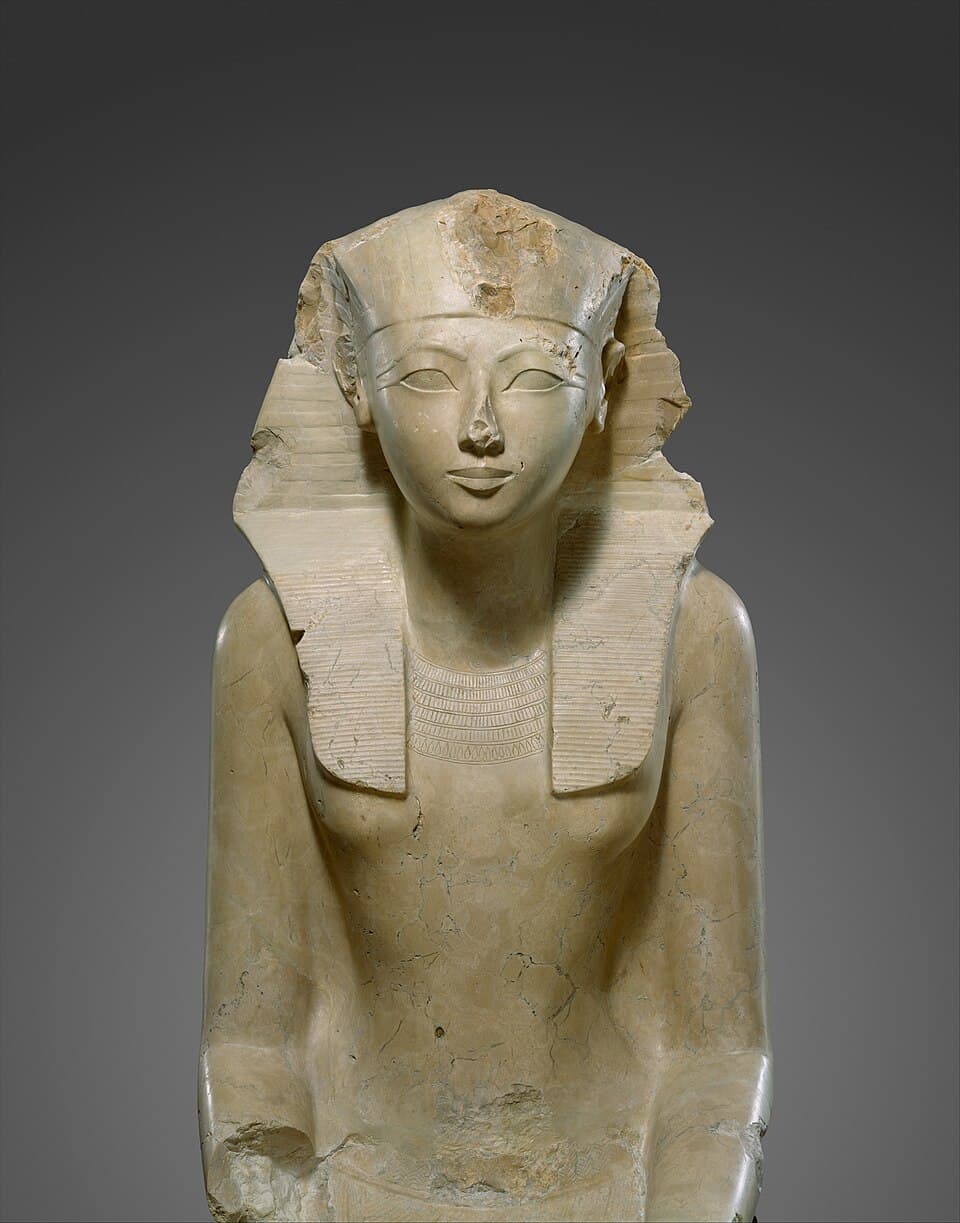
Ancient Egyptian · Politics · Exploration · Arts
Hatshepsut
-1507 – -1458
Early Life and Background
Hatshepsut, whose name means “Foremost of Noble Ladies”, was born around 1507 BCE into Egypt’s royal house of the Eighteenth Dynasty.[1][10] She was a daughter of Thutmose I, a successful warrior king who expanded Egypt’s influence into Nubia and the Levant, and his principal queen, Ahmose.[1][10] Her birth in this core royal line gave her an unusually strong claim to legitimacy compared with many rulers who derived authority through military or priestly backing.
Ancient Egyptian royal daughters received elite education and religious training rather than formal schooling in the modern sense. Hatshepsut would have learned to read and perhaps write hieroglyphs, at minimum becoming literate in religious formulae and royal titulary.[3][10] As a princess in Thebes, she was immersed in the cult of Amun‑Re, the chief deity of the New Kingdom, a relationship later emphasized in inscriptions portraying her as Amun’s chosen child.[10]
From an early age she held significant religious office, becoming God’s Wife of Amun, a powerful priestly title associated with ritual duties and symbolic partnership with the god.[10][12] This role not only enhanced her spiritual prestige but also placed her at the intersection of temple economy, ideology, and royal politics. Her familiarity with ceremonial life and temple administration would later shape her policies as ruler, especially her close alliance with the priesthood of Amun at Karnak.
Family, Marriage, and Dynastic Position
To consolidate royal legitimacy, Hatshepsut married her half‑brother Thutmose II, a common practice in the Egyptian royal family, which valued intra‑dynastic marriages to preserve the divine bloodline.[1][10] Thutmose II was the son of Thutmose I by a secondary wife, but Hatshepsut’s status as daughter of the principal queen gave their union strong ideological weight. Upon Thutmose II’s accession, Hatshepsut became Great Royal Wife, the chief queen and consort, while also retaining her prestigious religious title.
The couple’s known child was a daughter, Neferure, who appears in reliefs being closely associated with her mother and with the god Amun.[10] Hatshepsut’s lack of a male heir created a dynastic complication. The throne passed, after Thutmose II’s death, to a boy born to a lesser wife: Thutmose III
Hatshepsut’s family network also extended to powerful officials and priests, including figures such as Senemut, the steward of her daughter Neferure and a trusted courtier who oversaw major building projects.[10][17] Although later speculation has romanticized their relationship, the surviving evidence primarily attests to his administrative and architectural importance, particularly in the construction at Deir el‑Bahri and other sites. When Thutmose II died, likely in the late 15th century BCE, his son Thutmose III was still a child.[1][10][12] Following Egyptian precedent, Hatshepsut assumed the role of regent, ruling on his behalf. Around 1479 BCE she effectively governed Egypt, appearing in official contexts as queen and God’s Wife of Amun but exercising day‑to‑day authority over administration, building programs, and temple finances.[1][17] During this regency, Egypt was entering the New Kingdom, a period marked by consolidation after the expulsion of the Hyksos and by the strengthening of Thebes and Amun’s cult. Hatshepsut’s position drew on her unique combination of titles: royal daughter, Great Royal Wife, and religious leader. Over several years she gradually elevated her public status, appearing in inscriptions with increasing emphasis on her own lineage and divine favor.[10][17] Political dynamics at court remain partly obscured, but scholars infer that Hatshepsut built alliances among high officials, scribes, and priests, many of whom appear prominently in her building inscriptions.[3][10] Her regency was relatively peaceful, with no major recorded military campaigns in her early years. Instead, she focused on internal stability, restoration of monuments damaged in the Second Intermediate Period, and strengthening of the economy through trade and construction.[3][12] After several years as regent, Hatshepsut made a transformative decision: she assumed the full titulary and regalia of a pharaoh, ruling as king in her own right alongside Thutmose III.[1][4][7] This shift is generally dated to about 1473 BCE. In texts and imagery she adopted the throne name Maatkare and presented herself as a legitimate successor of Thutmose I, favored by the god Amun.[10] To align with the ideology of kingship, Hatshepsut was depicted in traditionally male regalia—short kilt, headdress, and even the ceremonial false beard—while inscriptions continued to use grammatically feminine forms in some cases.[10][17] This complex visual and textual strategy navigated a system that expected kings to be male without erasing her female identity. She effectively became a female king, a woman occupying the role of pharaoh rather than merely a queen consort. According to modern historians, she was only the third woman to become pharaoh in three millennia of Egyptian history and the first to attain the full power of the position for a prolonged period.[4][10] Egyptologist James Henry Breasted famously described her as “the first great woman in history of whom we are informed,” emphasizing the unprecedented documentation and scale of her rule.[10] Her elevation to kingship challenged patriarchal norms and required elaborate ideological justification, much of it expressed through temple reliefs, royal speeches, and genealogical claims. As king, Hatshepsut presided over a reign of roughly twenty years marked by peace, prosperity, and artistic innovation.[1][3][12] She ruled co‑jointly with Thutmose III, whose role initially appears subordinate in surviving inscriptions. Administrative power flowed through a network of officials, many of whom were intensely loyal to her and left statues and tombs celebrating their service. Hatshepsut prioritized internal development over foreign conquest. She restored and expanded temples, re‑instituted religious festivals, and invested in infrastructure that benefited both state and cult. Records suggest that Egypt’s economy flourished during her reign, with increased trade and agricultural productivity supplying the temple estates and royal building projects.[3][12] Her close alliance with the priesthood of Amun at Karnak was central. She commissioned obelisks, chapels, and renovations in the temple complex, presenting herself as Amun’s chosen king. In return, the priesthood gained resources and monumental support, reinforcing Thebes’s status as a religious capital. This reciprocal relationship helped legitimize her rule and stabilize the broader political order.[3][8][10] Hatshepsut is widely recognized as one of the most prolific builders in ancient Egypt.[10][11][12] Her reign produced a surge of construction that transformed the landscape of Thebes and other regions. These projects were not merely functional but deeply ideological, designed to enshrine her kingship and communicate her connection with the gods. Among her most significant works were: Art from her reign is noted for its refined style: elegant proportions, delicate modeling of features, and sophisticated narrative reliefs.[3][5] These innovations influenced later New Kingdom art. The sheer number of surviving monuments attests to the resources she commanded and the centrality of building in her statecraft. Rather than conducting large‑scale military campaigns, Hatshepsut focused on trade and diplomacy. Her most famous foreign venture was the expedition to Punt in her ninth regnal year.[12][15] Reliefs in her mortuary temple depict ships sailing to a distant land, interactions with the Puntite rulers, and the loading of valuable goods. The expedition brought back gold, ebony, ivory, animal skins, incense, and live myrrh trees, which were planted near Amun’s temple.[2][6][12] These resources enriched temple rituals and royal display, reinforcing Thebes’s religious significance. By re‑establishing trade routes disrupted in the Second Intermediate Period, Hatshepsut helped build the wealth of the Eighteenth Dynasty and integrated Egypt into broader Red Sea and African exchange networks.[11][12] Her foreign policy was not devoid of military action—some evidence suggests continued campaigns in Nubia and the Levant—but the emphasis in surviving texts is on prosperity and stability rather than conquest.[3][10][12] Modern scholars note that this profile contrasts with later pharaohs like Thutmose III, whose reigns are dominated by war annals, highlighting Hatshepsut’s distinctive approach to royal power. Ancient Egyptian rulers did not receive "awards" in the modern sense, but Hatshepsut accrued a range of religious and ideological honors. In temple inscriptions, she was described as Amun’s chosen, born from the god and legitimated by oracular confirmation.[10] Her narratives at Deir el‑Bahri portray Amun announcing her future kingship to the gods and to her father, embedding her rule in divine will. The continued use and expansion of the title God’s Wife of Amun under her reign further elevated her spiritual status.[10][12] She also commissioned statues of herself as a sphinx, seated king, or standing deity, reinforcing her semi‑divine status and emphasizing aspects of her identity—such as motherhood, royal daughterhood, and warrior leadership—through iconography. While later rulers tried to minimize her visibility, the scale of her temple complex, obelisks, and inscriptions themselves functioned as enduring "honors," asserting her place among Egypt’s greatest kings. Modern institutional recognition, such as major museum exhibitions and scholarly monographs, reflects a contemporary reevaluation of her significance.[3][5][6] Our knowledge of Hatshepsut’s personal life is limited and filtered through official propaganda. She appears in reliefs engaging in ritual performance, receiving offerings, and interacting with close family, especially her daughter Neferure.[10] Neferure held important titles, including God’s Wife of Amun, and may have acted in ceremonial roles supporting her mother’s rule.[10] The official Senemut, who served as steward to Neferure and overseer of works, is prominently associated with Hatshepsut’s building projects. He left numerous statues depicting himself with the princess and inscriptions detailing his roles.[10][17] While popular narratives sometimes imagine a romantic relationship between Hatshepsut and Senemut, the evidence securely attests only to his political and administrative prominence. Court life under Hatshepsut would have been dominated by ritual, building administration, and diplomatic reception. As king, she likely participated in major festivals such as the Opet and Valley Festivals, traveling in processions between Karnak and Luxor temples and visiting mortuary temples on the west bank.[3][10] Her court incorporated military officers, priests, scribes, and foreign emissaries, all of whom are partially visible in tomb art and inscriptions. Hatshepsut’s reign ended around 1458 BCE
Hatshepsut was likely buried in the Valley of the Kings, in a tomb originally prepared for her as queen (KV20) or possibly reconfigured arrangements, but the details are complex and subject to ongoing scholarly discussion.[10] Her mortuary temple at Deir el‑Bahri functioned as the primary cult site for her funerary rites and continued use. Some time after her death—probably in the later years of Thutmose III and under his successor Amenhotep II—a campaign to erase or diminish her memory was carried out.[10][12] Images of Hatshepsut as king were removed from walls; cartouches were chiseled away; statues were broken, buried, or re‑inscribed. Importantly, her name was not systematically excised from king lists, and many monuments survived sufficiently to allow later reconstruction of her story. Hatshepsut’s legacy is multifaceted, combining political, artistic, and gender‑historical significance. In Egyptian history, her reign stands out as a period of stability, prosperity, and monumental creativity during the formative decades of the New Kingdom.[1][3][12] Her building projects, especially at Deir el‑Bahri and Karnak, helped define the aesthetic of 18th‑Dynasty architecture and reinforced the centrality of Thebes. Economically, her emphasis on trade and reconstruction rather than conquest established a foundation on which later warrior pharaohs, including Thutmose III, could build.[3][11][12] The Punt expedition, in particular, illustrates how strategic commerce and ceremonial diplomacy could enhance Egypt’s wealth and international prestige without extensive warfare. In the broader history of women, Hatshepsut is a pioneering figure. She was Egypt’s second confirmed woman to rule as king in her own right and the first to do so for an extended, well‑documented period of nearly two decades.[10][17] Her reign demonstrated that a woman could occupy the highest office in one of the ancient world’s most powerful states, not merely as caretaker but as architect of policy, art, and religion. Modern scholarship has transformed her from an almost‑erased ruler into a central case study in how gender intersects with power. Exhibitions like the Metropolitan Museum of Art’s “Hatshepsut: From Queen to Pharaoh” and numerous books and documentaries have highlighted her achievements and the later attempt to overwrite them.[3][5][13] This recovery of her story has contributed to reassessing women’s roles in antiquity and challenging assumptions that ancient states were uniformly closed to female leadership. Egyptologist James Henry Breasted’s characterization of Hatshepsut as “the first great woman in history of whom we are informed” has been influential, though modern historians nuance this claim by noting earlier female rulers in Egypt and elsewhere.[10][17] Nonetheless, the richness of the evidence for her reign—temples, inscriptions, statuary—makes her one of the most accessible examples of early female sovereignty. In recent decades, Hatshepsut has become a subject of intense scholarly and public interest. Archaeological work at Deir el‑Bahri and Karnak continues to refine understanding of her building phases and iconography.[3][10] Epigraphic studies of her inscriptions explore how she framed her gender and legitimacy, while scientific analyses of mummified remains investigate her health and possible cause of death.[6][8] Popular media—from television documentaries to podcasts—often present Hatshepsut as “Egypt’s greatest female pharaoh”, highlighting the drama of her rise to power and subsequent near‑erasure.[4][13] While such narratives can oversimplify complex evidence, they have brought her story to wide audiences and underscored the importance of material culture in reconstructing women’s history. For historians of gender and power, Hatshepsut’s reign offers a rich case study in how a woman could appropriate, adapt, and transform a deeply masculinized institution. Her use of male regalia, combined with feminine grammar and emphasis on divine birth, illustrates strategies for negotiating gender norms while exercising authority. The partial erasure of her monuments, and their modern rediscovery, further show how historical memory is shaped by both ancient politics and contemporary research priorities. Today, Hatshepsut is widely regarded as one of ancient Egypt’s most successful and innovative rulers, regardless of gender.[1][3][6][12] Her temples, obelisks, and reliefs stand as enduring testimony to a reign that defied convention, expanded artistic horizons, and carved out a place for a woman at the pinnacle of pharaonic power.Regency and the Path to Power
Assuming Full Pharaonic Kingship
Government and Administration
Major Building Projects and Artistic Achievements
Trade, Exploration, and Foreign Relations
Awards, Honors, and Religious Recognition
Personal Life and Court Culture
Later Life, Death, and Burial
Legacy and Historical Impact
Modern Reception and Research
Dated achievements
5 indexed.
- Jan011458Politics
End of Hatshepsut’s reign and subsequent partial erasure
Around 1458 BCE, Hatshepsut’s successful two‑decade reign ended, after which later rulers partially erased her images and names from monuments.
View details Hatshepsut | Biography, Reign, & Facts - Jan011468Exploration
Dispatches famous trading expedition to Punt
Around 1468 BCE, in her ninth regnal year, Hatshepsut sent a major trading expedition to Punt, revitalizing long‑distance trade and documenting one of Egypt’s best-known voyages.