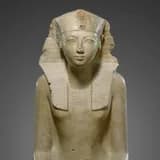
Around 1473 BCE, Hatshepsut began building her mortuary temple at Deir el‑Bahri, a masterpiece of New Kingdom architecture and a major statement of her kingship.
Circa 1473 BCE, soon after consolidating her position as pharaoh, Hatshepsut launched construction of her monumental terraced temple complex at Deir el‑Bahri on the west bank of the Nile at Thebes.[1473-01-01] Although the precise starting day is unknown, textual and archaeological evidence situate the beginning of this project early in her kingship. Designed as her mortuary temple and a major cult center for Amun, it quickly became one of the architectural masterpieces of the New Kingdom.
The complex, later known as the Mortuary Temple of Hatshepsut, represented a radical artistic and ideological statement. Its axial alignment, sweeping ramps, colonnaded terraces, and integration into the cliffs of Deir el‑Bahri showcased innovations in planning and aesthetics. Reliefs inside documented her divine birth, her expedition to Punt, and the legitimacy of her rule, blending theology, propaganda, and historical record.
This building program was historically significant because it anchored Hatshepsut’s reign in stone. At a time when her gender made her claim to kingship controversial, the temple proclaimed her divine authorization and permanent place in Egypt’s cosmic order. The project also stimulated the economy, mobilized artisans and laborers, and helped define the distinctive, elegant style of early 18th‑Dynasty art.
The legacy of starting Deir el‑Bahri is immense. The temple remains one of Egypt’s most celebrated monuments and a central source for understanding Hatshepsut’s ideology, foreign policy, and self‑presentation as a female king. Its survival, despite later defacement, allowed modern historians to reconstruct her achievements, making this architectural initiative a cornerstone of her historical memory and a landmark in world architectural history.