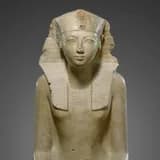
Around 1458 BCE, Hatshepsut’s successful two‑decade reign ended, after which later rulers partially erased her images and names from monuments.
Around 1458 BCE, Hatshepsut’s reign as king of Egypt came to an end, marking the close of one of the most prosperous and artistically vibrant periods of the Eighteenth Dynasty.[1458-01-01] The precise date and circumstances of her death remain uncertain; scholars infer the year from regnal calculations and the subsequent sole rule of Thutmose III. Her burial is usually associated with the Valley of the Kings, and her mummy has been tentatively identified in modern times.
The end of her reign was followed, some years later, by a systematic program to reduce her visible presence in the monumental record. Images of Hatshepsut as king were chiseled away, cartouches erased, and some statues destroyed or reworked, particularly during the later years of Thutmose III and possibly under Amenhotep II. This campaign did not fully obliterate her memory but did complicate the archaeological and textual picture of her rule.
Historically, the close of Hatshepsut’s reign is significant because it highlights the tensions her kingship produced in a patriarchal royal ideology. Her successful two‑decade rule demonstrated the viability of female sovereignty, yet later efforts to rewrite the record signal an attempt to restore a more conventional narrative of male succession. For Egypt, the transition returned the throne to a single male ruler who would embark on extensive military campaigns abroad.
In women’s history, the approximate end of Hatshepsut’s reign stands as both a culmination and a cautionary tale. She had shown that a woman could govern effectively at the pinnacle of an ancient state, overseeing peace, prosperity, and monumental creativity. Yet the partial erasure of her memory underscores how fragile women’s historical visibility can be, dependent on material survival and interpretive choices. Modern research—epigraphic, archaeological, and scientific—has played a crucial role in recovering her story, transforming the end of her reign from an episode of near‑forgetting into a focal point for rethinking gender and power in antiquity.