← All women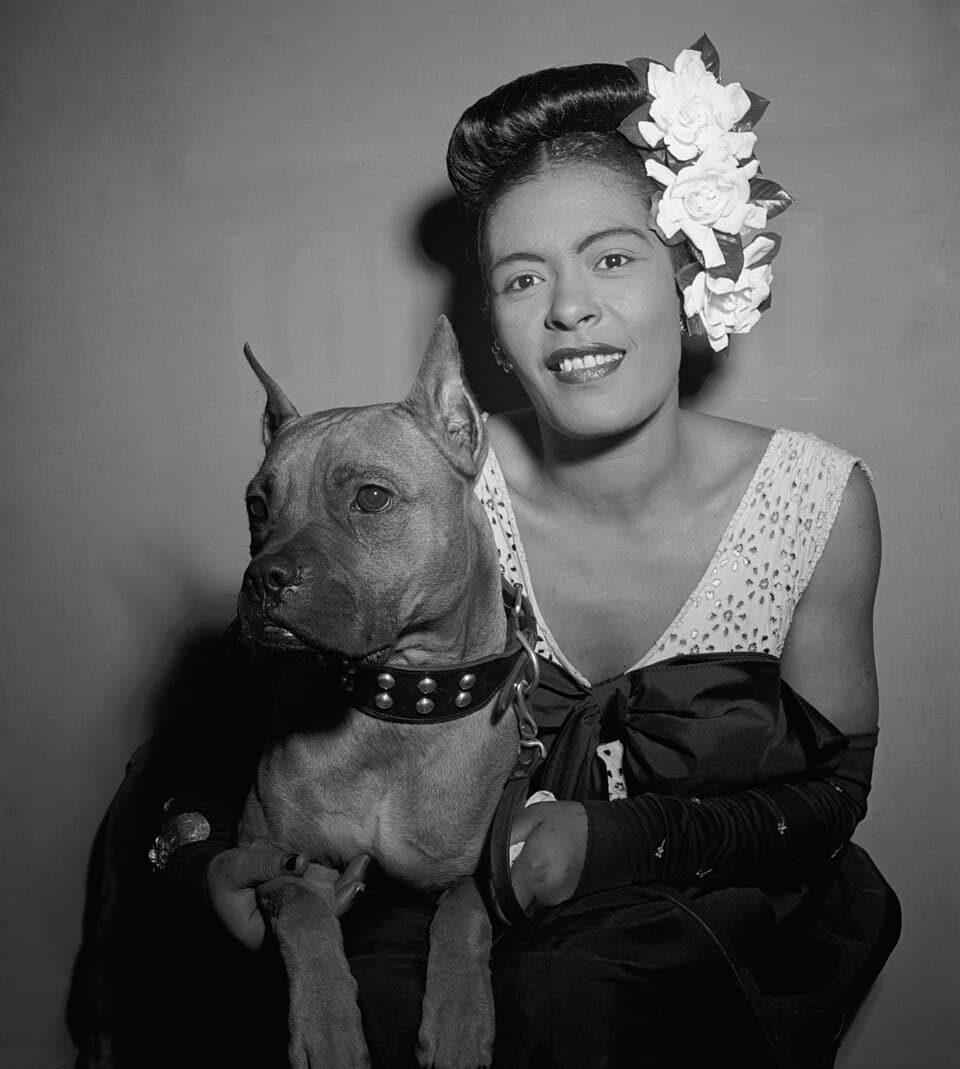
American · Arts · Activism
Billie Holiday
April 7, 1915 – July 17, 1959
Early Life and Background
Billie Holiday, born Eleanora Fagan on 7 April 1915 in Philadelphia, Pennsylvania, emerged from a childhood marked by poverty, instability, and racial discrimination to become one of the most influential vocalists of the twentieth century.[1][2][3] Her mother, Sarah Julia "Sadie" Fagan, was a teenaged domestic worker, and her father, Clarence Holiday (often spelled Halliday), was a jazz guitarist who later played with big bands, including Fletcher Henderson.[1][10][14] Her parents never married and separated soon after her birth; Holiday spent much of her early childhood in Baltimore, Maryland, living with relatives while her mother worked in East Coast cities.[2][10]
Holiday’s youth was punctuated by hardship. She was frequently left in the care of extended family and experienced neglect and abuse.[8][12][14] As a Black girl growing up under Jim Crow, she confronted segregated schools, limited economic opportunities, and the constant threat of racial violence. In her teens she was sent to a Catholic reform institution for truancy and later worked in a brothel, experiences she would recount—sometimes with embellishment—in her 1956 autobiography Lady Sings the Blues.[1][3][7]
Despite having no formal musical education, Holiday absorbed the emerging sounds of jazz and blues from an early age. She listened intensely to records by Bessie Smith and Louis Armstrong, singing along and developing her sense of phrasing and timing.[2][10][14] These self‑directed "lessons" in phrasing, improvisation, and emotional expression were crucial to her artistic formation; later critics would hear in her work a blend of blues feeling and instrumental‑like jazz phrasing rooted in these formative listening experiences.
Career Beginnings in Harlem
In the late 1920s and early 1930s, Holiday and her mother relocated to Harlem, amid the afterglow of the Harlem Renaissance.[1][10][16] Holiday initially sought work as a dancer in nightclubs, but her singing quickly attracted attention from musicians and patrons.[16] She began performing in small Harlem venues without proper cabaret licenses, often backed by house pianists and pickup bands. These appearances allowed her to hone a distinctive style built on rhythmic flexibility and conversational delivery rather than the belting approach favored by many contemporaries.[3][10]
Holiday’s breakthrough came when producer and talent scout John Hammond heard her singing in a Harlem club in the early 1930s.[3][7] impressed by her musicality and unique phrasing, Hammond arranged for her to make her first commercial recordings on 27 November 1933 with clarinetist Benny Goodman’s studio orchestra.[1][3] In this session, she recorded "Your Mother’s Son‑In‑Law" and "Riffin’ the Scotch," modest hits that introduced her voice to record buyers and the wider jazz community.[1][3][10] Hammond’s advocacy opened doors to further recording work and collaborations with some of the era’s most notable swing musicians.
Holiday’s most important early professional relationship was with pianist and bandleader Teddy Wilson, with whom she recorded a series of small‑group sessions beginning in 1935.[1][3] Issued under Wilson’s name for labels such as Brunswick and Vocalion, these discs paired Holiday with top swing instrumentalists in compact arrangements of popular songs. Among them were future Holiday signatures like "What a Little Moonlight Can Do" and "Miss Brown to You," which showcased her emerging mastery of timing, dynamics, and melodic recomposition.[1][19]
Rise to Prominence and Swing‑Era Collaborations
By the mid‑1930s, Holiday’s reputation as a recording artist was growing rapidly. On 12 September 1935, she appeared in Duke Ellington’s short film Symphony in Black: A Rhapsody of Negro Life, one of her earliest screen appearances.[1] In the film, which portrays vignettes of African American life, she plays a woman mistreated by her lover and sings the segment "Saddest Tale." The film’s Academy Award win for Best Short Subject helped raise her profile beyond the jazz world.
Through the late 1930s, Holiday performed and recorded with an array of leading swing musicians. In 1937 she toured and recorded with the Count Basie Orchestra, one of the premier big bands of the era, building her national reputation, though sources do not agree on an exact start date for her tenure.[1][3][10] On 12 February 1938, she made her first recordings with Basie’s band, including "I Can’t Get Started" and "They Can’t Take That Away from Me," demonstrating her ability to bring intimate nuance to large‑ensemble contexts.[1]
Holiday also continued her fruitful partnership with Teddy Wilson. On 24 March 1938, she recorded "What a Little Moonlight Can Do" with Wilson’s orchestra, a performance that became one of her signature early recordings and a jazz standard.[1] Later that year, on 23 August 1938, she cut "I’m Gonna Lock My Heart (And Throw Away the Key)," another hit that reinforced her growing status as a leading jazz vocalist.[1]
In late 1938, Holiday entered a new phase of barrier‑breaking visibility when she joined Artie Shaw’s Orchestra, one of the most prominent white big bands in the United States. Institutional histories and biographies identify her as the first African American woman to work full‑time as a featured singer with a white big band.[2][10] Touring with Shaw in 1938–1939, including by 21 October 1938, she confronted discriminatory conditions: some venues refused to allow her on stage, and she frequently endured racist treatment while traveling.[2][7][10] Although her tenure with Shaw was relatively brief, it remains a landmark in the integration of American popular music.
"Strange Fruit" and Musical Activism
Holiday’s career took a decisive political and artistic turn with her association with the anti‑lynching song "Strange Fruit". The song originated as a poem by Abel Meeropol, a Jewish schoolteacher and activist, who set it to music as a protest against lynching in the American South.[1] Holiday encountered the song in 1939 and insisted on performing it at Café Society, an integrated nightclub in Greenwich Village known for its left‑leaning clientele.[8][10]
On 20 April 1939, Holiday premiered "Strange Fruit" at Café Society under carefully staged conditions: service stopped, the room went dark except for a spotlight on her, and there was no encore afterward.[8] This theatrical presentation emphasized the gravity of the song’s imagery—"black bodies swinging in the Southern breeze"—and stunned audiences unaccustomed to overt political protest in a nightclub setting. The performance is widely regarded as introducing one of the earliest and most prominent anti‑lynching protest songs in American popular music.[8]
Holiday’s regular performance of "Strange Fruit" at Café Society drew critical attention and controversy. Major label Columbia, concerned about offending Southern distributors and radio affiliates, refused to record the song.[1][7] Holiday therefore turned to producer Milt Gabler of Commodore Records, an independent jazz label. On 2 July 1939, she recorded "Strange Fruit" for Commodore in New York.[1] The spare, mournful arrangement and Holiday’s measured, anguished delivery created a recording that many later critics would rank among the most important protest records of the twentieth century.
The Commodore release, issued later in 1939, became an underground hit and a rallying point for anti‑lynching activism, even as it attracted the suspicion of law‑enforcement and government agencies.[1][7][10] Decades later, institutions such as the Kennedy Center and the Library of Congress would hail the recording as a foundational work of musical protest, and in 2003 the Library of Congress added it to the National Recording Registry as a work of exceptional cultural and historical significance.[1]
Songwriting, Awards, and Mid‑Career Work
Alongside her interpretive genius, Holiday was an accomplished songwriter. In 1941 she co‑wrote "God Bless the Child" with Arthur Herzog Jr., reportedly inspired by a financial dispute with her mother; the song became one of her most enduring standards.[1][3][5] She later co‑wrote "Don’t Explain" and "Lady Sings the Blues," each drawing on her personal experiences of romantic betrayal and hardship.[5][10]
On 27 December 1944, Holiday recorded "Don’t Explain" with Herzog, a haunting ballad that exemplified her mature style—slower tempos, sparse phrasing, and an emphasis on emotional subtext.[1] Her ability to transform her own pain into universal songs of heartbreak deepened her connection with audiences and distinguished her from many contemporaries.
Holiday’s artistry earned critical recognition even as structural racism and sexism limited her opportunities. On 27 February 1946, she received the Esquire Magazine Gold Award for Best Female Vocalist, based on a readers’ and critics’ poll that ranked her ahead of peers in the field.[2] Throughout the 1940s she toured widely, appeared with top jazz musicians, and continued to record influential sides for labels including Decca, where she cut orchestrated ballads such as "Lover Man" and "You Better Go Now."[1][3]
Her interpretation of repertoire ranged from Tin Pan Alley standards to blues and original material, yet in every context she imposed an unmistakable personal stamp—altering melodies, stretching rhythms, and using silence as expressively as sound. Influential tenor saxophonist Lester Young, one of her closest musical partners, nicknamed her "Lady Day", while she called him "Prez"; their recordings together, such as "A Sailboat in the Moonlight" and "Mean to Me," rank among the high points of small‑group swing.[1][3][10]
Legal Troubles, Autobiography, and Carnegie Hall
Holiday’s mid‑career was marred by escalating struggles with alcohol and drug addiction. In 1947 she was arrested on narcotics charges and subsequently sentenced to a year and a day in federal prison in West Virginia, losing her New York City cabaret card upon release.[1][3][7] The loss of the card prevented her from performing in New York clubs that served alcohol, cutting her off from some of the city’s most lucrative and prestigious venues at a critical point in her career. Her conviction and the subsequent campaign of surveillance and harassment by federal narcotics agents have been interpreted by many scholars as racially and politically inflected, especially in light of her association with "Strange Fruit."[7][10]
Despite these obstacles, Holiday remained a major cultural figure. She gave large‑scale concerts, including appearances at Carnegie Hall, and continued to tour nationally. In the mid‑1950s she undertook a major project to narrate her life story. On 1 February 1956, Doubleday published her autobiography Lady Sings the Blues, written in collaboration with journalist William Dufty.[1][3] The book offered a frank account of her childhood, abusive relationships, racism in the music industry, and entanglements with the criminal justice system. Though later research has identified some inaccuracies and compressions, the memoir remains an essential, first‑person window into the experiences of a Black woman entertainer navigating mid‑century America.
To promote the book, Holiday appeared in concerts that combined readings from the memoir with musical performances. On 10 November 1956, she performed two sold‑out concerts at Carnegie Hall, where sections of the autobiography were read aloud onstage between songs.[1] These events symbolized Holiday’s recognition as an artist of national importance and linked her literary self‑portrait to her musical legacy.
Television, European Tours, and Late‑Style Recordings
As television became a dominant medium in the 1950s, Holiday gained new visibility. On 24 November 1954, she made her first appearance on "The Tonight Show", hosted by Steve Allen, singing for a national audience and further integrating jazz into mainstream American entertainment.[2] She also appeared on other television programs and in concert films, though surviving footage is comparatively limited.
Holiday’s international stature grew in the postwar years. On 23 February 1954, she opened a major European tour in London, one of the first extensive European concert tours by a leading American jazz vocalist after World War II.[1][2] She performed to enthusiastic audiences across the United Kingdom and continental Europe, often receiving more respectful treatment abroad than she did in the United States, where segregation and moral panic over her drug use continued to shape her career.
By the late 1950s, Holiday’s health had deteriorated significantly. Nevertheless, she embarked on one of her most ambitious recording projects. Beginning on 18 February 1958, she recorded the album Lady in Satin for Columbia Records with arranger Ray Ellis.[1] The sessions, featuring a large string orchestra and choir, represented a departure from her small‑group jazz settings and emphasized lush, romantic textures. Though some contemporaries criticized the album, later critics reassessed it as a powerful example of "late style," in which Holiday’s ravaged voice conveyed profound emotional depth.
In 1959, despite worsening illness, Holiday continued to perform. Her final public performance took place on 25 May 1959 in New York City, where she sang a repertoire that underscored the arc of her career.[1][2] Within weeks she would be hospitalized, bringing her life and art to an abrupt close.
Personal Life and Relationships
Holiday’s personal life was complex and often troubled. She experienced sexual abuse as a child and adolescent, episodes that shaped her later struggles with intimacy and trust.[8][12] Over the years she had relationships with men who were sometimes violent, exploitative, or involved in the drug trade, contributing to her entanglement with narcotics and the law.[1][7]
She married several times. Her first marriage was to trombonist Jimmy Monroe in 1941; although the relationship was tumultuous and marred by drug use and infidelity, she retained his surname professionally for some time.[1][3] She later married Joe Guy, a trumpeter who had been both her musical partner and drug supplier, and, in 1957, night‑club bouncer Louis McKay, who managed aspects of her career but was also reported to be abusive.[1][7] Holiday had no children.
Recent scholarship and institutional biographies note that Holiday was open about relationships with women, indicating that she was bisexual at a time when such openness carried social and legal risk.[10] This aspect of her life has become increasingly central to queer readings of her career and to broader histories of sexuality in the jazz world.
Holiday’s long‑term dependence on alcohol and heroin reflected both personal vulnerability and the broader context of the jazz scene, where substance use was widespread and often romanticized while Black users were harshly punished. Her experiences with the criminal justice system, especially her 1947 conviction and subsequent surveillance by federal agents, have been interpreted as examples of how race, gender, and addiction intersected in mid‑century law‑enforcement practices.[7][10]
Later Life and Death
By the late 1950s, Holiday’s health was in steep decline. Years of heavy drinking and drug use had led to cirrhosis of the liver and heart disease, and her voice had lost much of its earlier range and clarity. Yet she continued to perform and record, imbuing her late work with a raw, exposed vulnerability that many listeners found deeply moving.[1][3]
In May 1959, after her final New York performance on the 25th, she was admitted to Metropolitan Hospital in Manhattan for liver and heart problems.[1] While hospitalized, she was arrested on drug charges and placed under police guard, with agents reportedly seizing cash and flowers from her room.[7] On 17 July 1959, Holiday died of heart failure caused by cirrhosis, complicated by pulmonary edema.[1][3] She was 44 years old and, despite her fame, nearly destitute at the time of her death. She was buried at Saint Raymond’s Cemetery in the Bronx.[1]
News of Holiday’s death prompted tributes from musicians and critics who recognized her as a transformative figure in jazz and popular music. Saxophonist Lester Young, her closest musical compatriot, had died only months earlier, underscoring a sense of the passing of an era.[1][3] Over time, biographies, documentaries, and dramatic films would recast Holiday’s life as both a cautionary tale about addiction and exploitation and a testament to artistic resilience.
Awards, Honors, and Posthumous Recognition
During her lifetime, Holiday received relatively few formal awards, reflecting both the racial and gender biases of the era and the marginal status of jazz within official cultural institutions. The Esquire Gold Award for Best Female Vocalist in 1946 was one significant exception.[2] Nevertheless, her influence on fellow musicians and the listening public was widely acknowledged.
Posthumously, Holiday has received extensive recognition. She has been inducted into the Grammy Hall of Fame multiple times for recordings including "Strange Fruit," "God Bless the Child," and "Lover Man," honoring their lasting significance.[3] In 2000, she was posthumously inducted into the Rock and Roll Hall of Fame, with singer Diana Ross—who had portrayed a Holiday‑inspired character in the 1972 film adaptation of Lady Sings the Blues—presenting the induction.[7][18] The honor underscored her foundational role in shaping the vocal and emotional language of modern popular music.
On 19 March 2003, the Library of Congress added the 1939 Commodore recording of "Strange Fruit" to the National Recording Registry, citing its cultural, historical, and aesthetic importance.[1] Museums and cultural institutions, including the Smithsonian National Museum of African American History and Culture, have highlighted her in exhibitions and online features, emphasizing both her artistry and her role in Black cultural and civil‑rights history.[10]
Holiday has also been honored by the National Women’s Hall of Fame, which emphasizes her contributions to music and her triumph over adversity.[16] Numerous biographies, scholarly studies, and retrospectives, along with centennial commemorations in 2015, have further solidified her status as a central figure in American cultural history.[7][10][16]
Legacy and Historical Impact
Billie Holiday’s legacy rests on several intertwined contributions: her redefinition of vocal jazz, her pioneering use of popular music as a vehicle for social protest, and her enduring symbolism in discussions of race, gender, and the carceral state.
Musically, Holiday transformed the role of the singer in jazz. Drawing on instrumental phrasing, she lagged behind the beat, reshaped melodies, and used timbral nuance to convey complex emotions. Critics and historians often describe her as treating the voice like a horn, improvising within and around the song’s structure rather than simply delivering it.[1][3][14] Her approach influenced generations of vocalists across genres, from Frank Sinatra and Nina Simone to later soul, pop, and rock singers who embraced intimate, confessional delivery.
Her interpretation of "Strange Fruit" stands as a landmark in the history of protest music. Long before the civil‑rights movement of the 1950s and 1960s produced anthems like "We Shall Overcome," Holiday used her nightclub platform to confront audiences with graphic depictions of lynching, at considerable personal risk.[8][10] Scholars now see "Strange Fruit" as a precursor to later traditions of socially conscious music, and as an example of how Black women artists have used popular forms to challenge racial violence.
Holiday’s life story—shaped by childhood abuse, systemic racism, criminalization of addiction, and gendered exploitation—has made her a key figure in studies of intersectionality. Her treatment by law‑enforcement, particularly the targeting by federal narcotics agents, is often cited as an early example of punitive approaches to drug use that disproportionately affected Black communities.[7][10] At the same time, her ability to transmute personal suffering into art has made her an emblem of resilience for many listeners.
In cultural memory, "Lady Day" exists both as a voice—captured on records that remain widely listened to—and as a narrative refracted through autobiography, biography, film, and scholarship. Her recordings continue to be reissued and studied, and new generations discover her work through documentaries, feature films, and digital media. Institutions devoted to jazz history, Black history, and women’s history routinely center her contributions, underscoring her status as a foundational figure in twentieth‑century American culture.
Ultimately, Billie Holiday’s significance extends beyond jazz. She helped redefine what popular singing could express, turning three‑minute songs into sites of personal testimony and political witness. Her artistry and life story illuminate the possibilities and costs of Black women’s creativity in a segregated and frequently hostile society, ensuring her place in any serious account of modern music and women’s history.
Dated achievements
22 indexed.
- Apr071915Arts
Birth of Billie Holiday
Birth of Eleanora Fagan (Billie Holiday) in Philadelphia, Pennsylvania.
View details Billie Holiday – Wikipedia - Nov271933Arts
First commercial recording session with Benny Goodman
First commercial recording session with Benny Goodman, cutting “Your Mother’s Son‑In‑Law” and “Riffin’ the Scotch.”