← All women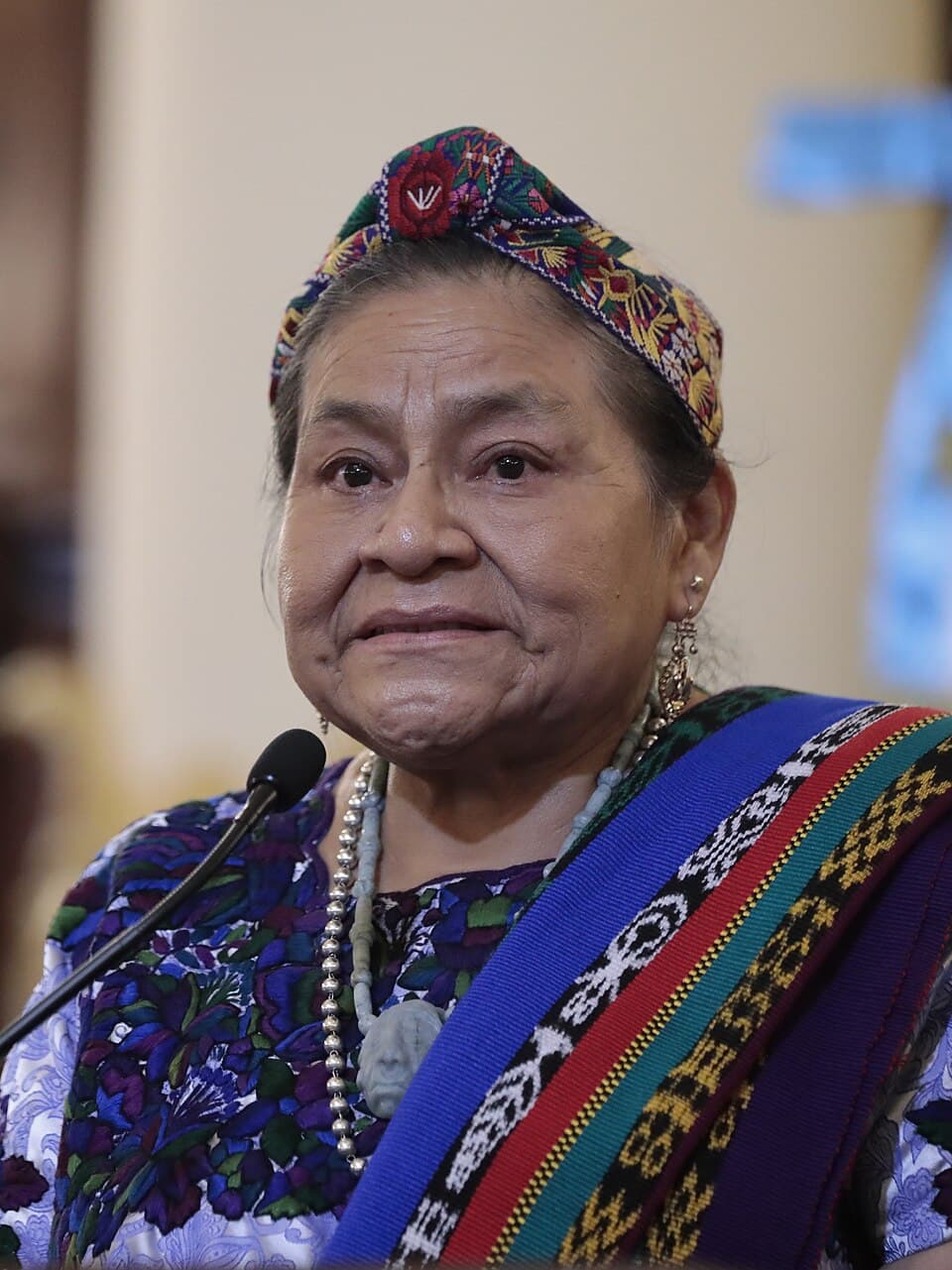
Guatemalan, Mexican · Activism · Politics
Rigoberta Menchú
January 9, 1959 – present
Early Life and Background
Rigoberta Menchú Tum was born on 9 January 1959 in Aldea Chimel, a small village in the municipality of Uspantán, in the Quiché highlands of Guatemala.[1][2][12] She belongs to the K’iche’ Maya people, one of the largest Indigenous groups in the country.[5][6] Her parents, Vicente Menchú and Juana Tum, were poor peasant farmers who cultivated small plots of land and worked seasonally on large coffee plantations. Menchú grew up in a large family that endured chronic poverty, discrimination, and the structural violence that characterized rural Indigenous life in mid‑twentieth‑century Guatemala.[1][9]
From an early age, Menchú was immersed in a world shaped by Indigenous cosmology, community solidarity, and Catholic religious teachings. She learned K’iche’ as her mother tongue and later Spanish as a second language, reflecting broader patterns of linguistic marginalization in which Indigenous children often had limited access to formal schooling.[1][2] According to biographical accounts, she received little formal education and instead worked alongside her family, first in subsistence agriculture and then in the highly exploitative conditions of coastal plantations where Indigenous workers were subject to low wages, harsh discipline, and poor living conditions.[1][13]
These childhood experiences of economic hardship, ethnic discrimination, and exposure to different cultural and religious currents formed the backdrop to Menchú’s emerging political consciousness. The Guatemalan state’s long history of excluding Indigenous communities from landownership, education, and political participation would later become central themes in her testimony and activism.[12][16] Her family’s efforts to preserve Maya rituals and communal practices even under pressure from landlords and military authorities contributed to her conviction that cultural survival is inseparable from social justice.
Coming of Age During Civil War
Menchú came of age during the Guatemalan Civil War, a conflict that lasted from 1960 to 1996 and resulted in widespread human‑rights violations, particularly against Indigenous communities.[12][16] By the late 1970s, the Guatemalan army had intensified counterinsurgency campaigns in the highlands, often targeting villages suspected of supporting leftist guerrillas. In this context, Menchú and many of her contemporaries became involved in grassroots organizing and religious-based social movements that sought to defend peasant rights.
According to several sources, in 1979 Menchú began working as a bilingual teacher and catechist in Indigenous communities, combining religious instruction with basic education.[6][11] She became increasingly active in social justice efforts, including the Comité de Unidad Campesina (CUC, Committee for Peasant Unity), which organized rural workers for better wages and land rights.[11] This involvement placed her and her family squarely in the sights of state repression.
During the early 1980s, the violence escalated dramatically. Menchú’s father, Vicente, was a well‑known community leader who participated in land struggles and protests. He died in January 1980 during the burning of the Spanish Embassy in Guatemala City, when police stormed the building in response to a peaceful occupation by Indigenous and peasant activists; almost all of the occupants were killed.[1][5] Menchú later recounted the deaths of her father, mother, and brother at the hands of security forces or allied paramilitaries, using these personal tragedies to illustrate the brutality of the conflict.[4][12]
Exile and Emergence as an International Voice
Facing direct threats to her life, Menchú went into exile in Mexico around 1981, joining thousands of Indigenous refugees who fled army campaigns in the highlands.[12][16] In Mexico she came into contact with human‑rights organizations, church groups, and solidarity networks that were documenting abuses in Guatemala and other Latin American countries.[12] This period was crucial in transforming her from a local activist into a figure capable of addressing international audiences.
While in exile, Menchú participated in speaking tours and meetings in Europe and North America, describing conditions in Guatemala and calling for international pressure on the government to end repression.[4] She became involved in broader Indigenous movements, framing the Guatemalan struggle as part of a continental pattern of colonial and postcolonial violence against Native peoples.[16] Her ability to articulate both personal trauma and structural injustice made her a compelling witness and advocate.
Testimonial Literature and "I, Rigoberta Menchú"
Menchú’s life story gained global prominence through the publication of the testimonial work "Me llamo Rigoberta Menchú y así me nació la conciencia" ("I, Rigoberta Menchú: An Indian Woman in Guatemala"). The book was produced through interviews Menchú conducted in the early 1980s with Venezuelan anthropologist Elisabeth Burgos‑Debray; it was first published in Spanish in 1982.
The English‑language edition, I, Rigoberta Menchú: An Indian Woman in Guatemala, appeared shortly thereafter and became widely used in universities, activist circles, and solidarity campaigns.[4][18] In it, Menchú recounts her childhood, family life, political awakening, and the violence inflicted on Indigenous communities by the Guatemalan state. The text blends autobiographical detail with collective testimony, aiming to represent the experiences of many Maya people rather than simply one individual.
Scholars have noted that the book played a major role in internationalizing awareness of the Guatemalan conflict and the condition of Indigenous peoples in Latin America.[4][16] It contributed to the genre of testimonio, in which marginalized subjects narrate their stories as political acts. Later debates emerged over the factual accuracy of certain episodes, particularly after anthropologist David Stoll questioned some details. Nonetheless, the broader consensus recognizes the book’s importance as a vehicle for exposing human‑rights abuses and articulating Indigenous perspectives on land, culture, and state violence.[2][9]
Nobel Peace Prize and Global Recognition
By the early 1990s, Menchú had become an internationally recognized advocate for Indigenous rights and peace. On 16 October 1992, the Norwegian Nobel Committee announced that she had been awarded the Nobel Peace Prize for her "struggle for social justice and ethno‑cultural reconciliation based on respect for the rights of indigenous peoples."[12] The prize was particularly symbolic given that 1992 marked the 500th anniversary of the arrival of Christopher Columbus in the Americas, a moment that Indigenous movements used to highlight centuries of dispossession.
Menchú received the medal and diploma at the Nobel ceremony in Oslo on 10 December 1992.[1][12] At age 33, she was one of the younger laureates in the prize’s history, and contemporary accounts described her as the first Indigenous person to win the Nobel Peace Prize.[12][15] The Nobel Committee emphasized her role in drawing attention to the plight of Indigenous peoples in Latin America and praised her efforts to promote dialogue rather than revenge.
With part of the Nobel funds, Menchú established the Rigoberta Menchú Tum Foundation in 1992, dedicated to human rights, Indigenous rights, and peace education.[5][13] The foundation focuses on legal assistance, intercultural education, and support for communities affected by violence. The Nobel recognition significantly increased her ability to mobilize resources and influence international agendas concerning Indigenous peoples and post‑conflict reconciliation.
Engagement with International Institutions
Beyond the Nobel Prize, Menchú’s advocacy deepened through formal roles in international organizations. On 20 March 1996, she was appointed a UNESCO Goodwill Ambassador, tasked with promoting Indigenous rights and a culture of peace.[5][6] This appointment came as Guatemala neared the end of its civil war; a final peace agreement was signed later that year, following negotiations in which Norway and other international actors played important roles.[12]
As a Goodwill Ambassador, Menchú participated in conferences, educational initiatives, and cultural projects, highlighting the importance of preserving Indigenous languages and traditions as part of broader peacebuilding.[5] She also supported efforts to strengthen human‑rights education and to incorporate Indigenous perspectives into curricula, arguing that historical memory and recognition of diversity are essential to preventing future violence.
In 1994, Menchú received the Right Livelihood Award, often described as the "Alternative Nobel Prize," for her work for social justice and ethno‑cultural reconciliation.[5][9] This award further underscored her role in shaping global discourses on Indigenous rights, development, and peace.
Prince of Asturias Award and Continued Honors
On 30 October 1998, Menchú was presented with the Prince of Asturias Award for International Cooperation in Oviedo, Spain.[6][8] The award citation praised her defense of human rights and her contribution to cooperation and understanding among peoples. For Spanish and European audiences, honoring Menchú linked historical debates about empire and colonization to contemporary efforts to build more equitable international relationships.
The Prince of Asturias Award added to a growing list of honors, including numerous honorary doctorates and recognitions from universities and civic organizations worldwide.[2][4] These accolades reflect both her personal achievements and the broader resonance of Indigenous struggles in global conversations about democracy and human rights.
Legal Advocacy and the Search for Justice
Following the end of the civil war, Menchú increasingly focused on legal strategies to address past atrocities. Through her foundation and alliances with international lawyers, she supported cases aimed at prosecuting perpetrators of human‑rights violations, including efforts to hold former Guatemalan officials accountable in foreign courts under the principle of universal jurisdiction.[5][9]
In 2003, Menchú served as a judge on the permanent people’s tribunal, a civil society mechanism that investigated human‑rights abuses in Guatemala and other countries.[5] She used this platform to insist on the importance of truth‑telling and reparations for victims of state violence. Her legal activism complemented the work of official truth commissions and contributed to ongoing debates about memory, justice, and impunity in Guatemala.
Founding Winaq and Entry into Party Politics
In 2006, Menchú co‑founded Winaq, widely described as Guatemala’s first Indigenous political party.[5][6] The party’s name, derived from a K’iche’ word meaning "person" or "people" in fullness, reflects its emphasis on dignity, pluralism, and Indigenous leadership. Winaq seeks to represent marginalized communities and to promote policies such as multicultural education, rural development, and environmental protection.
The creation of Winaq marked a strategic shift from predominantly protest‑based politics to attempts to secure institutional power through elections. It offered a vehicle through which Indigenous activists could contest municipal and national offices under a platform explicitly grounded in Indigenous worldviews and human‑rights principles.[5][9] Menchú’s stature as a Nobel laureate gave the party national visibility but also attracted scrutiny from established political elites.
Presidential Campaigns
On 7 February 2007, Menchú registered her first presidential candidacy with Guatemala’s Supreme Electoral Tribunal, running under the Winaq banner in alliance with other parties.[5][6] She became one of the first highly prominent Indigenous women to seek the presidency, challenging entrenched patterns of racial and gender exclusion in Guatemalan politics.[5][16] Her campaign emphasized anti‑corruption measures, social inclusion, and respect for Indigenous rights.
Although Menchú did not win the election and obtained a relatively small percentage of the vote, her candidacy itself was widely viewed as a milestone. It signaled that Indigenous-led parties could participate at the highest levels of electoral competition and that an Indigenous woman could credibly aspire to national executive power.[5][9]
Menchú ran for president again in the 2011 elections. On 3 May 2011, she was officially nominated as a presidential candidate, again representing Winaq in alliance with other left-leaning groups.[5] Her second campaign reinforced her commitment to sustained engagement with Guatemala’s democratic institutions. While she again failed to secure the presidency, the campaign contributed to normalizing Indigenous participation in national politics and kept issues of human rights and accountability on the public agenda.[9]
Personal Life
Menchú’s personal life has often been described in relation to her family’s suffering and resilience. She married Ángel Canil, with whom she has at least one son, commonly referred to as Mash in journalistic profiles.[11] Biographical sources note that motherhood and family responsibilities coexisted with her demanding schedule of activism, travel, and organizational leadership.[11]
Her family experiences, including the loss of close relatives during the civil war and the challenges of raising children amid ongoing political conflict, have shaped her emphasis on intergenerational memory and the transmission of cultural knowledge. Menchú has frequently invoked the experiences of mothers and grandmothers in her speeches, arguing that women play a central role in preserving community values and sustaining resistance to injustice.[4][15]
Writings and Intellectual Contributions
Beyond I, Rigoberta Menchú, Menchú has contributed to other books and publications. She is credited as the author of the autobiographical work "Crossing Borders" (1998), which reflects on her experiences of exile, activism, and engagement with international institutions.[5][14] Her writings, interviews, and speeches explore themes of cultural identity, colonialism, gender, and the ethics of reconciliation.
Scholars in fields such as anthropology, Latin American studies, and human-rights law have engaged extensively with Menchú’s testimonial and public discourse. Some have debated the boundaries between individual autobiography and collective representation, while others have highlighted her role in expanding the genre of testimonio and challenging conventional notions of historical evidence.[16] Regardless of these debates, Menchú’s narratives have helped reshape how academics and activists understand Indigenous agency in modern politics.
Legacy and Historical Impact
Rigoberta Menchú’s legacy is multifaceted. She is widely regarded as a symbol of Indigenous resistance and a key figure in global human-rights movements.[2][9] Her testimony and activism brought international attention to the Guatemalan Civil War’s genocidal campaigns against Maya communities and contributed to pressure for peace negotiations and accountability.[12][16]
As a Nobel Peace laureate, Menchú helped shift the prize’s focus toward grassroots human-rights activism and the rights of Indigenous peoples.[12] Her recognition in 1992 highlighted the importance of listening to those most affected by violence and exclusion, rather than only to state leaders or elite diplomats. Subsequent Nobel awards to other human-rights defenders and Indigenous leaders can be situated within a broadened understanding of peace that her selection helped to consolidate.
Menchú’s work with the Rigoberta Menchú Tum Foundation, her role as UNESCO Goodwill Ambassador, and her participation in legal actions against perpetrators of atrocity crimes have all contributed to ongoing processes of truth, memory, and justice in Guatemala.[5][13] Her efforts illustrate how survivors and witnesses can become agents of institutional reform and transnational advocacy.
In the realm of politics, the founding of Winaq and her presidential campaigns opened space for Indigenous participation and challenged patriarchal and racist norms in Guatemalan democracy.[5][6] Even though electoral success has been limited, these initiatives have inspired other Indigenous politicians and activists, especially women, to seek office and to articulate policy platforms grounded in Indigenous worldviews.
At a broader level, Menchú has become an emblematic figure in educational materials, documentaries, and classroom resources around the world. Organizations such as Learning for Justice present her story as an example of courage, resilience, and the power of testimony in confronting injustice.[15] Her life continues to prompt critical reflection on the ethics of representation, the complexities of post-conflict reconciliation, and the enduring struggles of Indigenous peoples for self‑determination.
Later Life
In the decades following the peace accords, Menchú has remained active in human-rights advocacy, educational work, and political engagement. She continues to lead and advise the Rigoberta Menchú Tum Foundation, which operates in Guatemala and abroad, and to participate in international forums on Indigenous rights, climate change, and peacebuilding.[13][4]
Menchú has also maintained a presence in Guatemalan public life, commenting on issues such as corruption, transitional justice, and the rights of migrants and refugees. Her perspective as both a survivor of state violence and a Nobel laureate gives her a unique voice in debates over how to build inclusive and accountable institutions.[9][16]
As of the mid‑2020s, Rigoberta Menchú Tum is alive and continues to be referenced widely in scholarship, activism, and educational materials.[5][6] Her trajectory—from a K’iche’ Maya village in the Quiché highlands to global recognition—encapsulates many of the central tensions and possibilities of contemporary human-rights politics: the challenge of representing collective suffering, the difficulties of achieving justice in post-conflict societies, and the ongoing struggle to secure respect and rights for Indigenous peoples worldwide.
Dated achievements
7 indexed.
- Jan091959Activism
Birth of Rigoberta Menchú Tum
Birth of Rigoberta Menchú Tum in Aldea Chimel, Uspantán, Quiché, Guatemala, into a K’iche’ Maya peasant family.
View details Rigoberta Menchú Tum – Facts - Oct161992Activism
Announcement of Nobel Peace Prize to Rigoberta Menchú Tum
Norwegian Nobel Committee announces Rigoberta Menchú Tum as the 1992 Nobel Peace Prize laureate for her work for Indigenous rights.