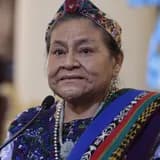
Rigoberta Menchú Tum receives the Prince of Asturias Award for International Cooperation in Oviedo, Spain.
On 30 October 1998, Rigoberta Menchú Tum received the Prince of Asturias Award for International Cooperation at a ceremony in Oviedo, Spain.[6][8] The award recognized her "tireless work for the defense of human rights, particularly those of indigenous peoples," and her contribution to peace and mutual understanding between cultures.
By 1998, Menchú was already a Nobel Peace laureate and a prominent international advocate. The Prince of Asturias Award, one of Spain’s most prestigious honors, underscored European recognition of her efforts to bridge North–South divides and to bring Indigenous issues into mainstream diplomatic and intellectual debates.[6]
This presentation was historically significant because it linked Indigenous human-rights activism to the sphere of international cooperation, emphasizing that struggles for cultural survival and social justice are integral to global peace and development. In the context of post–Cold War rethinking of international relations, honoring Menchú signaled that cooperation should include listening to historically marginalized communities.
The award amplified support for her foundation and educational initiatives and strengthened transatlantic networks between Latin American Indigenous movements and European civil-society organizations.[13][5] It also helped cement Menchú’s reputation as a key interlocutor between Indigenous communities and international institutions.
The 30 October 1998 ceremony thus forms part of a broader trajectory in which Menchú’s activism not only challenged abuses in Guatemala but also reshaped understandings of international solidarity, highlighting the centrality of Indigenous rights to cooperative global politics.