← All women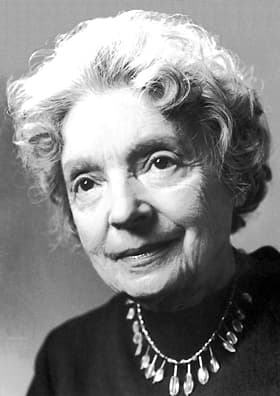
German, Swedish · Literature · Arts
Nelly Sachs
December 10, 1891 – May 12, 1970
Early Life and Family Background
Nelly Sachs, born Leonie Nelly Sachs on 10 December 1891 in Schöneberg, then a separate municipality near Berlin, came from an assimilated upper‑middle‑class Jewish family.[1][2][4][6][12][16][18] Her father, Wilhelm (William) Sachs, was a prosperous manufacturer and factory owner, and her mother, Margarete (often rendered Margaretha), presided over a comfortable bourgeois household. The family’s position allowed them to live in a fashionable area of Berlin and cultivate a rich cultural environment.
Sachs suffered from frail health as a child and was largely educated at home rather than in public schools.[2][6] Private tutoring gave her access to music, dance, and literature, while shielding her from some of the social constraints placed on young middle‑class women. Like many girls of her milieu, she studied piano and dancing, but she also developed an early passion for reading and writing. She encountered German Romantic writers and was deeply moved by the work of Swedish Nobel laureate Selma Lagerlöf, whose blend of folklore, spiritual symbolism, and moral seriousness profoundly influenced Sachs’s imagination.[2][6][10]
In her teens, Sachs began writing poetry and prose, publishing her first pieces in newspapers and magazines in the early 20th century.[9][12][18] Her early work reflected Romantic and neo‑Romantic sensibilities: lyrical language, fascination with legends, and an interest in metaphysical themes. In 1921 a volume often cited as Legenden und Erzählungen (Legends and Tales) appeared, marking her entrance into print culture, though she remained far from widely known.[9][12] Through these formative years she lived as a respectable Berliner daughter whose literary aspirations coexisted with conventional gender expectations.
Career Beginnings in Berlin
During the Weimar Republic, Sachs continued to publish short prose and poetry in Berlin periodicals, developing a small but steady presence in the city’s literary scene.[9][10][18] Her texts from this period are generally characterized by a nonpolitical, inward‑looking Romanticism, with little explicit attention to her Jewish identity. For many assimilated German Jews, Jewishness was a matter of background rather than public identity, and Sachs was no exception at first.[16][18]
The rise of National Socialism in 1933 radically altered her situation. As antisemitic measures escalated, Jews were excluded from professional and cultural life. Sachs, unmarried and living with her parents, experienced increasing social isolation and fear.[10][16] Her father died in 1930, and she and her mother relied on their savings as the environment became more hostile.[15][16] By the late 1930s, deportations and violence against Jews were intensifying, and Sachs herself was threatened with arrest.
It was in this context that her writing began to engage directly with Jewish themes. During the Nazi years she grew more conscious of her Jewish heritage and began composing poems that grappled with persecution, exile, and spiritual trial.[9][10][16] The shift from Romantic inwardness to historical catastrophe would define her mature work. Yet, while still in Germany, she had little opportunity to publish these new texts, and they circulated only in limited circles.
Escape to Sweden and Exile (1940–1950)
Sachs’s survival is inseparable from her relationship with Selma Lagerlöf. After years of admiring Lagerlöf’s writings, Sachs established a correspondence with the Swedish author and eventually received crucial practical support.[2][6] In the spring of 1940, as deportations loomed, Lagerlöf and her associates helped secure transit for Sachs and her mother to Sweden. The Nobel Prize biographical notes specify that Sachs arrived in Sweden on 16 May 1940, an escape that likely saved their lives.[2][6]
In Sweden, Sachs and her mother settled in Stockholm, living in modest rented rooms and depending on small stipends and occasional translation work.[2][6][18] Sachs began learning Swedish intensively so she could earn income by translating Swedish literature into German. She engaged with contemporary Swedish poets such as Gunnar Ekelöf, Johannes Edfelt, and Karl Vennberg, translating their modernist works and thereby opening channels between Swedish and German literary cultures.[2][6][3]
The years of wartime exile were marked by both material hardship and creative transformation. From Stockholm, Sachs received news of the deportation and murder of friends and relatives in Nazi camps.[10][16] This knowledge, combined with her own narrow escape, shaped the thematic core of her later poetry: the suffering and annihilation of European Jewry, the spiritual meaning of catastrophe, and the search for language worthy of mourning.
Even in Sweden, Sachs faced barriers as a refugee woman writer: limited finances, lack of established networks, and the challenges of working in a language that was not her own. However, the Swedish literary community gradually recognized her talent. Her translation work made her a cultural intermediary, while her German poems began to attract attention among those interested in German‑language writers in exile.[2][3][18]
Postwar Writing and Major Works
After 1945, as the scale of the Holocaust became publicly known, Sachs’s poetic focus sharpened around themes of deportation trains, concentration camps, and martyrs. She drew on Biblical imagery, Hasidic tales, and Kabbalistic mysticism to articulate suffering and transformation.[5][10][16] Her style combined compressed, often fragmentary language with visionary metaphors, producing a distinctive voice within postwar literature.
One of her earliest significant collections dealing with the Shoah is In den Wohnungen des Todes ("In the Dwelling Places of Death"), published in the late 1940s. It is frequently cited as a foundational work of Holocaust poetry, weaving images of burning chimneys, ashes, and displaced souls into a spiritual register that resists both despair and simple consolation.[3][5][10][16] Subsequent plays and radio dramas, such as Eli: Ein Mysterienspiel vom Leiden Israels ("Eli: A Mystery Play of the Suffering of Israel"), expanded her engagement with Jewish destiny in dramatic form.
In the 1950s and 1960s, Sachs produced a series of major collections that consolidated her reputation. The 1966 volume Flucht und Verwandlung ("Flight and Metamorphosis")—whose title became a key phrase for her oeuvre—examined exile as both physical displacement and spiritual transformation.[10][14][16] In 1967, the English‑language collection O the Chimneys introduced her work to a broader Anglophone audience, gathering poems about the Holocaust and martyrdom.[12][16] Throughout these publications, Sachs grappled with the paradox of writing in German, the language of persecutors as well as of her own poetic formation, and sought to purify it through elegiac and mystical uses.
Her work was increasingly recognized by critics as a central contribution to Holocaust memory and postwar German‑language literature. Scholars have emphasized how her poems avoid direct documentary description in favor of archetypal and symbolic representation, enabling intense emotional and spiritual resonance while maintaining historical awareness.[10][14][16] Sachs became identified as a bridge figure between Romanticism, modernism, and Jewish mystical traditions.
Awards, Honors, and Recognition
Sachs’s breakthrough into institutional recognition began in Sweden. In 1958 she received a poetry prize from the Swedish Poets Association or Swedish Radio, honoring both her original verse and her translations.[2][15][16] The award signaled her integration into Swedish literary life and affirmed the importance of exiled German‑language poets in the country’s cultural landscape.
In 1959, the Kulturkreis der deutschen Wirtschaft (Cultural Circle of German Industry) awarded Sachs its Ehrengabe, an honorary poetry prize.[7][15][18] This was her first official recognition from postwar Germany and carried symbolic weight: an industrial‑cultural body in the country she had fled now honored a Jewish refugee whose work confronted the Holocaust. The award helped cement her reputation in West Germany as "the poet of Jewish fate."[9][14][16]
Further German recognition followed in 1960, when Sachs received the Meersburger Droste-Preis, named for Annette von Droste-Hülshoff, a 19th‑century German woman poet.[9][15][16][18] Sachs traveled briefly to Germany for the prize ceremony, returning for the first time to the land of her birth. The award explicitly linked her to an earlier female poetic tradition and acknowledged her significance as a contemporary woman poet.
In 1961 the city of Dortmund established the Nelly Sachs Prize, a biennial international literary award for writers who promote understanding between peoples, and chose Sachs herself as its first recipient.[7][9][15][18] The creation of a prize bearing her name, immediately conferred on her, marked an extraordinary honor and demonstrated the alignment between her work’s ethical concerns and the prize’s mission.
Her standing continued to rise. In 1965 Sachs was awarded the Peace Prize of the German Book Trade (Friedenspreis des Deutschen Buchhandels) in Frankfurt, becoming the first woman to receive this prestigious distinction.[7][9][14][16][18] The prize is among Germany’s most important honors for cultural figures, recognizing contributions to peace and humanity. Awarding it to a Jewish exile poet was a significant step in West Germany’s public engagement with the Holocaust and with Jewish intellectual voices.
The pinnacle of her recognition came in 1966, when Sachs received the Nobel Prize in Literature, shared with Israeli writer Shmuel Yosef Agnon.[1][2][4][6][11][12][16][17][18] The Nobel committee honored her "outstanding lyrical and dramatic writing, which interprets Israel's destiny with touching strength."[6] She is widely acknowledged as the first German‑speaking woman to win the Nobel Prize in Literature.[5][6][16] The award ceremony took place on 10 December 1966, her seventy‑fifth birthday, in Stockholm, where she had lived since 1940.[2][6][14]
Additional recognition followed. In 1967 Sachs was made an honorary citizen of Berlin, symbolically reconnecting her to the city from which she had once fled.[10] Various universities and institutions studied and celebrated her work, and translations appeared in multiple languages. In 1971, after her death, the Royal Library in Stockholm opened a dedicated Nelly Sachs room, housing her manuscripts and commemorating her life and art.[16]
Personal Life and Relationships
Sachs never married and had no children.[1][4][16][18] Her personal life revolved around her parents, especially her mother, with whom she lived both in Berlin and in exile. Her father’s death in 1930 left her economically and emotionally dependent on her mother.[15][16] In Sweden, mother and daughter shared cramped quarters and faced financial insecurity.
The death of her mother in 1950 deeply affected Sachs, leading to intense grief and a prolonged psychological crisis.[5][10][16] She sank into depression and, in subsequent years, experienced episodes of persecution paranoia, fearing that Nazi agents might still be pursuing her. From roughly 1959 to 1962 she was intermittently hospitalized in Sweden for mental health treatment.[5][10]
These experiences of mourning and mental illness profoundly shaped her poetry. Themes of loss, maternal figures, and spiritual guardians recur in her work, as does a sense of fragile survival. Her psychological suffering illustrates the long-term impact of persecution on refugees, particularly women whose caregiving roles and emotional ties could intensify feelings of responsibility and bereavement.
Sachs also formed significant intellectual relationships. Her correspondence with Selma Lagerlöf combined literary admiration and practical asylum-seeking. In the 1950s she began corresponding with the Romanian‑born Jewish poet Paul Celan, another major figure of Holocaust verse.[10] They finally met in person in 1960 in Zurich and later in Paris, deepening a mutual literary and emotional bond rooted in shared trauma and the German language.[10] These relationships demonstrate how networks among exiled and survivor writers contributed to the evolution of Holocaust literature.
Later Life in Sweden
Throughout her decades in Sweden, Sachs lived modestly in Stockholm, largely outside the public eye despite her growing international fame.[2][6][18] She depended on grants, prize money, and occasional support from cultural institutions. Her routine was centered on writing, translating, and reading; she rarely traveled except for award ceremonies and brief visits.
Sweden granted Sachs citizenship in 1952, making her formally Swedish while she continued to write primarily in German.[18] This dual identity—German‑language poet, Swedish citizen, Jewish survivor—shaped perceptions of her work and contributed to her role as a transnational figure. The Swedish setting offered relative safety and institutional support, yet she never fully overcame the psychological scars of persecution.
Sachs’s mental health struggles in the late 1950s and early 1960s coincided with intensified international attention to her poetry. Even while intermittently hospitalized, she continued to write, revising and composing texts that would later appear in key collections. Her resilience in the face of illness and trauma underscores the depth of her commitment to bearing witness through art.[5][10]
Death
Nelly Sachs died on 12 May 1970 in Stockholm at the age of 78.[1][2][4][6][12][16][17][18] By then, she was internationally known as a Nobel laureate and one of the foremost poetic voices of the Holocaust. Her death closed a life that spanned the German Empire, Weimar Republic, Nazi dictatorship, and postwar exile.
She was buried in Stockholm, the city that had served as her refuge since 1940. Obituaries and memorial essays across Europe and beyond emphasized her status as "the poet of Jewish fate" and as a moral conscience whose work confronted genocide without abandoning spiritual hope.[9][10][14][16]
Legacy and Historical Impact
Sachs’s legacy lies above all in her transformation of Holocaust memory into a distinctive poetic idiom. Unlike more documentary or realist accounts, her work blends historical awareness with mystical symbolism, drawing on Biblical, Hasidic, and Kabbalistic sources to interpret catastrophe as a profound spiritual rupture.[5][10][16] Her poems and plays treat the victims of the Shoah as martyrs and seekers, refusing to reduce them to anonymous numbers.
In literary history, Sachs is considered a central figure in postwar German‑language poetry, alongside contemporaries such as Paul Celan and Ingeborg Bachmann.[10][14][16] Her use of German as both a tainted and redeemable language influenced subsequent debates about whether and how poetry is possible after Auschwitz. By purifying German through lament and prayer, she sought to reconstitute it as a vehicle for justice and remembrance.
For women’s history, Sachs’s career demonstrates the emergence of women writers as authoritative interpreters of historical trauma and religious experience. As the first German‑speaking woman to receive the Nobel Prize in Literature and the first woman honored with the Peace Prize of the German Book Trade, she broke gender barriers in elite cultural recognition.[5][6][7][9][14][16][18] Her success showed that a woman’s voice, shaped by marginalization and exile, could be central to global literary canons.
Her work also has a lasting impact on Jewish cultural history. Sachs gave poetic form to the suffering of European Jewry and to the spiritual questions raised by the Holocaust: the meaning of covenant, the silence or hiddenness of God, and the fate of Israel in history.[5][10][16] Though she lived in Sweden and never emigrated to Israel, her Nobel acceptance remarks distinguished between Agnon, representing Israel, and herself, representing "the tragedy of the Jewish people."[4] This self-understanding highlights her role as a diasporic voice of mourning.
Institutionally, her name endures through the Nelly Sachs Prize in Dortmund, awarded to writers from around the world for promoting understanding between peoples.[7][9][15][18] The dedicated room in the Royal Library in Stockholm, opened in 1971, provides an archival focal point for scholars.[16] Numerous studies, translations, and creative responses continue to engage with her work. In educational contexts, her poems are taught as key texts in discussions of the Holocaust, women’s writing, and modern spirituality.
Sachs’s historical significance rests not only on the honors she received but also on her courageous decision to write from within vulnerability: as an unmarried, aging woman refugee, financially insecure and psychologically fragile, who nonetheless fashioned an enduring voice. Her poetry remains a testament to the possibility of ethical and aesthetic response to unimaginable violence, and to the central role that women have played in articulating such responses.
Dated achievements
9 indexed.
- Dec101891Literature
Birth of Nelly Sachs in Schöneberg, Berlin
Birth of Leonie (Nelly) Sachs in Schöneberg, Berlin, into an upper-middle-class Jewish family.
View details Nelly Sachs – Wikipedia - Jan011958Literature
Swedish Poets Association / Swedish Radio poetry prize (approximate date)
Approximate 1958 poetry prize from the Swedish Poets Association/Swedish Radio for Sachs’s verse and translations.