← All women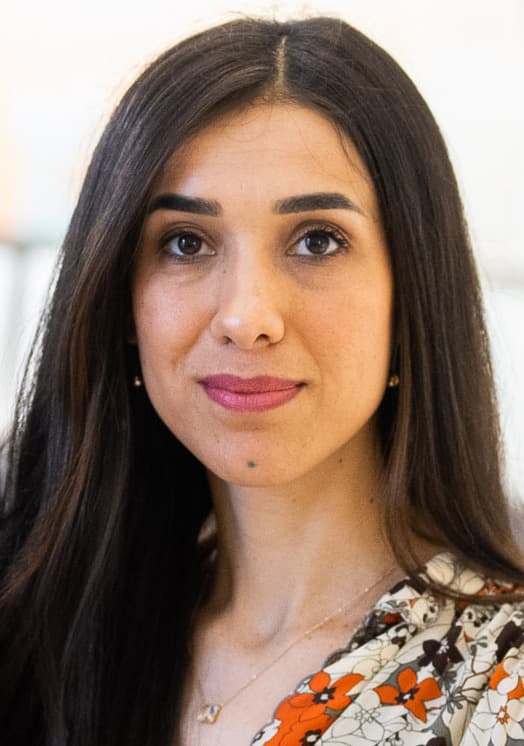
Iraqi, German, Yazidi · Activism · Politics
Nadia Murad
March 10, 1993 – present
Early life and background
Nadia Murad Basee Taha was born on 10 March 1993 in the village of Kojo (Kocho), in the Sinjar region of northern Iraq, a predominantly Yazidi area near the Syrian border.[2][3][4] She grew up in a poor family of farmers and shepherds in a tight-knit rural community.[10][13][15] The Yazidis are an ancient ethno-religious minority whose monotheistic faith incorporates elements of pre-Islamic Mesopotamian, Christian and Islamic traditions, and they have long faced discrimination and periodic persecution in Iraq.[10][15]
Murad has described her childhood as peaceful and sheltered despite the community’s marginalization. She attended local school and helped with farm work.[10][13] As a teenager she dreamt of becoming a history teacher or opening a beauty salon, ambitions reflecting both her interest in education and a desire for economic independence within the constraints of a conservative rural setting.[13][16] Her family placed importance on education for both sons and daughters, though opportunities for higher education were limited in Sinjar.
Growing up, Murad was aware of the Yazidis’ precarious position in Iraqi society, particularly after the 2003 U.S.-led invasion and the rise of extremist groups that branded Yazidis as “devil-worshippers.”[10][15] However, she has noted that until 2014, Kojo had been largely spared the region’s violence. That sense of relative security collapsed when the so-called Islamic State (ISIS/ISIL/Daesh) launched a genocidal campaign against the Yazidis in August 2014.
Genocide, kidnapping, and escape
In early August 2014, ISIS forces attacked Yazidi areas around Mount Sinjar, aiming to eradicate the community through mass killings, forced conversions, and enslavement.[10][3] On 15 August 2014, militants surrounded Kojo, separated men from women and children, and carried out mass executions.[13][15] Hundreds of men and older women were killed, including Murad’s mother and several of her siblings.[1][4][5][10] Young women and girls, including 21‑year‑old Murad, were abducted, subjected to forced marriage, rape, and sexual slavery, and trafficked among ISIS fighters.[5][10]
Murad was taken to Mosul and held as a sex slave, repeatedly beaten, raped, and threatened with death if she refused conversion to ISIS’s interpretation of Islam.[5][10][15] She attempted escape several times and was recaptured and punished.[5] After approximately three months, she was able to flee when a captor left a door unlocked; a neighboring Sunni Muslim family helped her obtain false identity documents and reach the Kurdistan region of Iraq.[5][10] Her escape is generally dated to November 2014, and the BBC notes that she "became an activist… after escaping in November 2014."[5]
In Iraqi Kurdistan she received medical attention and began working with Yazidi organizations documenting ISIS crimes.[10] Through the assistance of the International Organization for Migration and the German government, she was resettled to Germany in 2015 as part of a program to support Yazidi women traumatized by ISIS captivity.[10][15] The program, based in the German state of Baden‑Württemberg, provided specialized psychosocial care and a safe environment, allowing Murad to begin processing her experiences and considering how to speak publicly about them.
Beginning of public activism
Once in Germany, Murad chose to testify publicly about what had happened to her and to her community. In late 2014 and 2015 she gave interviews to journalists and human-rights organizations, describing the massacres in Kojo and the systematic sexual enslavement of Yazidi women and girls.[5][10] Overcoming cultural and social stigma around sexual violence in her community, she insisted that naming the crimes was essential to seeking justice.
In December 2015 she addressed the United Nations Security Council, providing one of the earliest, most detailed survivor accounts of ISIS’s atrocities to that body.[7][10] Her testimony emphasized that the crimes should be recognized as genocide and that sexual violence was not incidental but central to ISIS’s strategy of terror and control. She called for the rescue of remaining captives, the prosecution of perpetrators in international and national courts, and support for survivors’ long‑term recovery.[10]
Murad also testified before national parliaments and at conferences in Europe and North America. Her calm, precise descriptions of extreme violence drew widespread attention to the Yazidi genocide and helped catalyze international efforts to document ISIS crimes. As her profile grew, she faced ongoing security risks and personal costs, but she continued to frame her advocacy as a duty to her community and to victims of sexual violence in other conflicts.[10][11]
Formal roles and institutional advocacy
Murad’s activism quickly moved from individual testimony to institutional engagement. On 16 September 2016, the United Nations Office on Drugs and Crime (UNODC) appointed her as its first Goodwill Ambassador for the Dignity of Survivors of Human Trafficking, a newly created role focused specifically on survivors.[2][10][12] In this capacity she has worked to raise awareness about human trafficking in conflict and post-conflict settings and to promote survivor‑centered approaches in law enforcement and victim support.
Murad has met with heads of state, foreign ministers, and international prosecutors, pressing for recognition of ISIS’s actions against the Yazidis as genocide and for accountability mechanisms to prosecute crimes including sexual slavery, forced conversion, and mass executions.[10][11] She has supported the establishment of UN-mandated investigative mechanisms, such as the United Nations Investigative Team to Promote Accountability for Crimes Committed by Daesh/ISIL (UNITAD), which was created to collect and preserve evidence for future trials.
Her advocacy extends beyond the Yazidi case to broader efforts to reform how the international community responds to conflict‑related sexual violence. She has argued that survivors must be included in designing policies on reparations, transitional justice, and community reconstruction, and she has highlighted the intersection of gender, religion, and ethnic identity in patterns of persecution.[10][11]
Nadia’s Initiative and survivor-led projects
In 2016 Murad founded Nadia’s Initiative, a non-profit organization dedicated to rebuilding communities in crisis and advocating for survivors of sexual violence.[1][10] The organization’s initial focus has been on the Yazidi homeland of Sinjar, particularly Kojo and surrounding villages devastated by ISIS.
Nadia’s Initiative works on two main fronts. First, it undertakes development and reconstruction projects in Sinjar, including rehabilitating infrastructure, schools, health facilities, and agricultural systems, with the aim of creating conditions for displaced Yazidis to return home safely.[10] Second, it engages in global advocacy to promote justice for survivors of genocide and conflict-related sexual violence, lobbying governments and international institutions to recognize these crimes and support survivor-led recovery.
Murad has emphasized that reconstruction is inseparable from justice: rebuilding physical infrastructure without legal accountability risks normalizing impunity. Through Nadia’s Initiative she has sought to build partnerships with states, NGOs, and multilateral organizations, insisting that survivors be treated as active agents rather than passive recipients of aid.[10][11]
In 2019 she co‑founded the Global Survivors Fund together with Denis Mukwege and other partners to support reparations for survivors of conflict-related sexual violence.[1][11] The Fund aims to provide interim reparations and advocate for states and institutions to adopt comprehensive reparations programs, bridging the gap between recognition of harms and concrete support.
Major publications and public voice
Murad’s memoir, The Last Girl: My Story of Captivity, and My Fight Against the Islamic State, was published in English in 2017.[16][13] Co‑written with journalist Jenna Krajeski, the book chronicles her life in Kojo, the 2014 attack, her months in captivity, and her emergence as an activist. It became a New York Times bestseller and has been translated into multiple languages.[16] The memoir provided a detailed, first‑person account that complemented legal and journalistic documentation of ISIS’s crimes.
Through the book and numerous public lectures, Murad has shaped global understanding of the Yazidi genocide and of sexual violence as a weapon of war. She has spoken at universities, including Harvard, where she discussed “the making of an activist” and described how personal trauma, community expectations, and international politics intersect in her work.[14] Her speeches frequently link her own experience to those of survivors in other conflicts, emphasizing shared patterns of gendered and communal violence.
Murad has also used social and traditional media to maintain attention on the plight of Yazidis still missing or displaced, on the slow pace of reconstruction in Sinjar, and on the need for legal accountability. Her public voice balances personal narrative with legal and political analysis, contributing to evolving frameworks for understanding sexual and gender-based violence in international law.
Awards, honors, and recognition
Murad’s advocacy has been recognized by numerous awards that collectively illustrate a shift toward elevating survivor leadership in global human-rights discourse. Beyond acknowledging personal courage, these honors have helped amplify her demands for justice and reconstruction.
Early recognition came from European institutions. On 19 September 2016, the Parliamentary Assembly of the Council of Europe awarded her the Václav Havel Human Rights Prize for her campaign on behalf of Yazidi survivors and calls for accountability for ISIS crimes.[5][7] On 13 December 2016, the European Parliament awarded her and Lamiya Aji Bashar the Sakharov Prize for Freedom of Thought, its highest human‑rights honor, for raising awareness of the Yazidi genocide and sexual violence by ISIS.[4][6][7] Around the same period she received the Peace Prize of the United Nations Association of Spain, recognizing her efforts against human trafficking and genocide.[1]
Also on 13 December 2016, Murad received the Clinton Global Citizen Award for leadership and advocacy on behalf of Yazidi survivors.[4] In 2016 she was included in the TIME 100 list of the world’s most influential people, reflecting the rapid global impact of her testimony and activism.[1][4] She also received the Oxi Courage Award that year for her bravery in sharing her story and campaigning against sexual violence and human trafficking.
In 2018 Murad’s work reached a new level of global recognition. On 25 September 2018, she was honored with the Global Goals Changemaker Award at the UN Global Goals Awards in New York for advancing Sustainable Development Goal targets related to gender equality and justice for survivors.[4] On 26 September 2018, Georgetown University’s Institute for Women, Peace and Security presented her with the Hillary Clinton Award for Advancing Women in Peace and Security.[4]
On 5 October 2018, the Norwegian Nobel Committee announced that Murad and Congolese surgeon Denis Mukwege would jointly receive the Nobel Peace Prize "for their efforts to end the use of sexual violence as a weapon of war and armed conflict."[2][4][5] She became the first Iraqi and the first Yazidi Nobel laureate.[1][2][4][6] On 10 December 2018, she formally received the prize at the ceremony in Oslo and delivered a widely noted Nobel lecture.[2][10][12] In October 2018 Chapman University announced that it would confer an honorary Doctor of Humane Letters and installed a bust of Murad on its campus.[4]
Recognition continued in subsequent years. On 11 April 2019 she received the International DVF Award from the Diller–von Furstenberg Family Foundation, honoring her courage and leadership.[4] On 18 May 2019 the American Academy of Achievement presented her with its Golden Plate Award.[4] On 21 November 2019 she received Germany’s Bambi Award (Medienpreis) for bringing global attention to the Yazidi genocide and sexual violence in war.[4]
On 5 March 2020, Vital Voices Global Partnership honored Murad with its Global Trailblazer Award for her leadership and advocacy against sexual violence and human trafficking.[4] On 18 September 2020, the Sandra Day O’Connor Institute for American Democracy awarded her the Justice O’Connor Award for her global human‑rights work.[4]
In 2022, TIME named Murad one of its Women of the Year, highlighting her mission to protect survivors of sexual violence and to develop accountability mechanisms for genocide.[4] On 2 March 2022 TIME published her profile in the Women of the Year series.[4] In 2024 she was named to the BBC 100 Women list as one of the year’s most influential and inspiring women, recognizing her continued advocacy for sexual‑violence survivors and minority rights.
In March 2026 France awarded Murad the National Order of the Legion of Honor, one of its highest distinctions, for her fight against sexual violence in conflict and her advocacy for Yazidi survivors.[4] This decoration placed her within a long lineage of human-rights defenders and cultural figures recognized by the French state.
Political and legal impact
Murad’s activism has had tangible political and legal consequences. She was a key figure in the international push to recognize ISIS’s actions against the Yazidis as genocide. Several bodies, including the United Nations and national parliaments, have described the attacks on Sinjar and other Yazidi areas in these terms, drawing in part on survivor testimony that Murad helped bring to global attention.[10][11]
Her work contributed to the establishment of mechanisms such as UNITAD, which collects and preserves evidence of ISIS crimes for use in future prosecutions.[10] She has advocated for the use of universal jurisdiction and international criminal law to prosecute ISIS members for crimes against humanity, war crimes, and genocide, emphasizing the inclusion of sexual slavery and rape as central charges rather than secondary abuses.
Murad has also influenced the development of policy frameworks around reparations and survivor support. Through Nadia’s Initiative and the Global Survivors Fund, she has promoted models of reparations that combine financial compensation, access to education and healthcare, psychosocial support, and community rebuilding.[1][11] Her insistence that survivors be involved in designing these programs reflects a broader shift toward participatory justice in transitional contexts.
Her advocacy intersects with the United Nations’ women, peace, and security agenda. She has argued that preventing and responding to conflict-related sexual violence is a core security issue, not simply a humanitarian or women’s issue, and that peace processes must address such violence explicitly.[10][11]
Personal life
Murad has been based primarily in Germany since her resettlement in 2015, living under protection due to security concerns arising from her visibility and from threats by ISIS supporters.[10][12][15] She has obtained German residency and later citizenship while maintaining strong ties to the Yazidi diaspora and to Sinjar.
In 2020 she married Abid Shamdeen, a fellow Yazidi and activist who has worked with Yazda, a global Yazidi organization that has supported documentation and advocacy around the genocide.[4] The couple’s partnership reflects shared commitments to justice for Yazidis and to broader human‑rights work. Public information about her personal life remains limited, in part because of ongoing security and privacy considerations; there is no widely reported information about children as of the mid‑2020s.
Murad has spoken about the psychological burdens of reliving her trauma through repeated testimony and public speeches, and about periods when she considered withdrawing from activism.[10][14] She credits support from other survivors, her family, and allied organizations with enabling her to continue. Her personal narrative emphasizes resilience not as an individual trait but as something sustained by community and collective action.
Legacy and historical impact
Nadia Murad’s historical significance lies in her role as a pioneering survivor‑advocate who has reshaped global understanding of sexual violence in conflict, genocide, and minority persecution. As a young Yazidi woman from a small rural village, she entered international politics not through elite channels but through the articulation of lived experience of extreme violence.
Her testimony and advocacy helped establish the Yazidi case as a paradigmatic example of twenty‑first‑century genocide, demonstrating how armed groups use sexual slavery, forced conversion, and the destruction of cultural and religious sites to attempt the eradication of a community.[10][11] By insisting that sexual violence is central to such campaigns, she has contributed to a reframing of international law and policy around conflict‑related sexual violence as a core component of atrocity crimes.
Murad’s recognition as the first Iraqi and first Yazidi Nobel laureate is symbolically powerful for communities that have long been marginalized in both regional and global politics.[1][2][4][6] Her prominence challenges stereotypes about Middle Eastern women, religious minorities, and survivors of sexual violence, showing that they can be central actors in shaping international norms and institutions.
Her work with Nadia’s Initiative and the Global Survivors Fund models a mode of activism that links testimony to concrete reconstruction and reparations, moving beyond awareness‑raising to structural change. Her emphasis on survivor leadership and participation has influenced a growing movement that places those directly affected by mass atrocities at the forefront of efforts to design justice and recovery mechanisms.[1][10][11]
Within women’s history, Murad stands in a lineage of figures who have forced the international community to confront gendered violence in war—from comfort women of World War II to survivors of conflicts in Bosnia, Rwanda, and the Democratic Republic of Congo. Her contributions have helped secure sexual and gender-based violence as a permanent concern of international law, security policy, and human-rights practice.
Later life and ongoing work
As of the mid‑2020s, Murad continues to lead Nadia’s Initiative and to speak globally about the Yazidi genocide and sexual violence in conflict.[10][11] She has focused increasingly on long‑term reconstruction in Sinjar, advocating for de‑mining, infrastructure repair, schools, and hospitals, as well as legal reforms in Iraq to recognize and support survivors of ISIS crimes.[10]
She remains engaged with international institutions, participating in conferences on atrocity prevention, women, peace, and security, and transitional justice. At events such as her 2019 visit to Harvard University, she has reflected publicly on the personal costs of activism and on the need to prepare younger survivors and community members to assume leadership roles.[14]
While security conditions in Sinjar and political tensions in Iraq and the wider region continue to complicate returns for many Yazidi displaced persons, Murad has maintained that reconstruction and justice for Yazidis are essential tests of the international community’s commitment to preventing future genocides. Her life story—from a village in northern Iraq to the Nobel stage in Oslo and honors across Europe and North America—embodies both the vulnerability of marginalized communities to extreme violence and the capacity of survivors to drive global change.
Murad remains a central figure in debates over how to address the legacies of ISIS, the rights of survivors of sexual violence, and the place of religious and ethnic minorities in the Middle East. Her ongoing work suggests that her historical impact will continue to evolve as efforts to secure justice and rebuild Yazidi life in Sinjar unfold.
Dated achievements
20 indexed.
- Mar101993Activism
Birth of Nadia Murad in Kojo, Iraq
Birth of Nadia Murad in Kojo, Iraq, into a Yazidi farming family in the Sinjar region.
View details Nadia Murad – Facts | NobelPrize.org - Nov012014Activism
Escape from ISIS captivity and start of public activism
After escaping ISIS captivity around November 2014, Nadia Murad begins publicly advocating for Yazidi survivors.