← All women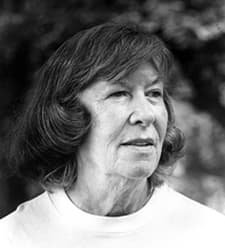
American · Literature · Arts
Mona Van Duyn
May 9, 1921 – December 2, 2004
Early Life and Background
Mona Jane Van Duyn was born on May 9, 1921, in Waterloo, Iowa, the daughter of Earl George Van Duyn, a businessman, and Lora (Kramer) Van Duyn.[7][9] Shortly after her birth the family moved to Eldora, a small town that would serve as the backdrop for her formative years.[3][7] Van Duyn later recalled "cleaning out" the local library in her zeal to read, a habit that laid the foundation for her lifelong engagement with literature.[3]
Despite her intense love of books, her family had little interest in poetry, and her literary ambitions met with limited encouragement at home.[5][6] Growing up in the rural Midwest during the Great Depression, Van Duyn developed an awareness of ordinary people’s struggles and routines that would later inform her characteristic focus on middle‑class American life. Her early reading included both popular fiction and canonical works, giving her a broad sense of literary possibility.[5]
Van Duyn attended Iowa State Teachers College (now the University of Northern Iowa), where she earned a B.A. in English in 1942.[3][7][10] She then continued her studies at the University of Iowa, receiving an M.A. in English in 1943.[7][9][10] At Iowa she encountered a vibrant literary environment and began to take her own writing more seriously, experimenting with poetic forms and deepening her understanding of literary criticism.
Marriage, Education, and Early Career
While at the University of Iowa, Van Duyn met Jarvis A. Thurston, a fellow student and future professor of English. The two married on August 31, 1943
After completing her degrees, Van Duyn taught at several institutions, including schools in the Midwest and later Washington University in St. Louis.[3][4][9] She and Thurston moved to St. Louis around 1950, and the city became their long‑term home.[2][3][4] At Washington University she taught creative writing and literature, influencing generations of students while continuing to develop her own work. Her teaching career was characterized by a seriousness about craft and an insistence that poetry should attend closely to both emotional and intellectual life.[5][6] In 1947 Van Duyn and Thurston co‑founded Perspective, a Quarterly of Literature, a literary journal based in St. Louis.[1][3][4] Van Duyn co‑edited Perspective until the mid‑1970s, helping to bring significant contemporary writing to a wider audience.[1][4] The journal published poetry, fiction, and criticism and played a notable role in the regional and national literary community. Through this editorial work, Van Duyn honed her critical sensibilities and engaged deeply with the work of other writers, which in turn informed her own poems. Van Duyn’s first collection, Valentines to the Wide World, appeared in 1959 through Cummington Publishing.[1][4] The book established many of the themes that would recur throughout her career: the tensions within marriage, the complexity of family relationships, and the interplay between private life and public events. Written in carefully structured forms, the poems combined wit, emotional depth, and an observational stance toward everyday experience. Her second major collection, A Time of Bees, was published in 1964 as part of the University of North Carolina Press’s Contemporary Poetry Series.[1][4][10] The volume continued her exploration of domestic life and community while deepening her engagement with philosophical questions. Critics noted her ability to balance formal control with a conversational tone, rendering complex ideas in accessible language. Throughout the 1960s and 1970s, Van Duyn produced a series of important books. To See, To Take was published in 1970 and would later win the National Book Award for Poetry.[2][4] It included many of her best‑known poems and solidified her reputation as a major American poet. In Bedtime Stories (1972) and Merciful Disguises (1973; reissued 1982), she continued to probe the ironies and difficulties of family life, often using narrative and dramatic monologue to explore the inner worlds of her characters.[2][4] Her later collection Letters from a Father, and Other Poems (1982) further expanded her range, including poems that addressed aging, memory, and intergenerational relationships.[4] The title poem, in particular, became widely discussed for its moving treatment of a father’s late‑life reflections and the daughter’s response, showcasing Van Duyn’s capacity to integrate emotional intimacy with structural elegance. In 1990 she published Near Changes, the book that would earn her the Pulitzer Prize for Poetry.[2][4] This collection surveys the transformations associated with later life—physical change, shifting relationships, and evolving self‑understanding—while maintaining the sharp wit and formal discipline that had long characterized her work. Later volumes include Firefall (1993/1994) and If It Be Not I: Collected Poems, 1959–1982 (1994), which gathered and revisited many of her earlier achievements.[4] Critics have often described Van Duyn as a formalist, noting her frequent use of rhyme, meter, and traditional structures.[5][10] At the same time, her diction and scenarios are distinctly contemporary, drawing on suburban settings, modern psychology, and the complexities of middle‑class American existence. She herself defended regular verse "not just [as] style but lifestyle," suggesting that form was both aesthetic choice and ethical stance.[10] Van Duyn’s work attracted significant recognition from mid‑century onward. In 1956 she received the Eunice Tietjens Memorial Prize from Poetry magazine for her sequence "Three Valentines to the Wide World," an early national honor that helped build her reputation beyond regional circles.[1][9] She gained further acclaim with the Helen Bullis Prize from Poetry Northwest in 1964.[9] In the late 1960s she received a cluster of major magazine and anthology awards: the Harriet Monroe Memorial Prize from Poetry (1968), the Hart Crane Memorial Award from American Weave Press (1968), and first prize in the Borestone Mountain Poetry Awards (1968).[1][4][9] These honors reflected the broad admiration for her poems among editors and critics. A landmark in her career came in 1966, when she was selected as one of the first five poets to receive a literature grant from the newly created National Endowment for the Arts (NEA).[5][9] This early federal support for poetry not only aided her work materially but also signaled a new institutional recognition of the art form. In 1970 Van Duyn received the Bollingen Prize in Poetry from the Yale University Library, joining a distinguished list of recipients.[3][4] The following year, on March 10, 1971, she was presented the National Book Award for Poetry for To See, To Take, cementing her status as a leading American poet.[2][3] She was awarded a Guggenheim Fellowship in poetry in 1972, enabling her to focus more intensively on writing.[5][9] Additional recognition followed: the Loines Prize from the National Institute of Arts and Letters (1976), a fellowship from the Academy of American Poets (1981), and the Carl Sandburg Prize from Cornell College (1982).[1][3][9] In 1985 she was elected a Chancellor of the Academy of American Poets, a role that placed her within the governing leadership of a major national poetry organization.[1][4] In 1987 Van Duyn received the Shelley Memorial Award from the Poetry Society of America.[1][9] Two years later, in 1989, she was honored with the Ruth Lilly Poetry Prize, one of the largest monetary awards for a U.S. poet, granted for extraordinary lifetime achievement.[1][2][9] In 1990 she received the Missouri Arts Award, recognizing her contributions to the state’s cultural life.[9] Her most celebrated honor came on April 18, 1991, when she won the Pulitzer Prize for Poetry for Near Changes.[2][5] The Pulitzer confirmed her canonical status and broadened her readership. In the early 1990s she also received the Golden Plate Award from the American Academy of Achievement and was inducted into the St. Louis Walk of Fame, underscoring both national and regional recognition.[1][3] The culmination of Van Duyn’s public career came with her appointment as Poet Laureate Consultant in Poetry to the Library of Congress. On June 24, 1992, Librarian of Congress James H. Billington announced her selection, making her the first woman to hold the modern title of U.S. Poet Laureate Consultant in Poetry.[2][3][11] She served during the 1992–1993 season, beginning her formal term in September 1992.[2][3] As Poet Laureate, Van Duyn organized readings and events at the Library of Congress, inviting a range of poets to present their work and fostering a broader public engagement with poetry.[5][11] She was particularly interested in promoting accessibility, aiming to reach readers beyond specialized academic or literary circles. Her tenure emphasized the idea that poetry could speak to ordinary experiences and concerns—a reflection of her own thematic preoccupations. Her appointment marked a significant moment in women’s cultural history. Although the earlier position of "Consultant in Poetry" had existed since 1937, women had not previously held the updated "Poet Laureate Consultant" title.[11] Van Duyn’s service helped normalize the presence of women in prestigious national literary offices and contributed to the eventual appointment of other women Poets Laureate. Van Duyn’s marriage to Jarvis Thurston was both personally and professionally influential. Thurston, an eminent scholar and critic, taught at Washington University and shared Van Duyn’s commitment to literature.[3][4][9] Together they cultivated a household intensely focused on reading, writing, and intellectual conversation, an environment that nurtured Van Duyn’s creativity. Though detailed information about children is less emphasized in standard biographical sources, her poetry often reflects family relationships, suggesting a deep engagement with intergenerational ties and domestic roles.[2][5][6] Van Duyn’s work frequently portrays women negotiating the demands of marriage, motherhood, and professional life, and these experiences are rendered with both humor and seriousness. Her long residence in the St. Louis area fostered strong connections to local cultural institutions. She participated in readings, seminars, and literary events, and her presence helped shape the city’s identity as a center for contemporary poetry.[3][4] Friends and colleagues have remarked on her combination of intellectual rigor and personal warmth, qualities that made her both a demanding and supportive mentor. Van Duyn’s poetry is noted for its formal discipline and engagement with everyday life. She often employed regular rhyme and meter, even as many contemporaries turned toward free verse.[4][5][10] This choice was not nostalgic but strategic: she used traditional forms to frame modern experiences, preventing sentimentality and enabling complex patterns of irony and reflection. Common themes in her work include marriage, family, aging, community, and the moral significance of seemingly minor interactions.[5][6] She frequently portrays middle‑class American life—suburban houses, local institutions, domestic routines—with a keen eye for detail and an awareness of underlying tensions. Her poems examine the contradictions between self‑image and behavior, love and resentment, stability and change. Van Duyn’s tone often combines humor with gravity. She can be sharply satirical, exposing pretension or self‑deception, but her work also exhibits compassion for human frailty. Critics have praised her ability to balance these modes, producing poems that are simultaneously intellectually demanding and emotionally resonant.[2][5][6] Her work also engages with broader historical and cultural forces, including the impact of war, social change, and shifting gender roles. By filtering these subjects through the lens of domestic and relational life, she offers an alternative perspective on major 20th‑century developments, one grounded in the experiences of women and families rather than exclusively public institutions. Van Duyn’s legacy rests on both her literary achievements and her institutional influence. As a poet, she demonstrated that formally crafted verse could remain vital in a late‑20th‑century context, and she helped legitimize themes of domesticity and middle‑class life as worthy of serious poetic exploration.[2][5][6] Her major books, particularly To See, To Take and Near Changes, continue to be studied for their craft and insight. Institutionally, her role as co‑editor of Perspective, Chancellor of the Academy of American Poets, and U.S. Poet Laureate enabled her to shape literary culture beyond her own writing.[1][3][4][11] She influenced editorial decisions, mentorship networks, and public programming in ways that broadened opportunities for other writers, including women. Her appointment as the first woman U.S. Poet Laureate Consultant in Poetry in 1992 stands as a key milestone in women’s cultural history.[2][11] It signaled a shift in the gender dynamics of high‑profile literary offices and helped pave the way for subsequent women laureates. Combined with her Pulitzer and other major awards, this achievement positioned her as a model for women poets seeking both artistic excellence and institutional recognition. Scholars and critics continue to analyze Van Duyn’s work for its subtle treatment of moral and philosophical questions, its innovations in narrative and dramatic monologue, and its representation of women’s lives within mid‑ and late‑20th‑century America.[5][6] Her poems contribute to ongoing discussions about the relationship between form and ethics, and between private life and public language. In her later years, Van Duyn remained active in writing and literary life, even as she faced health challenges. She continued to live in the St. Louis area, teaching intermittently and participating in readings and events.[3][4] She published Firefall and her collected poems, consolidating her body of work for new generations of readers.[4] On December 2, 2004, Van Duyn died of bone cancer at age 83 at her home in University City/Ladue, a suburb of St. Louis.[3][8][9] Obituaries in major newspapers, including the Los Angeles Times, emphasized that she had received every major U.S. poetry prize and highlighted her status as the first woman Poet Laureate of the United States.[3][13] Her death marked the end of a career that had significantly reshaped expectations about who and what American poetry could represent. Since her passing, her work has remained in print through collected editions, and academic studies have continued to engage with her contributions to form, theme, and literary institutions. Van Duyn is widely regarded as one of the most important American poets of the late 20th century, and her career serves as a testament to the possibilities open to women who pursue poetry with sustained seriousness and craft.Major Works and Poetic Development
Awards, Honors, and Recognition
Poet Laureate and National Influence
Personal Life
Poetic Themes and Style
Legacy and Historical Impact
Later Life and Death
Dated achievements
20 indexed.
- May091921Literature
Birth of Mona Van Duyn in Waterloo, Iowa
Mona Jane Van Duyn is born in Waterloo, Iowa, on May 9, 1921, beginning the life of a future Pulitzer Prize–winning poet and first woman U.S. Poet Laureate.
View details Encyclopedia.com – Van Duyn, Mona 1921–2004 - Jan011956