← All women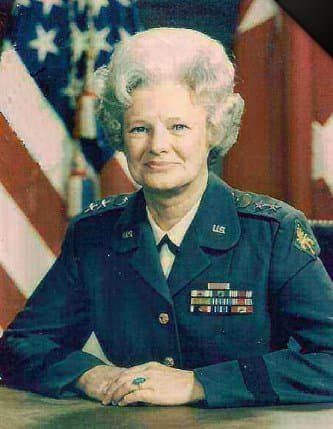
American · Politics
Mary E. Clarke
December 3, 1924 – June 10, 2011
Early life and education
Mary Elizabeth “Betty” Clarke was born on December 3, 1924, in Rochester, New York. She grew up in an era when American women were still expected to pursue limited public roles, yet her later life would demonstrate an unusual capacity for leadership in one of the nation’s most hierarchical institutions. Sources identify her as Mary Elizabeth Clarke and note that she was raised in Rochester and educated there before entering the workforce as a secretary and defense worker. Those early jobs reflected the practical opportunities available to many young women in the 1930s and 1940s, especially as the United States mobilized for war.
Available biographical accounts identify Rochester West High School as part of her education. After graduation, she worked first as a secretary and then as a defense worker. This combination of clerical and wartime industrial experience preceded the turning point of her military career: enlistment in the Women’s Army Corps in 1945. Her background was not unusual for the era, but her response to the opportunities and constraints of that era was exceptional. She entered military service at a moment when women’s contributions were expanding, but still tightly defined by gendered assumptions about support roles rather than command.
Entry into military service
Clarke enlisted in the Women’s Army Corps in August 1945, just as World War II was ending. The WAC had been created to expand women’s military participation, and Clarke’s enlistment placed her inside one of the principal channels through which American women served the war effort. Although sources do not provide a precise day for her enlistment, the month is well documented, and the timing is significant: she joined at a moment when the Army was reconsidering how women fit into postwar military life.
Her early Army career quickly moved beyond the entry level. After basic training, she was sent to Berlin in 1948 and served with the Berlin Brigade during the Berlin Airlift crisis, a formative experience that placed her in one of the Cold War’s most intense early confrontations. By 1949 she had completed WAC Officer Candidate School and was commissioned as a second lieutenant. That transition from enlisted soldier to officer was an important step in her advancement, reflecting both her ability and the Army’s need for trained women leaders.
Rise through the Women’s Army Corps
After her commission, Clarke served in Tokyo as a commanding officer of a WAC unit and later held a variety of positions in several states and in Washington, D.C. Her assignments included work with the Office of Equal Opportunity and service at the Pentagon. These postings indicate that she became a trusted staff officer as well as a leader of soldiers. She built her career in a period when the Army was slowly changing, but when women still faced major structural barriers to advancement. Her success depended not only on competence, but also on persistence in a system that had few models for women in senior posts.
In 1972, as a colonel, Clarke was assigned as commander of the U.S. WAC Center and School at Fort McClellan, Alabama. This position placed her at the center of women’s Army training. In 1975, she became the final Director of the Women’s Army Corps. That directorship carried special historical weight because the WAC was approaching dissolution as the Army moved toward greater integration of women into the regular force. Clarke’s role at the end of the WAC era made her a transitional figure: she represented the institution’s highest level of leadership just as the institution itself was being absorbed into a new Army structure.
Historic promotions and command
Clarke’s most widely remembered achievement came in November 1978, when she was promoted to major general, becoming the first woman in U.S. Army history to attain that rank. This was a landmark for women’s military leadership in the United States. General officer rank had long been a symbol of exclusive male authority in the Army, and Clarke’s promotion broke that barrier in a highly visible way. Her elevation recognized decades of service and also established a precedent for future generations of women officers.
Also in 1978, Clarke became the first woman to command a major U.S. Army installation and to serve as commandant of the U.S. Army Military Police School and U.S. Army Chemical School at Fort McClellan. This assignment was more than symbolic. It placed her in charge of major training institutions and a substantial military community, demonstrating that women could be entrusted with broad operational command, not merely specialist or support roles. Her appointment was part of the Army’s gradual adaptation to changing views on gender and leadership in the late 20th century.
The Army’s and the public’s recognition of Clarke extended beyond these firsts. In 1978, Norwich University awarded her an honorary doctorate in military science. After retiring from active duty, she remained involved in military affairs, including service on advisory bodies focused on women in the services. These appointments show that her expertise continued to be valued after she left command.
Retirement and later service
Clarke retired from the U.S. Army in October 1981 after 36 years of service. At the time, this was the longest recorded Army career by a woman. Her retirement marked the close of a career that had stretched from the final months of World War II through the Cold War and into the period of Army integration. She had moved from enlisted service to officer status, from unit command to major institutional leadership, and from the WAC to the Army’s senior command structure.
Even after retirement, Clarke continued to be associated with military and advisory work. Sources note her participation on the Women in the Services Defense Advisory Committee and other later advisory roles. These post-retirement activities suggest that her knowledge and experience remained relevant to the evolving place of women in the armed forces. Her service thus extended beyond formal active duty into the realm of policy influence and institutional memory.
Personal life
Publicly available biographical sources emphasize Clarke’s professional life rather than her private one. The accessible records consulted here do not provide a detailed account of marriage or children, and no reliable evidence has been included here beyond what can be verified in those sources. That absence is itself historically revealing: the documentary record has often centered military accomplishment over the domestic details of women’s lives, especially when those women served in male-dominated institutions.
Legacy and historical impact
Mary E. Clarke is remembered as one of the most important pioneers in the history of women in the U.S. Army. Her significance rests on a set of connected achievements: she was the first woman to reach the rank of major general, the first woman to command a major Army installation, and the last director of the Women’s Army Corps. Each of those milestones marked a different kind of institutional barrier being crossed or closed.
Her career mattered not only because she was first, but because she demonstrated competence across multiple kinds of Army service: enlistment, officer training, overseas duty, staff work, training command, and installation leadership. In an era when women had to prove themselves repeatedly in order to advance, Clarke did exactly that. Her service helped broaden the Army’s understanding of women’s capabilities and offered a precedent for future women officers seeking command opportunities.
Clarke died on June 10, 2011, in San Antonio, Texas, and was buried at Fort Sam Houston National Cemetery. Her death prompted continued recognition of a woman whose career had been intertwined with the transformation of the modern Army. For women’s history, her life stands as a durable example of how individual achievement can alter institutions: by occupying roles once thought inaccessible, Clarke helped make those roles more imaginable for the women who followed.
Dated achievements
10 indexed.
- Dec031924Politics
Birth of Mary E. Clarke
Mary E. Clarke, future Army pioneer and first woman major general, is born in Rochester, New York.
View details Mary E. Clarke - Wikipedia - Aug011945Politics
Enlistment in the Women’s Army Corps
Clarke enlists in the Women’s Army Corps during World War II, beginning a 36-year Army career.