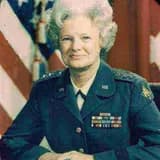
Clarke serves as the last Director of the Women’s Army Corps before its dissolution.
In 1975, Mary E. Clarke became the final Director of the Women’s Army Corps. Sources identify the year but not the exact date, so this entry is recorded as a year-level marker.
Her directorship was important because it came at the end of an era. The Women’s Army Corps, created during World War II, had long served as the separate institutional framework for women in the Army. By the mid-1970s, however, the Army was moving toward fuller integration, and Clarke’s role placed her at the center of that transition. As the last director, she oversaw the closing chapter of a structure that had simultaneously enabled women’s service and limited women’s advancement.
Clarke’s leadership during this period required balancing advocacy for women soldiers with the practical realities of Army reorganization. She had to work within a system that still treated women’s service as distinct, even as policy changes increasingly pointed toward integration. The significance of her directorship lies not only in the title itself, but in the fact that she became the final person to hold that office before the WAC was dissolved. In historical terms, Clarke’s tenure symbolizes both continuity and change: she helped guide women’s service through the end of a segregated framework and toward a more integrated future in the Army.