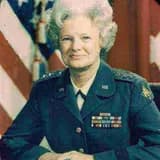
Clarke becomes the first woman to command a major Army installation and lead the Military Police and Chemical Schools.
Also in 1978, Mary E. Clarke became the first woman to command a major U.S. Army installation and to serve as commandant of the U.S. Army Military Police School and U.S. Army Chemical School at Fort McClellan, Alabama. The sources do not provide a precise month and day, so this event is recorded as a year-level marker.
Clarke’s assignment was historically significant because it paired her promotion with real operational command. Commanding a major installation meant overseeing a substantial military community and a broad set of training and support functions. It was not a symbolic office: it required authority over personnel, facilities, training, and institutional standards. That a woman was selected for such a post in 1978 reflected both Clarke’s own record and the Army’s growing, if still incomplete, openness to women in top leadership.
The dual command also mattered because the Military Police School and Chemical School were key Army training institutions. Being commandant of both placed Clarke in a role of direct influence over doctrine, instruction, and professional development. Her leadership helped normalize the presence of women in the highest echelons of Army administration and command. In the broader history of women’s military advancement, this was one of the clearest demonstrations that women could lead beyond women’s units and into mainstream Army institutions.