← All women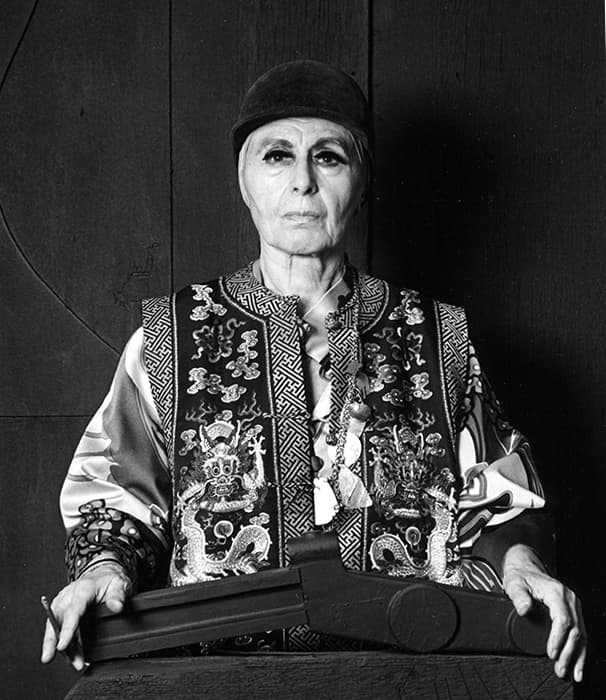
American · Arts
Louise Nevelson
September 23, 1899 – April 17, 1988
Early Life and Background
Louise Nevelson was born Leah Berliawsky on September 23, 1899, in Pereiaslav near Kyiv, in the Poltava Governorate of the Russian Empire, in a Jewish family that would later join the massive wave of Eastern European migration to the United States.[2][4][9] Her early childhood was marked by economic hardship and increasing antisemitic pressures, factors that contributed to her family’s decision to emigrate.
In 1905, when Nevelson was a young girl, the Berliawsky family immigrated to the United States and settled in Rockland, Maine, where her father operated a lumberyard.[1][2][5] Growing up among piles of timber and wooden offcuts, Nevelson began to play with scraps from the yard, an experience she later credited as foundational to her sculptural imagination.[1] According to accounts from the National Museum of Women in the Arts, she declared her intention to become a professional sculptor by around the age of ten, well before such a path seemed realistic for an immigrant girl in small-town Maine.[1]
Nevelson’s schooling in Rockland was conventional, but her artistic ambitions were not. She developed a strong sense of independence and visual curiosity, gravitating toward theater and visual culture. The cultural isolation of Maine, combined with her status as a Jewish immigrant, made the prospect of an artistic career appear distant. Yet these conditions also pushed her to imagine other lives beyond the town, setting the stage for her eventual relocation to New York City, then emerging as a global cultural center.
Move to New York and Early Career
In 1920, Nevelson married Charles Nevelson, a wealthy ship owner from a prominent Rockland family.[1][5] The marriage gave her financial stability but also placed her within a conservative social milieu that did not fully support her artistic ambitions. That same year, she moved with her husband to New York City, a move that would prove decisive for her life and work.[1][12]
In New York, Nevelson initially studied drama, reflecting her interest in performance and theatrical spaces, which later influenced the staging of her sculptural environments.[12] By the late 1920s she had turned decisively toward visual art. Around 1928–1929, she enrolled at the Art Students League of New York, where she studied under Kenneth Hayes Miller and other instructors, deepening her understanding of modern art.[5][12] These years were formative: she encountered Cubism, modern European painting, and the New York art scene, although her husband and his family reportedly disapproved of her artistic pursuits.[5]
The tension between her domestic role and creative ambitions contributed to the eventual separation of the marriage. After the couple had one son, Myron (Mike) Nevelson, born in the early 1920s, the relationship deteriorated; they separated in the early 1930s and divorced in 1941.[1] Nevelson’s decision to pursue art in spite of familial and social pressures became an important part of her later public identity as a fiercely independent woman artist.
European Study and Artistic Development
In 1931, Nevelson traveled to Europe and studied briefly with the influential abstract painter Hans Hofmann in Munich.[2][5][12][13] Hofmann’s teaching emphasized modernist principles, including Cubist structure and expressive color, and he also encouraged collage and experimental composition. These ideas significantly affected Nevelson’s evolving practice.
Nevelson returned to New York in the early 1930s, where she continued to study with Hofmann at his New York school.[12][13] Through Hofmann, she deepened her engagement with Cubism and collage techniques and became more attuned to European modernism.[1] Around this time, she also worked for a period as an assistant to the famed Mexican muralist Diego Rivera on a mural project, gaining firsthand experience with large-scale public art and the logistics of working on monumental surfaces.[1][5]
To support herself and her son, Nevelson took on a variety of jobs, including teaching art. In the late 1930s, she taught at the Education Alliance School of Art in New York and participated in the Works Progress Administration (WPA), a New Deal program that employed artists to create public works during the Great Depression.[1][14] This environment exposed her to a community of artists working in socially engaged and experimental modes, while also giving her crucial financial support.
First Exhibitions and Transition to Sculpture
During the 1930s, Nevelson produced paintings, drawings, and smaller sculptures, gradually moving toward the assemblage-based practice for which she would become known. Her first major breakthrough came in 1941, when she boldly approached the director of the Nierendorf Gallery in New York and demanded an exhibition.[14] Impressed by her work, the gallery granted her a solo show, followed by several more exhibitions.[14][10] This marked her emergence on the New York art scene as a serious sculptor, although critical and commercial success were not immediate.
Throughout the 1940s and early 1950s, Nevelson continued to experiment with materials and formats. She was drawn to found objects, especially pieces of wood collected from the streets, construction sites, and demolished buildings in New York.[14][1] These materials resonated with her childhood experiences in the lumberyard and with her interest in resurrecting discarded fragments into new, unified forms. Her development was gradual and largely self-directed, characterized by long periods of work with limited external recognition.
Monochromatic Assemblages and Major Works
Nevelson’s signature style began to crystallize in the mid-1950s. By 1955, she had created major early assemblages such as "Black Majesty", a large, monochromatic wooden wall sculpture constructed from scavenged wood.[6][10] In 1956, the Whitney Museum of American Art acquired Black Majesty, giving Nevelson a significant early institutional endorsement.[6][10] The acquisition signaled that major museums were recognizing the importance of her unconventional sculptural language.
Her work often consisted of wooden boxes and compartments filled with a variety of shapes—spindles, chair legs, molding, and other architectural fragments—arranged into dense, rhythmic compositions. She typically painted these assemblages a single color, most famously black, but also white and gold, to unify the elements and emphasize form and shadow rather than material diversity.[1][11] These monochromatic walls took on a monumental scale and were frequently installed as environmental ensembles.
Institutional recognition continued to build. In 1957, the Brooklyn Museum acquired her work "First Personage", further cementing her presence in major New York collections.[6][2][10] In 1958, the Museum of Modern Art (MoMA) acquired "Sky Cathedral", one of her best-known large assemblages, bringing her work into MoMA’s permanent collection.[6][10][11] Sky Cathedral exemplified her mature style: a vast, black wooden wall composed of stacked boxes filled with found forms, creating an architectural and spiritual presence that blurred the line between sculpture and environment.
Nevelson’s reputation expanded internationally with her participation in MoMA’s landmark exhibition "16 Americans" in 1959, where her group of sculptures titled "Dawn’s Wedding Feast" was included.[15] The exhibition introduced a wider public to her work and positioned her alongside other major figures of postwar American art. By the late 1950s and early 1960s, she was widely regarded as an Abstract Expressionist sculptor, though her work differed markedly from the gestural painting associated with that movement.[15][4]
Sidney Janis Gallery and Framing as a Major Abstract Expressionist
A central institutional milestone occurred in 1962 when Nevelson joined the Sidney Janis Gallery in New York, a leading gallery for postwar American and European art.[12][2] She became the gallery’s first sculptor and its first female Abstract Expressionist, a barrier-breaking achievement in a roster dominated by male painters.[12] This affiliation significantly raised her profile in the commercial and critical art worlds.
Through Sidney Janis, Nevelson’s works were placed in conversation with those of major contemporaries, and her large-scale assemblages were increasingly seen as central to the evolution of abstract and environmental art. The gallery’s support also facilitated further museum acquisitions and major commissions, reinforcing her status as one of the leading sculptors of the twentieth century.[12]
Public Commissions and Environmental Sculpture
From the 1960s onward, Nevelson undertook a series of major public commissions that extended her practice into outdoor and civic spaces. Around 1967, her sculpture "Black Sun" was installed in what is now the Seattle Art Museum’s Olympic Sculpture Park, demonstrating her ability to translate her boxed assemblage language into large, outdoor work.[9][11] Over subsequent decades, she produced numerous public pieces that interacted with architecture and urban environments.
In the 1970s, Nevelson created Louise Nevelson Plaza in New York’s Financial District, an outdoor environment incorporating several monumental sculptures.[5][9][11] Though specific installation dates for its component works are not easily documented by day and month, the plaza became one of the earliest public spaces in New York named for and dominated by the sculptures of a woman artist. Other commissions placed her works in cities across the United States and abroad, reinforcing her role as a major figure in the development of site-specific and environmental art.
Awards, Honors, and Institutional Recognition
By the late 1960s and 1970s, Nevelson’s achievements were recognized through numerous awards and honors. In 1969, she was elected to the American Academy of Arts and Letters, one of the United States’ most prestigious arts institutions.[2] This election placed her among a select group of artists and writers whose work is considered foundational to American culture.
In 1976, the City of New York awarded her the Mayor’s Award for Contributions to the Cultural Life of the City, acknowledging the profound impact of her work on New York’s artistic landscape.[2] Nevelson’s sculptures and installations had become integral to the city’s cultural identity, and this municipal recognition affirmed her significance as a builder of New York’s visual environment.
The following year, 1977, she received the Edward MacDowell Medal for Outstanding Lifetime Contribution to the Arts, a prestigious accolade recognizing her overall impact on the arts across her career.[2] In 1978, she was honored with the Skowhegan Medal for Sculpture, signaling her central role in the development of contemporary sculptural practice.[2]
In 1979, the American Institute of Architects (AIA) awarded Nevelson a Medal for Sculpture, acknowledging the architectural scale and spatial ambition of her works.[2] This recognition by a major professional architecture organization underscored the extent to which her sculptures functioned as environmental and architectural structures, not merely discrete objects.
Her highest official honor came in 1985, when President Ronald Reagan presented her with the National Medal of Arts, the United States government’s top award for artists.[2][8] The medal formally recognized her pioneering role in twentieth-century sculpture and affirmed that her assemblage-based, monochromatic environments were central to American artistic heritage.
Personal Life and Identity
Nevelson’s personal life was complex and often intertwined with her artistic identity. Her marriage to Charles Nevelson provided initial material support but constrained her creative pursuits; their eventual separation in the early 1930s and divorce in 1941 freed her to commit fully to her art.[1][5] She raised her son, Mike, while juggling teaching and other forms of employment, and she often faced economic insecurity.
As an adult, Nevelson cultivated a striking public persona. She was known for her dramatic clothing, layered jewelry, and turbans, projecting an image consistent with the theatricality of her work.[4][11] This self-fashioning can be understood as both a strategy for asserting presence in a male-dominated art world and an extension of her interest in assemblage—she assembled herself as carefully as she assembled her sculptures.
Her identity as a Jewish immigrant woman shaped her experiences and perspectives. Some scholars and critics have linked the dense, enclosed spaces of her assemblages to themes of memory, diaspora, and the construction of personal and cultural worlds from fragments.[6][14] Nevelson herself emphasized intuition and spiritual resonance, often describing her works as cathedrals, altars, or wedding feasts, suggesting a symbolic dimension beyond formal abstraction.
Legacy and Historical Impact
Louise Nevelson is widely regarded as one of the most original sculptors of the twentieth century, particularly noted for her monumental assemblages made of found wooden objects painted in monochrome.[4][7][11] Her work helped pioneer installation art and site-specific environments, setting precedents for later generations of artists who treat space itself as a medium.[12]
Her legacy is especially significant within women’s art history. At a time when sculpture and Abstract Expressionism were overwhelmingly male fields, Nevelson asserted herself through scale, ambition, and a distinctive visual language. She became a key figure in feminist art discourse, frequently cited as an example of how women could claim monumental space and institutional recognition in the visual arts.[6][14][1]
Major institutions continue to hold and exhibit her work, including the Museum of Modern Art, the Whitney Museum, the Brooklyn Museum, and numerous museums across the United States and Europe.[4][14] The Louise Nevelson Foundation and galleries such as Pace Gallery maintain archives and promote scholarship on her life and work, ensuring ongoing critical engagement with her contributions.[2][12]
Artists and scholars have highlighted the way Nevelson transformed discarded materials into unified, spiritual environments, reading her practice as a metaphor for constructing identity from fragments and for the capacity of marginalized individuals—immigrants, women—to reshape cultural landscapes.[6][16] Her influence can be seen in contemporary installation art, assemblage, and feminist practices that challenge traditional hierarchies of materials and subject matter.
Later Life and Death
In her later years, Nevelson remained active in the studio and continued to receive commissions and honors. She lived and worked primarily in New York City, maintaining her reputation as a central figure in the city’s art world. Accounts from museums and biographies describe her as tirelessly committed to her practice, often working on multiple large-scale projects simultaneously.[4][11]
Louise Nevelson died on April 17, 1988, in New York City.[2][3][4] She was 88 years old. By the time of her death, her position as a leading sculptor had been firmly established, and her works had entered major collections worldwide. Her passing marked the transition of her oeuvre from contemporary practice to historical legacy, prompting further reassessment of her role in modern and feminist art histories.
Today, Nevelson’s sculptures remain fixtures in museums, public plazas, and academic discussions. Her life story—beginning in a small Ukrainian town, passing through immigrant childhood in Maine, and culminating in international recognition in New York—continues to resonate as a powerful narrative of artistic determination, innovation, and the reshaping of cultural spaces by a woman who refused to accept the limitations imposed upon her.
Dated achievements
9 indexed.
- Sep231899Science
Birth of Louise Nevelson
Louise Berliawsky was born in Kiev, then part of the Russian Empire (now Ukraine), on September 23, 1899.
View details Louise Nevelson - Wikipedia - Jan011962Science
First sculptor and first female Abstract Expressionist represented by Sidney Janis Gallery
Nevelson joined Sidney Janis Gallery in 1962 as its first sculptor and first female Abstract Expressionist artist.