← All women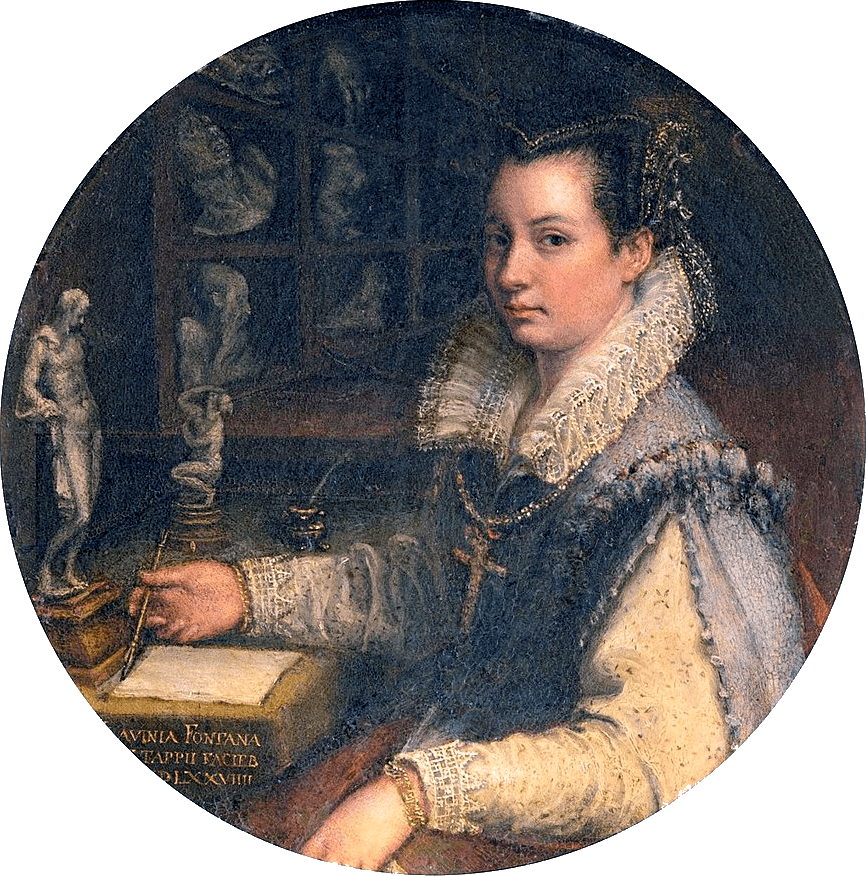
Italian · Arts
Lavinia Fontana
August 24, 1552 – August 11, 1614
Early Life and Background
Lavinia Fontana (24 August 1552 – 11 August 1614) was an Italian Mannerist painter whose career in Bologna and Rome made her one of the earliest documented professional women artists in Western Europe.[4] She was born in Bologna, then part of the Papal States, into a family firmly embedded in the city’s artistic and intellectual life.[4] Her father, Prospero Fontana, was a well-known painter of the Bolognese school, active in major projects and familiar with Roman artistic trends.[13] Her mother, Antonia de’ Bonardis, came from a family involved in printing, a trade linked to humanist scholarship.[12]
Growing up in Prospero’s workshop, Lavinia received practical training in drawing, color, and composition. Bologna’s relatively progressive climate toward learning, aided by its ancient university, made it one of the few Italian cities where a girl could plausibly access such instruction.[13] Contemporary accounts and later biographers note that Prospero not only allowed but encouraged his daughter’s talent, letting her assist on commissions and absorb the workings of a professional studio.[13]
By the early 1570s, Fontana was producing independent works. Some of her earliest signed paintings include small devotional images and portraits, which demonstrate both technical competence and a distinctive sensitivity to surface detail—especially textiles and jewelry—that would become hallmarks of her mature style.[14]
Career Beginnings and Development
Fontana’s professional breakthrough coincided with her marriage in 1577 to Gian Paolo Zappi, a minor nobleman and fellow painter from Imola.[2] Sources emphasize that the couple negotiated an unusual arrangement: Zappi would manage household and business affairs, allowing Lavinia to concentrate on painting.[2] This understanding enabled her to rely on commissions as the main source of family income, a role almost unheard-of for a woman in sixteenth-century Italy.[7]
From the late 1570s onward, Fontana began signing portraits for Bolognese aristocrats and scholars. The National Museum of Women in the Arts notes that for roughly twenty years beginning in the 1580s she was the portraitist of choice among Bolognese noblewomen and also painted important figures connected to the University of Bologna.[2] Her portraits are distinguished by precise representation of costumes—brocades, lace, elaborate ruffs—and by acute attention to status symbols such as jewelry, small dogs, and furnishings.
At the same time, Fontana produced religious works for private devotion. These smaller panels and canvases helped build trust among ecclesiastical patrons and demonstrated her ability to handle sacred subject matter in line with Counter-Reformation expectations. Gradually, her commissions increased in scale and prestige.
Major Works and Accomplishments
One of Fontana’s most important early achievements was the altarpiece "Assumption of the Virgin", painted around 1583–1584 for the church at Ponte Santo near Imola.[1][11] Art historians identify this work as the first altarpiece produced on commission by a woman, and among the earliest large, publicly displayed figure paintings by a female artist.[11] Executing a major altarpiece required command of complex multi-figure composition, theological symbolism, and the logistical challenges of large-scale painting, indicating that Fontana had quickly attained a level of professional competence comparable to male contemporaries.
Throughout the late 1580s and 1590s, Fontana developed and managed her own workshop in Bologna.[14] She took on assistants and trainees, delegating parts of the painting process while retaining control over key passages such as faces and hands. The Brooklyn Rail describes her as the first woman to run her own workshop at a time when women were not legally or socially permitted to conduct business independently.[17] Her studio produced portraits, religious images, and mythological scenes for local elites, Roman nobility, and foreign patrons, including the King of Spain.[14]
Fontana’s growing reputation made her one of the most sought-after portraitists in Italy. Encyclopedia.com notes that she produced over 135 sophisticated oil paintings, and recognizes her as one of the first female portraitists to actively seek commissions.[12] The National Museum of Women in the Arts observes that for twenty years beginning in the 1580s, she enjoyed sustained demand among Bolognese noble families and academic communities.[2] Her portraits of noblewomen, often shown in opulent dress with precise fashion details, have become key visual documents for historians studying elite female self-presentation in the late Renaissance.[2]
In the 1590s, Fontana expanded her range by painting mythological scenes featuring female nudes, including works such as "Minerva Dressing".[14][17] These canvases depict unclothed women in complex narrative settings. Because women were usually barred from life drawing classes and from using nude models, art historians regard Fontana as the first known woman artist to depict female nudes, and possibly the first to employ live female models.[14][9] Her treatment of the female body, executed by a woman for both male and female patrons, complicates conventional assumptions about the "male gaze" in Renaissance art.
Fontana also secured major church commissions in Bologna and elsewhere during the 1590s. The National Gallery of Victoria’s essay on her and Elisabetta Sirani emphasizes that she was the first woman employed by the Counter-Reformation Church to paint large public altarpieces.[16] These works, aligned with the doctrinal directives of the Council of Trent, contributed to the Church’s effort to use visual art as a tool for teaching and devotion. Her success in this sphere shows that religious institutions could acknowledge women’s artistic expertise even within conservative frameworks.
By the end of the sixteenth century, Fontana was widely considered Italy’s first professional female artist working under the same commercial conditions as men and outside the protective environments of courts and convents.[11][2] She negotiated fees, managed a workshop, and supported a large family through painting income, setting an unprecedented model of female artistic professionalism.
Move to Rome and Later Career
A crucial turning point in Fontana’s career came when she moved from Bologna to Rome, around 1603–1604, under the patronage of Cardinal Girolamo Bernerio.[7][9] Scholars identify her as Rome’s first public woman painter, meaning that she received large, public commissions rather than working solely in private or convent settings.[9] In Rome she painted monumental altarpieces, including a well-known depiction of Saint Hyacinth for the Dominican church of Santa Sabina.[7] These works integrated her into the visual program of the papal capital at the height of the Counter-Reformation.
Fontana’s Roman period also brought institutional recognition. She was admitted as the first woman member of the Accademia di San Luca, the prestigious academy and guild of painters in Rome.[7][4] Membership signaled that her male peers and official bodies acknowledged her as a master artist. According to EBSCO’s research starter, this honor broke a barrier in an era when women were typically restricted to lower-status subjects such as still lifes.[7]
Her reputation in Rome led to appointment as an official portraitist at the Vatican Palace under Pope Paul V.[7][2] In this role she painted high-ranking clerics and lay figures connected to the papal court, participating directly in shaping the visual image of papal authority. The National Museum of Women in the Arts notes that she became portraitist at the court of Pope Paul V and received numerous honors during her Roman years, including a bronze portrait medallion cast in 1611 by sculptor and architect Felice Antonio Casoni.[2]
Alongside portraits and altarpieces, Fontana continued to produce mythological and allegorical works. Her Roman paintings are often larger in scale and more ambitious in composition than her earlier Bolognese works, reflecting both increased confidence and the demands of high-status patrons.
Awards, Honors, and Recognition
Within her lifetime, Fontana received notable honors that confirm her exceptional status. Her membership in the Accademia di San Luca formalized her position within the professional artistic community of Rome.[7] She was further distinguished as a portraitist at the Vatican Palace, a role rarely granted to women.[2][7] In 1611, Casoni’s casting of a bronze portrait medallion in her honor signaled high esteem; such medals were usually reserved for prominent figures in politics, religion, or culture.[2]
Modern recognition of Fontana’s importance has grown steadily. The National Museum of Women in the Arts highlights her in its collection and programming as a pioneering professional woman artist.[2] The organization AWARE – Archives of Women Artists, Research and Exhibitions notes that she is the author of the most surviving works of any Italian woman artist active in the late Renaissance, with a catalogue of about 130 paintings preserved in institutions and private collections worldwide.[15] Recent exhibitions, such as "Lavinia Fontana of Bologna (1552–1614)", and publications, including a Yale University Press monograph, further cement her status in art history.[18][19]
Personal Life
Fontana’s personal life was closely entwined with her professional activities. Her marriage to Gian Paolo Zappi in 1577 was not merely a domestic arrangement but a business partnership that allowed her to function as a career artist.[2] Zappi’s support—handling household management and assisting with workshop tasks—was crucial to her ability to maintain a high volume of commissions.
The couple had eleven children, though only three survived their mother.[2][17] Remarkably, Fontana continued painting throughout her pregnancies, sometimes integrating maternity and female domestic experience into the representation of her sitters. Her ability to manage motherhood, workshop leadership, and a demanding commission schedule has been repeatedly cited by modern scholars as evidence of the extraordinary pressures faced by early modern women who worked professionally.
Contemporary documents and later sources sometimes refer to her as Lavinia Zappi, reflecting the convention that women adopted their husband’s surname.[5][6] However, in artistic circles and on signed works she retained Fontana, signaling ongoing identification with her father’s artistic legacy and emphasizing continuity with the Bolognese school.
Style, Themes, and Major Works
Fontana’s style is usually classified within the Mannerist tradition, characterized by elongated figures, complex compositions, and vibrant coloration.[4][10] In portraits, she combined careful likeness with intricate detail, producing works that function both as individualized representations and as documents of fashion and status. Her sitters—often noblewomen—are shown with elaborate hairstyles, sumptuous fabrics, and symbolic objects, conveying both personal identity and social rank.
In religious works, Fontana adhered to Counter-Reformation demands for clarity, decorum, and doctrinal correctness. Altarpieces such as the "Assumption of the Virgin" and later Roman works present saints and biblical figures with emotional expressiveness but without the ambiguity associated with earlier Mannerist experiments.[1][16] Her ability to balance stylistic sophistication with theological clarity helped secure church commissions.
Her mythological paintings, especially those with female nudes, reveal a different dimension. Here, Fontana explored themes of virtue, chastity, and desire through classical stories. The female body is depicted with both sensuousness and dignity, suggesting a woman artist’s negotiation with erotic subject matter that was typically controlled by male patrons and painters.[14][17]
Although many individual works are known by title and location, the documented corpus remains uneven. The Spanish-language Wikipedia notes that approximately 135 works are attributed to her, but only around 32 are securely signed and dated.[8] This imbalance reflects common problems in attributing workshop-produced paintings and highlights the need for ongoing research.
Legacy and Historical Impact
Fontana’s legacy rests on multiple intertwined achievements. First, she is widely regarded as the first professional female career artist in Western Europe, working outside the protected environments of courts and convents and supporting her family through commissions.[4][11] Second, she was likely the first woman to run her own commercial workshop, training assistants and managing production at scale.[14][17] Third, she appears to be the first woman to paint large public altarpieces and the first known woman to depict female nudes, thereby expanding both the genres and subject matter accessible to women artists.[16][14][9]
These "firsts" have made Fontana a central figure in feminist art history. Organizations such as AWARE and the National Museum of Women in the Arts frequently cite her as a pioneer whose example helped later artists, including Elisabetta Sirani and Artemisia Gentileschi, envision professional possibilities.[15][16] She demonstrates that, under certain social and familial conditions, women could participate fully in the artistic economy of the Renaissance, not merely as amateurs or convent painters but as recognized professionals.
Her oeuvre also provides rich material for historians of gender and representation. The way she portrayed noblewomen, female scholars, and mythological heroines contributes to our understanding of how women in late sixteenth- and early seventeenth-century Italy negotiated visibility, piety, and status. Scholars have noted that her portraits often emphasize intelligence and dignity alongside ornament, subtly challenging stereotypes that reduce women to decorative objects.[2][17]
In addition, Fontana’s career helps reframe narratives of art history that have traditionally marginalized women. By documenting her membership in professional institutions, her central role in church commissions, and her economic success, recent research undermines the idea that women were absent from early modern art or confined to minor genres.
Later Life and Death
Fontana spent her final decade primarily in Rome, continuing to paint for ecclesiastical and noble patrons. Her 1611 portrait medallion by Casoni indicates that she remained highly respected in artistic and social circles.[2] Despite the loss of many biographical details, available evidence suggests that she maintained workshop activity and a steady flow of commissions into her sixties.
She died in Rome on 11 August 1614.[1][3][7] Some sources note that she was buried in a Roman church, although specifics vary and are less securely documented than the date itself. By the time of her death, she had produced what AWARE describes as the largest surviving body of work by any Italian woman artist active in the late Renaissance.[15]
After her death, Fontana’s reputation experienced periods of relative obscurity, as canonical art histories focused on male masters. However, twentieth- and twenty-first-century scholarship and exhibitions have revived interest in her work. Institutions such as the National Museum of Women in the Arts and major European museums now feature her paintings prominently, and recent monographs reassess her contributions to portraiture, religious art, and gendered representation.[2][18][19]
Today, Lavinia Fontana is recognized not only as a skilled Mannerist painter but as a transformative figure in the history of women’s participation in the arts. Her career provides a key case study for understanding how talent, supportive family structures, and strategic patronage could allow a woman to navigate—and partially reshape—the constraints of early modern society.
Dated achievements
11 indexed.
- Aug241552Science
Birth of Lavinia Fontana in Bologna
Born in Bologna, Italy, daughter of Mannerist painter Prospero Fontana, who trained her in his workshop.
View details Britannica: Lavinia Fontana - Jan011577Science
First professional female career artist working on open commissions
Around her marriage, Fontana arranged for her husband to manage household affairs so she could paint professionally — widely regarded as Italy's first professional female painter.