← All women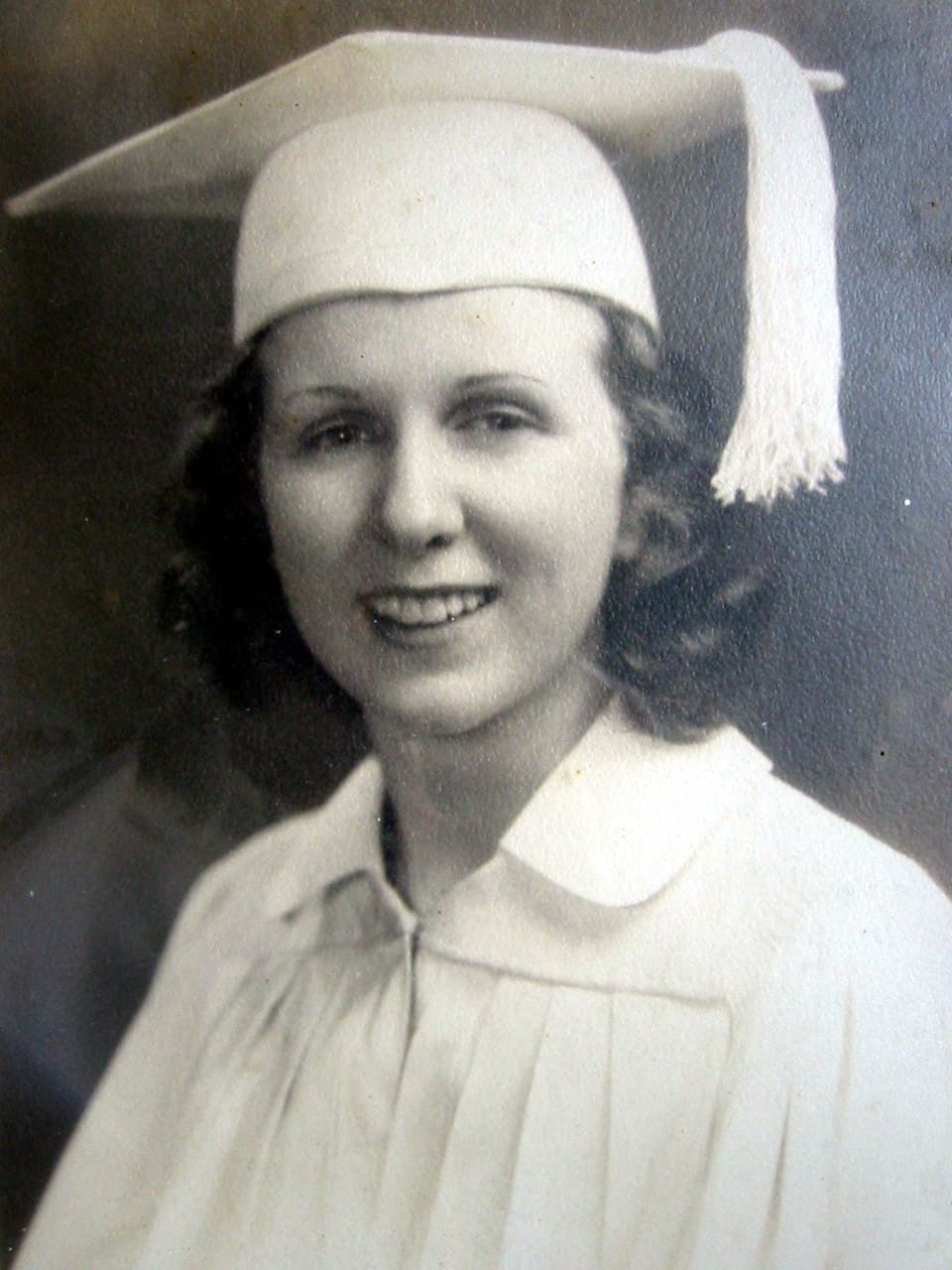
Irish, American · Science
Kay McNulty Mauchly Antonelli
February 12, 1921 – April 20, 2006
Early Life and Background
Kathleen Rita "Kay" McNulty Mauchly Antonelli was born on 12 February 1921 in Feymore, near Creeslough, a small village in County Donegal, Ireland.[1][6][11] The area was a Gaeltacht, meaning Irish was the dominant language, and she grew up speaking Irish as her first language.[1][2] Her birth occurred during the Irish War of Independence, a context that deeply shaped her family’s circumstances.
Kay’s father, James McNulty, was an Irish patriot and commandant of the Doe Battalion of the Irish Volunteers, associated with the struggle for independence.[2][8] On the night of her birth, he was reportedly arrested for his political activities.[2] After the conflict and subsequent political changes, he was released and, facing economic hardship and lingering tensions, emigrated with his family to the United States, settling in Pennsylvania.[2][8]
The McNulty family moved to Philadelphia when Kay was about three years old.[3][7][8] Having grown up in a Gaelic-speaking region, she initially spoke only Irish and had to learn English after migration.[2] The challenges of adaptation, including language shift and integration into American schools, were formative experiences. Her parents strongly encouraged education, seeing it as the chief advantage of life in the United States.[3][11]
In Philadelphia, Kay attended Catholic schools, where her aptitude for mathematics became clear. She excelled in arithmetic and algebra and consistently performed at the top of her classes.[2][7] In high school she took all available mathematics courses, an unusual path for a girl in the 1930s, when expectations for women’s education were limited and few pursued advanced study in technical subjects.[2][7]
Education and Formative Influences
Kay’s teachers recognized her talent and encouraged her to continue in mathematics. She earned a scholarship to Chestnut Hill College for Women, a small Catholic institution in Philadelphia.[2][3][7] There she majored in mathematics, taking courses in algebra, geometry, trigonometry, and related fields.
Chestnut Hill College at the time offered relatively advanced training for women in mathematics, but the student body reflected broader social norms: in her graduating class of 92, only three women majored in mathematics.[2][7][8] Kay was one of those three, a testament to both her ability and her willingness to pursue a field still widely regarded as masculine.
She graduated with a bachelor’s degree in mathematics in 1942.[2][7][8][11] This degree proved decisive for her subsequent career. As the United States intensified its involvement in World War II, the military sought mathematically trained personnel to perform complex calculations related to ballistics and other technical problems. Chestnut Hill, along with other colleges, became a recruitment pool for women with mathematical training.
Kay’s formative influences included the intersection of her immigrant experience, her parents’ emphasis on education, and wartime demands. The combination placed her at a unique juncture where talent in mathematics, gendered labor patterns, and military needs converged, opening an unexpected path into computing.
Career Beginnings: Human "Computer" for the U.S. Army
Shortly after graduating in 1942, Kay was hired as one of approximately seventy‑five women to serve as human "computers" at the Moore School of Engineering, part of the University of Pennsylvania.[1][2][11] On 1 July 1942, she reported for duty and learned that her role was to compute bullet and missile trajectories for the U.S. Army’s Ballistics Research Laboratory.[3]
These women human computers worked in teams using mechanical desk calculators and detailed differential equations to generate firing tables. The tables specified how to aim artillery under varying conditions—temperature, wind, elevation—and were essential for improving the accuracy of weapons.[1][11] The work required precision, stamina, and mathematical understanding, and was performed under heavy wartime pressure.
In this period, computing was not yet conceived as an electronic or digital activity. "Computer" referred to a person rather than a machine. Kay’s role thus placed her in a technically demanding yet low‑status position, typical of how wartime organizations relied on women’s labor for intensive calculation tasks.[1][2]
Her performance distinguished her among the human computers. She proved adept at understanding the underlying mathematics, not merely following numerical procedures, and she developed a reputation for reliability and speed.[2][11] This reputation became crucial when the Army began exploring the possibility of automating trajectory calculations with an electronic machine.
Transition to ENIAC and the Birth of Electronic Programming
By 1944, the U.S. Army was supporting a top‑secret project at the Moore School—known initially as Project X—to build an electronic device that could compute ballistic trajectories far more quickly than human teams.[1][11] This machine became the ENIAC (Electronic Numerical Integrator and Computer), designed by physicist John W. Mauchly and engineer J. Presper Eckert.
Given their experience with trajectories, Kay and several other human computers were selected to be trained to configure and operate the new machine. In June 1945, she was chosen as one of the six original ENIAC programmers, alongside Betty Holberton, Ruth Teitelbaum, Frances Spence, Marlyn Meltzer, and Jean Bartik.[1][4][6][11] They were tasked with translating ballistic equations and other problems into instructions that ENIAC could execute via plugboards, switches, and control panels.
No programming manuals existed, and the women had limited initial guidance. Kay and her colleagues studied ENIAC’s wiring diagrams, logical organization, and component functions to understand how data flowed through the machine.[1][6][11] They developed methods for structuring calculations into sequences, configuring accumulators and function tables, and creating what would now be recognized as subroutines—reusable segments of computation. Though these innovations were not formally named or documented as such at the time, later historians have emphasized their conceptual importance.[1][6]
Programming ENIAC required both mathematical skill and an intuitive grasp of electronic logic. Kay worked on setting up problems so that the machine’s parallel units could work efficiently together, debugging issues caused by mis‑wiring or hardware failures, and ensuring that results matched known values from hand calculations.[1][6][11]
ENIAC’s First Public Demonstration
After months of testing and refinement, ENIAC was ready for public demonstration. On 15 February 1946, at the Moore School of Engineering, the machine ran its first full program successfully and was presented to military officials, scientists, and press representatives.[1][6]
During this demonstration, ENIAC performed ballistic calculations and other numerical tasks that previously required days of manual work. It completed them in seconds or minutes, conclusively illustrating the potential of electronic digital computing.[1][6][11] Kay’s programming work, though not highlighted publicly, was essential to this success; she and the other women had configured the machine, loaded the problems, and verified the outputs.
The event is widely recognized as the first public demonstration of a general‑purpose electronic digital computer.[1][6] However, contemporary press coverage focused almost entirely on the machine’s hardware and on Mauchly and Eckert as inventors. The women programmers were largely absent from official reports and photographs, reflecting broader patterns in which women’s technical contributions were marginalized.
For Kay, the demonstration marked both a professional triumph and an example of how her work could be overshadowed. Internally, colleagues understood that programming had made the demonstration possible, but externally the term "programmer" had yet to gain recognition as a distinct and valued role.
Post‑ENIAC Work: BINAC, UNIVAC and Software Development
Following ENIAC’s successful debut, Kay continued to work on programming the machine for various applications. In mid‑1947, ENIAC was moved to the Ballistics Research Laboratory at Aberdeen Proving Ground, and she remained involved in configuring and running programs there.[2][6] Her experience made her one of the very few people who understood both the machine’s design and its operational intricacies.
As Mauchly and Eckert transitioned into commercial computing ventures, developing machines such as BINAC (Binary Automatic Computer) and UNIVAC I, Kay contributed to programming and software design for these systems.[2][6][8] Much of her work occurred in informal or semi‑formal capacities, reflecting the evolving nature of computing organizations and gendered divisions of labor. She specialized in applications and programming techniques, while Mauchly focused more on hardware and system architecture.[3][8]
In these years, formal documentation of programming practices remained limited. Nonetheless, Kay and her colleagues helped shape early standards for coding, problem setup, and verification. Their experience with ENIAC’s complex wiring and function tables translated into insights about designing more flexible and efficient programming environments on subsequent machines.[1][6]
Awards, Honors, and Later Recognition
For decades, Kay’s contributions were overshadowed by the public prominence of ENIAC’s inventors and by prevailing assumptions that women were assistants rather than central technical figures. She was often described primarily as the wife of John W. Mauchly, with her own programming work left unmentioned.[8]
Beginning in the 1980s and 1990s, historians of computing and advocates for women in technology began reexamining the roles of the ENIAC programmers. Oral histories, archival research, and institutional initiatives helped bring Kay’s achievements to light.[1][6][11] She participated in interviews and public talks, describing in detail how she and her colleagues had learned to program ENIAC from circuit diagrams and had devised practical techniques for operating the machine.[1][3]
In 1986, the Letterkenny Institute of Technology in County Donegal established an award and scholarship program in her name, recognizing her as a role model for Irish students in computer science.[3][7] In 1997, she was inducted into the Women in Technology International Hall of Fame, an honor acknowledging her status as one of the earliest computer programmers and a pioneer of software.[3][7][9] Chestnut Hill College awarded her an honorary doctorate, further affirming her historical importance.[3]
These honors not only celebrated her individual career but also contributed to a broader reframing of computing history, in which women’s foundational contributions were given overdue attention. Kay came to be described as one of the "mothers of modern‑day computer programming," highlighting how her wartime work had helped create an entirely new profession.[2][7]
Personal Life
In 1948, Kay married John W. Mauchly, co‑designer of ENIAC.[3][6][11] Sources agree on the year of the marriage, though the exact date is not consistently documented.[3][6] Her parents reportedly opposed the match, and some accounts note that they did not attend the wedding.[3] After marrying, she resigned from her formal work with the Army but continued to collaborate closely with Mauchly on computing projects.
The couple had five children together and also raised two children from Mauchly’s previous marriage.[3][8] Balancing family responsibilities with technical work, Kay often contributed to programming, problem analysis, and client interactions in Mauchly’s ventures, though she was not always formally credited or employed under her own name.[3][8]
After Mauchly’s death in 1980, Kay later married Severo Antonelli, a photographer associated with the Italian Futurist school and founder of the Antonelli Schools of Photography.[8] She adopted his surname, and many historical sources now refer to her as Kathleen McNulty Mauchly Antonelli or Kathleen Antonelli.[1][6]
Throughout her life, she maintained ties to Ireland, returning frequently and engaging with family and community there.[2][12] Her dual identity as Irish-born and American-trained placed her at an intersection of national histories of technology.
Legacy and Historical Impact
Kay McNulty’s legacy rests primarily on her role as one of the six original programmers of ENIAC and as an early pioneer of software programming. Historians now emphasize that the success of ENIAC’s first public demonstration and its operational utility depended critically on the programming work of McNulty and her colleagues.[1][6]
Her trajectory from human computer to electronic programmer illustrates key shifts in twentieth‑century technology and gender roles. Initially hired to perform repetitive numerical labor, she became one of the small group who transformed computing into a programmable activity, requiring intellectual design and abstraction rather than mere calculation.[1][2][11]
Within women’s history, Kay’s story highlights the ways women entered technical fields through wartime opportunities, carried out highly skilled work, and then experienced decades of limited recognition. The eventual rediscovery and celebration of her contributions contribute to a broader effort to correct the historical record and to emphasize that women were present at the very origins of computer science.
In Ireland, she is commemorated as one of the country’s most significant technological figures, with museum exhibits and articles presenting her as a role model for girls interested in STEM.[2][7] In the United States, institutions such as the University of Pennsylvania and Chestnut Hill College highlight her role in ENIAC and early computing.[1][6][11] The naming of scholarships and awards after her indicates how her life story is used to inspire new generations of students.
Popular accounts sometimes describe her as "the first woman computer programmer," reflecting her place among the earliest group of programmers of a general‑purpose electronic digital machine.[2][7] While such superlatives simplify a complex history, they underscore the symbolic power of her career in public memory.
Later Life and Death
In her later years, particularly from the 1980s onward, Kay was increasingly involved in efforts to document and share the history of ENIAC and its women programmers. She gave talks, participated in interviews, and worked with historians to clarify technical details about early programming practices.[1][3][10][11] These activities helped deepen scholarly understanding of the origin of software and correct misconceptions about who did the work.
She lived in Wyndmoor, Pennsylvania, near the Antonelli Institute founded by her second husband, Severo Antonelli.[8][12] Friends and colleagues remember her as both a devoted family member and a keen observer of technological change, aware that the massive, room‑sized ENIAC she had helped program had given way to ubiquitous personal computers and networks.
On 20 April 2006, Kay died of cancer at her home in Wyndmoor at the age of 85.[1][4][6][9][11][13] She was buried in Philadelphia.[8][9] Obituaries and memorial notices emphasized her role in ENIAC and her pioneering status as one of the first computer programmers, reflecting the success of decades of advocacy and historical research that had brought her contributions to light.
Kay McNulty Mauchly Antonelli is now firmly established in the historical record as a central figure in the early development of computer programming. Her life story—spanning a Gaelic-speaking Irish childhood, wartime service as a human computer, pioneering electronic programming, and late‑life recognition—offers a vivid example of women’s often hidden but crucial roles in the making of modern technology.
Dated achievements
6 indexed.
- Feb121921Science
Birth in Creeslough, County Donegal, Ireland
Kathleen Rita 'Kay' McNulty was born in the Feymore area of Creeslough, County Donegal, Ireland, during the Irish War of Independence.
View details Kathleen McNulty - Engineering and Technology History Wiki - Jul011942