← All women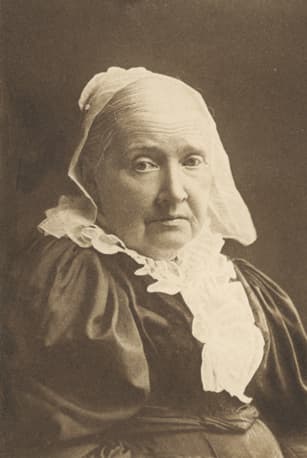
American · Literature · Activism · Politics
Julia Ward Howe
May 27, 1819 – October 17, 1910
Early Life and Background
Julia Ward Howe was born on May 27, 1819, in New York City, the fourth of seven children in a prominent banking family headed by Samuel Ward and his wife Julia Rush Ward.[1][2][15] Her father was a wealthy Calvinist banker, and the household was both privileged and deeply conservative in its religious and gender expectations.[1][14] This tension between material comfort and spiritual rigidity became one of the defining forces in Howe’s intellectual and emotional development.
Unlike most women of her era, Howe enjoyed extensive education, though it remained within gendered confines. She was taught by private tutors and attended schools for young ladies until about age sixteen, where she studied modern languages, literature, philosophy, and music.[9][15] Denied access to universities because of her sex, she nonetheless pursued a largely self-directed intellectual life, reading voraciously in theology, German philosophy, and contemporary political thought.[14][15] By her early twenties she was already publishing anonymous poems and reviews in literary magazines, gaining experience in the public literary sphere while constrained by expectations of female modesty.[1][19]
Her mother died when Julia was five, and her father’s stern authority shaped her youth.[14][15] The loss of her mother and emotional distance from her father helped cultivate a reflective, inward-looking sensibility that later expressed itself in her poetry and essays on marriage, morality, and the position of women. At the same time, her social position gave her access to prominent circles in New York and, later, Boston, where she encountered abolitionists, reformers, and Unitarian thinkers who expanded her political and spiritual horizons.[4][5]
Marriage, Family, and Formative Conflicts
In 1843 Howe married Dr. Samuel Gridley Howe, a famed physician, abolitionist, and reformer known for his work with the blind at the Perkins Institution in Boston.[4][15] The marriage of two celebrated reformers might have promised equality, but in practice it was deeply conflicted. Samuel Howe insisted on traditional gender roles, tried to control Julia’s public activities, and disapproved of her writing, especially when it addressed marital and sexual themes.[4][15][16]
The couple moved to Boston, where Julia entered the city’s rich intellectual milieu and bore six children: Louisa, Julia Romana, Henry, Laura, Maud, and Florence.[4][15] Childbearing, household responsibilities, and her husband’s disapproval constrained her literary ambitions, but they also sharpened her understanding of women’s dependence within marriage. She drew on these experiences in her early poetry, which frequently explored themes of frustrated desire, religious doubt, and the search for selfhood.
Howe’s correspondence and later biographical treatments describe the marriage as a "civil war" of ideals: her husband was a public champion of liberty for enslaved people and the blind, yet he resisted the idea that his wife deserved similar autonomy and public voice.[13][16] These contradictions fueled Howe’s developing feminism and her determination to speak openly about the inequities of marriage and women’s legal status in the United States.
Literary Beginnings and "Passion-Flowers"
Howe’s first major literary success came with the publication of "Passion-Flowers", an anonymous volume of poetry issued in 1854.[10][17] The exact day of publication is not clearly documented, but the book’s impact is well recorded. Contemporaries quickly speculated that Julia was the author, and the verses’ frank treatment of marital conflict and female frustration scandalized some readers—especially her husband, who viewed the book as an exposure of private life.[13][15]
"Passion-Flowers" established Howe’s reputation as a serious poet and intellectual. The poems blended romantic and religious imagery with sharp commentary on the limits imposed on women in mid-19th-century America.[10][11] For a woman of Howe’s class to write so critically and publicly about marriage was itself a daring act. The controversy surrounding the book highlighted the double standard that permitted male reformers to speak openly while expecting their wives to remain silent.
She followed this debut with other volumes, including "Words for the Hour" (1857) and later collections of poetry and essays.[11][15] Her literary work increasingly engaged political and philosophical themes, moving beyond purely private sentiments into questions of slavery, national destiny, and women’s rights. These early books laid the groundwork for her most famous composition and for her later role as a public lecturer and essayist.
The Civil War and "The Battle Hymn of the Republic"
The American Civil War reshaped Howe’s public life. She and her husband had long been committed abolitionists, supporting antislavery causes and associating with leading reformers.[1][5][15] In November 1861, during a visit to Union army camps near Washington, D.C., Howe heard soldiers singing "John Brown’s Body".[5][17] At the suggestion of a clergyman, she wrote new, more elevated lyrics that would capture the religious and moral fervor of the Union cause.
In the early hours of that November morning, Howe drafted the poem that became "The Battle Hymn of the Republic", a work of five stanzas invoking apocalyptic imagery and divine judgment.[5][11][17] The text was soon submitted to The Atlantic Monthly, which published it in its February 1862 issue under the title "Battle Hymn of the Republic."[5][11] Almost immediately, the poem was set to the existing tune and adopted as a rallying song for Union troops.
The "Battle Hymn" quickly gained iconic status as the unofficial anthem of the Union army and, later, as a broader American patriotic hymn.[2][11][15] Howe’s fusion of religious language and political purpose resonated deeply with wartime audiences, framing the conflict as a holy struggle against slavery. The song continued to be sung in subsequent social movements, including the Civil Rights movement of the 20th century.[6] Howe’s authorship of the hymn cemented her national fame and demonstrated the power of women’s voices in shaping public sentiment, even when women were legally barred from voting or holding office.
Postwar Pacifism, the Mothers’ Day Proclamation, and Women’s Rights
After the Civil War, Howe’s focus shifted from the immediate abolitionist struggle to broader questions of peace and women’s political participation. In 1870, she issued what became known as the "Mother’s Day" or "Mother’s Peace Day" Proclamation, an impassioned call for women around the world to unite in the cause of peace and to reject war as a means of resolving conflicts.[3][5][16] In the proclamation, she appealed to women’s roles as mothers and moral guardians, arguing that they bore a special responsibility to protest the devastation of war.
This proclamation did not create the modern, sentimental Mother’s Day celebrated in the United States, but it is widely regarded as an important antecedent and as a landmark in the history of women’s international peace activism.[3][5][16][18] Howe envisioned a solemn annual council where women would gather to discuss strategies for securing world peace, highlighting her belief in women’s collective moral authority.
During the late 1860s and 1870s, Howe also became deeply involved in the organized women’s suffrage movement. In 1868–1869, she worked with Lucy Stone, Henry Blackwell, and others to form the American Woman Suffrage Association (AWSA), which favored a state-by-state strategy for winning the vote and generally supported the 15th Amendment even though it did not enfranchise women.[1][11][15][19] Howe emerged as one of the organization’s most respected leaders and orators, delivering lectures across the country.
She helped establish and later co-edited the AWSA’s newspaper, The Woman’s Journal, which became a central voice of the suffrage and women’s rights movement.[1][15][16][19] For about twenty years, Howe wrote essays and editorials for the journal, addressing topics from voting rights and married women’s property laws to education and international peace. Her work in AWSA and The Woman’s Journal illustrates her evolution from poet to full-fledged public intellectual and movement strategist.
Lecturing Career and Intellectual Contributions
From the 1860s onward, Howe built a substantial career as a lecturer in the United States and abroad. She spoke on literature, ethics, women’s rights, and social reform, often framing women’s suffrage as both a moral imperative and a logical extension of democratic principles.[1][15] Her lectures brought her into contact with diverse audiences, from elite women’s clubs to grassroots suffrage gatherings.
Howe published travel books and biographical and philosophical works, including volumes on European travel and studies of famous figures.[11][15] She wrote biographies and character sketches that explored the interplay of individual conscience and social responsibility. Her essays often argued that denying women full citizenship impoverished the moral and intellectual life of the nation.
She was active in Boston’s network of women’s clubs, helping to organize the New England Women’s Club and participating in other associations that offered women opportunities for education and public discussion.[10][14][15] These clubs served as incubators for reform ideas and provided Howe with a forum to refine her arguments for suffrage and social change.
Awards, Honors, and Barrier-Breaking Recognition
By the late 19th and early 20th centuries, Howe’s decades of literary and activist work were widely recognized. She received honorary degrees, including one from Smith College, acknowledging her contributions to American letters and women’s advancement.[19] She was celebrated at public events, and her birthdays drew tributes from suffrage organizations and literary societies.
In 1908, Howe achieved a landmark distinction when she became the first woman elected to the American Academy of Arts and Letters.[11][15][19] This prestigious body had previously been the preserve of male writers and artists; Howe’s election marked a breakthrough in women’s inclusion in the cultural establishment. Her recognition there underscored the seriousness with which her contemporaries regarded both her literary contributions and her social and philosophical thought.
Various accounts also note that she was considered the first woman elected to certain arts and letters societies or honored as a "Suffragist of the Month" and similar commemorations in later historical projects.[7][14] While these retrospective honors came after her lifetime, they reflect the enduring esteem for her role in expanding the boundaries of women’s participation in public intellectual life.
Personal Life, Later Years, and Evolving Views
Howe’s personal life was marked by both family devotion and ongoing struggle against patriarchal constraints. Her relationship with Samuel Gridley Howe remained complex; despite periods of affection and shared public causes, their ideological conflicts over women’s independence never fully resolved.[13][16] After his death in 1876, Julia experienced greater freedom to pursue her lecturing and organizational work without marital opposition.[15]
She maintained close relationships with her children and participated actively in their lives. Several of her daughters, including Laura E. Richards, became writers and reformers in their own right, suggesting the transmission of her intellectual and activist legacy within the family.[15] Howe’s home became a gathering place for reformers, writers, and clergy, reflecting her role as a central node in Boston’s progressive circles.
Religiously, Howe moved away from her father’s strict Calvinism toward liberal Unitarian theology, emphasizing moral action, social responsibility, and the innate dignity of every person.[4][5][16] Her commitment to prison reform, peace advocacy, and internationalism fit naturally within this spiritual framework. She came to see women’s emancipation not merely as a political necessity but as a moral and religious one.
Legacy and Historical Impact
Julia Ward Howe’s legacy spans multiple domains: literature, music, abolitionism, women’s rights, peace activism, and prison reform. Her authorship of "The Battle Hymn of the Republic" secured her place in American cultural memory, as the hymn continued to be sung in churches, schools, and political rallies well into the 20th and 21st centuries.[2][6][11] The song’s use in the Civil Rights movement and other struggles for justice illustrates the enduring power of Howe’s fusion of religious and political language.[6]
In the sphere of women’s rights, Howe’s leadership in the American Woman Suffrage Association and her editorial work at The Woman’s Journal helped build the organizational and intellectual infrastructure that later suffragists relied upon.[1][11][15][19] Her advocacy contributed to the broader movement that eventually achieved the passage of the 19th Amendment in 1920, ten years after her death. While she did not live to see national women’s suffrage, her speeches and writings helped legitimize the idea that women belonged in political life.
The Mother’s Day / Mother’s Peace Day Proclamation left a significant mark on the history of peace movements and on later conceptions of Mother’s Day as more than a purely sentimental observance.[3][5][16][18] Activists and scholars have drawn on Howe’s vision to argue for a return to a more politically engaged, internationalist understanding of the holiday—one focused on women’s common responsibility for peace rather than commercial celebration.
Her breakthrough as the first woman elected to the American Academy of Arts and Letters signaled a shift in the cultural establishment’s willingness to recognize women writers and thinkers as peers to men.[11][15][19] This institutional acknowledgment helped pave the way for later generations of women to receive equal recognition in the arts and humanities.
Modern women’s history organizations, museums, and memorials consistently highlight Howe as an exemplar of 19th-century women’s activism.[1][5][7][14] She appears in educational resources, suffrage memorials, and literary histories as a figure who connected poetic expression with practical reform work. Her willingness to critique the inequalities of marriage, even at personal cost, has made her a reference point in feminist historiography.
Later Life and Death
In her final decades, Howe remained active in public life despite advancing age. She continued to lecture, write, and attend suffrage and peace meetings, becoming a respected elder stateswoman of the reform world.[1][5][15] Her birthdays were occasions for public celebration, and she received honorary degrees and tributes that recognized her pioneering role.
Howe died on October 17, 1910, in Rhode Island, with sources differing over whether the location was Newport or Portsmouth.[2][3][5][15][17] All agree that she was ninety-one years old and that she passed away peacefully after a long and influential life. She was buried at Mount Auburn Cemetery in Cambridge, Massachusetts, among other notable reformers and intellectuals.[5][10]
Her death prompted tributes that emphasized both her literary achievements and her moral leadership. Newspapers and suffrage organizations remembered her as the author of the nation’s most famous war hymn and as a woman who had spent decades arguing that women’s voices were essential to public life.[1][5][15] The tension between those two roles—war hymn writer and peace advocate—embodied the complexities of the 19th-century reform milieu and of Howe’s own evolving views.
Today, Howe is commemorated at historic sites, in women’s history curricula, and through ongoing performances of "The Battle Hymn of the Republic." Institutional profiles by organizations such as the National Park Service, the National Women’s History Museum, and the Perkins School for the Blind ensure that new generations encounter her story not only as a poet but as an abolitionist, suffragist, and visionary for peace.[1][4][5][10][16]
Dated achievements
4 indexed.
- May271819Science
Birth of Julia Ward Howe
Julia Ward Howe was born in New York City to a prominent banking family, later becoming one of America's most influential writers and reformers.
View details Britannica: Julia Ward Howe - Nov011861Science
Writes the lyrics to 'The Battle Hymn of the Republic'
Howe composed the iconic Civil War anthem after visiting Union Army camps near Washington, D.C., inspired by the marching soldiers' cadence.