← All women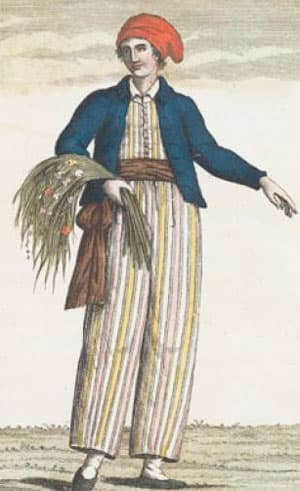
French · Exploration · Science
Jeanne Baret
July 27, 1740 – August 5, 1807
Early Life and Background
Jeanne Baret (also spelled Barret, Baré or Barré) was born on 27 July 1740 in the small village of La Comelle in Burgundy, France.[3][9] She was the daughter of illiterate, impoverished agricultural laborers, growing up in a rural peasant milieu with little formal education or social mobility.[6][1] Parish records and later biographical work confirm her birth date and local origins, situating her firmly in the world of eighteenth‑century French countryside life.[2][3]
Although specific details of her childhood are sparse, historians infer that Baret gained practical botanical knowledge through everyday tasks: gathering herbs, working the land, and possibly assisting with folk medicine.[6] In rural Burgundy, women’s knowledge of plants for food, medicine, and household use was widespread, even if not recognized as "science" by male academies. This informal expertise would later underpin her role in global botanical exploration.
As a woman of the lower classes in pre‑Revolutionary France, Baret faced overlapping barriers of gender and class. Opportunities for schooling, patronage, or participation in official scientific circles were vanishingly rare. Her subsequent trajectory—from peasant daughter to assistant to a royal botanist and participant in the first French circumnavigation—was therefore highly unusual and required both personal determination and contingent connections.
Career Beginnings and Relationship with Philibert Commerson
At some point in adulthood, likely in the early 1760s, Baret left rural Burgundy for ParisPhilibert Commerson, a prominent French physician and botanist.[10] Commerson, who was deeply engaged in plant collecting and classification, relied on assistants to help organize specimens and conduct field work; Baret quickly proved indispensable in this role.
According to biographical and encyclopedic accounts, Baret served as Commerson’s housekeeper, nurse, and botanical aide, managing his household and assisting with his scientific endeavors.[10][11] Their relationship evolved beyond employer‑servant boundaries. Many sources indicate that they became intimate partners, and Baret may have had a child with Commerson prior to the expedition, though details remain fragmentary in the surviving record.[3][11] Regardless of their exact domestic arrangement, Baret’s role in Commerson’s work was significant. She helped prepare specimens, organize notes, and likely participated in local collecting trips even before any formal voyage.
Commerson’s scientific reputation brought him to the attention of the French Crown and naval authorities. In the mid‑1760s, he was invited to serve as naturalist on a major voyage of exploration led by Louis Antoine de Bougainville, which would constitute the first French circumnavigation of the globe.[3][11] When Commerson was appointed expedition botanist, Baret’s skills and familiarity with his work made her the obvious choice as his principal assistant.
Bougainville’s Circumnavigation and Baret’s Disguise
The Bougainville expedition, sailing on the vessels Boudeuse and Étoile, departed France in 1766 with the dual aims of asserting French imperial presence and conducting scientific research.[3][1] However, French naval regulations strictly prohibited women from serving aboard warships, reflecting widespread social norms that confined women’s roles largely to domestic spheres.[6][11]
To circumvent this barrier, Baret and Commerson adopted a daring plan. In November 1766, Baret disguised herself as a man, binding her chest and wearing male clothing.[11] Under the name "Jean Baret" (or Baré), she was enrolled on the storeship Étoile as Commerson’s valet and assistant.[3] On 6 November 1766, she embarked from Rochefort as part of Bougainville’s circumnavigation fleet.[3]
Throughout the voyage, Baret performed the strenuous work of a field botanist’s assistant. Commerson suffered from poor health, including a leg wound that made walking difficult, so Baret often carried heavy equipment, pressed and labeled specimens, and ventured ashore in challenging conditions to collect plants.[11][1] Together they amassed an extraordinary collection: sources estimate more than 5,000–6,000 plant specimens gathered from South America, the Pacific, and the Indian Ocean, many of them new to European science.[1][4][12]
Among their notable finds was a showy tropical vine first collected in Brazil and later famous worldwide. Commerson named it Bougainvillea in honor of the expedition’s commander, Louis Antoine de Bougainville.[11][9] Modern writers have emphasized Baret’s likely crucial role in discovering and collecting this plant, though formal credit in published descriptions went to Commerson.
Voyage Highlights: South America, the Strait of Magellan, and Tahiti
The expedition’s route took Baret and Commerson first to Brazil, where they collected in the region around Rio de Janeiro, documenting a wide range of tropical flora.[9][11] They then sailed south to the Strait of Magellan, navigating treacherous waters at the southern tip of South America. During these segments, Baret’s disguise remained effective, and she was known to the crew only as "Jean".
The fleet crossed the Pacific, reaching Tahiti in April 1768. On 7 April 1768, events on Tahiti exposed Baret’s true sex. Local islanders quickly recognized that Commerson’s valet was a woman and reacted by surrounding and touching her, drawing the attention of the French sailors.[3][16] Their recognition revealed that "Jean" was in fact Jeanne. Reports from the voyage suggest that the discovery caused a scandal and may have led to harassment or violence against her.[11][15]
Bougainville later acknowledged the episode in his own account, noting both the violation of naval regulations and Baret’s courage. Despite the revelation, she remained with the expedition, continuing her botanical duties. The Tahiti incident has become one of the most discussed moments of her journey, symbolizing both the fragility of her disguise and the cultural encounter that brought an otherwise hidden gender transgression to light.
Mascarenes and Indian Ocean Work: Mauritius and Madagascar
After traversing the Pacific and visiting additional islands, Bougainville’s ships made their way to the Indian Ocean. On 12 March 1769, Baret and Commerson arrived at Île de France (Mauritius), a key French colonial base.[3] There Commerson accepted a position as botanist to the island’s governor, and Baret continued as his assistant.
From Mauritius, the pair undertook collecting trips across the Mascarenes, including Madagascar, building on their already extensive collections.[9] Working from a colonial center rather than a ship allowed for sustained field work and specimen processing. Baret’s responsibilities likely expanded in this period, as Commerson’s health continued to decline. She organized materials, prepared herbarium sheets, and possibly led or co‑led excursions, though the official records seldom mention her by name.
Commerson died on Mauritius in 1773, leaving Baret effectively stranded in the Indian Ocean.[10] Without her employer and protector, she had to secure new means of support and eventual passage home. Some sources suggest she ran a tavern or small business during this time, reflecting her adaptability and entrepreneurial skill.[11] Eventually, she arranged transport back to Europe via ships returning around the Cape of Good Hope.
Completion of the Circumnavigation and Official Recognition
Baret’s long journey ended when she landed at La Rochelle on 7 January 1775.[3] Having departed France in November 1766, traveled through South America, the Pacific, the Indian Ocean, and returned via the African coast, she had completed a full circumnavigation of the globe.[3][11] Historians and institutions now recognize this date as marking her status as the first woman known to have circumnavigated the world.[2][1][6]
Her achievement was remarkable not only for the distance traveled but for the circumstances: she had sailed most of the way disguised as a man on a naval vessel that officially banned women, performed demanding scientific labor, and navigated periods of scandal and vulnerability. Later translations and publications of Commerson’s notes acknowledged her role, and in the 1770s she received a small state pension, reflecting official recognition of her contributions to the expedition and to French science.[10][2]
Despite this pension, Baret did not become a prominent public figure. Unlike Bougainville and other male officers, she did not write a narrative of the voyage, and her name appeared only sporadically in contemporary documents. It was primarily through twentieth‑ and twenty‑first‑century historical research that her circumnavigation and botanical work gained wider acclaim.
Personal Life: Marriage and Provincial Years
After returning to France, Baret settled in Saint‑Aulaye, in the Dordogne region.[2][9] On 28 March 1774, she married Jean (Antoine) Dubernat, a French soldier.[3][10] Parish records document the marriage, and later sources describe Dubernat as a veteran who had served in the French military.
The couple likely operated a small shop or business in Saint‑Aulaye, providing a stable livelihood in the provincial town.[11] Baret’s modest pension supplemented their income. While details of her daily life in this period are sparse, surviving records indicate she lived respectably and without further public controversy.
There is limited information about any children from the marriage or about her family relationships in later life. The archival silence around these aspects of her biography is typical for women of her class and era, whose domestic lives were seldom documented unless they intersected directly with legal or ecclesiastical matters.
Major Scientific Contributions
During the Bougainville expedition and subsequent Indian Ocean work, Baret and Commerson assembled one of the largest botanical collections of their time. Historians and institutions estimate that they gathered thousands of plant specimens, often cited as over 6,000, from Brazil, the Strait of Magellan, Tahiti, Madagascar, Mauritius, and other locales.[1][4][9]
Key contributions associated with their work include:
- Extensive documentation of South American flora, adding new species to European knowledge and feeding into later taxonomic systems.[9]
- The collection and early description of Bougainvillea, a genus that would become widely cultivated as an ornamental plant across the tropics and subtropics.[11][9]
- Significant additions to the understanding of Indian Ocean and Mascarenes flora, including plants from Mauritius and Madagascar that were relatively unknown in Europe.[9]
Because Commerson did not complete many formal publications during his lifetime, much of their material was integrated into later works by other botanists, often without explicit credit to Baret. Nonetheless, modern scholars recognize that she performed indispensable field and curatorial labor. Her practical botanical knowledge, stamina, and organizational skills were critical to the success of the collections that underpinned parts of eighteenth‑century French natural history.
Awards, Honors, and Later Recognitions
In the years following the expedition, Baret received a
Long after her death, institutions and scholars began to honor her legacy more publicly. In 2012, botanists led by Eric Tepe described a new species of nightshade, Solanum baretiae, in the journal PhytoKeys, explicitly naming it for Jeanne Baret and citing her role as the first woman to circumnavigate the globe.[5][11] This act of nomenclatural recognition embeds her name permanently in botanical taxonomy.
In 2018, the International Astronomical Union named a mountain range on Pluto after Baret, as part of a scheme honoring historic explorers.[1] This planetary feature symbolically extends her commemorative presence beyond Earth, connecting her eighteenth‑century oceanic journey with contemporary space exploration.
Museums, archives, and educational projects—such as the Royal Museums Greenwich, the New York Botanical Garden, and various women’s history initiatives—have produced articles, exhibitions, and podcasts about Baret, further cementing her reputation as a pioneering woman in exploration and science.[1][5][6][19]
Legacy and Historical Impact
Baret’s legacy is multifaceted, encompassing maritime history, the history of science, and feminist scholarship. She is widely recognized today as the first woman known to have completed a circumnavigation of the globe, a feat accomplished under conditions of legal prohibition and social risk.[2][3][6]
Her story challenges traditional narratives of exploration that foreground male commanders and downplay the contributions of assistants, servants, and women. By highlighting her role as Commerson’s botanical collaborator and the practical labor she performed, historians show how scientific achievements often depended on uncredited workers. Baret’s combination of courage—agreeing to sail in disguise—and competence—handling thousands of specimens under harsh conditions—has made her an emblem of women’s resilience in the face of institutional exclusion.
Feminist and gender historians also view Baret’s life as a case study in how women navigated restrictive norms. Her cross‑dressing to board the Étoile, the revelation of her sex in Tahiti, and her subsequent ability to remain with the expedition complicate simple binaries of compliance and resistance. She operated within patriarchal structures while subtly subverting them, leveraging personal relationships and practical skill to access spaces from which women were formally barred.
In popular culture and public history, Baret has become an inspirational figure representing the "hidden half" of exploration and scientific endeavor. Books, articles, and podcasts devoted to her life have contributed to a broader reappraisal of women’s roles in early modern global history, encouraging researchers to look for other women whose contributions went undocumented or were minimized.
Later Life and Death
After her marriage to Jean Dubernat and settlement in Saint‑Aulaye, Baret lived out her remaining decades in relative quiet. She continued to receive her small pension, and her business activities helped sustain the household.[10][11] There is no evidence that she undertook further long‑distance travel or major scientific projects, though her earlier experiences must have shaped her perspectives on the world.
On 5 August 1807, Jeanne Baret died at her home in Saint‑Aulaye at the age of 67.[2][1][3][8] Parish and local records confirm this date and place of death, though contemporary notices did not highlight her past achievements. For many years, reference works mentioned only her birth year, and some treated her death date as unknown.[10] It was through later archival and historiographical work that scholars pieced together her full life span.
Today, Baret is remembered not for a dramatic or public death but for the extraordinary journey and scientific labor that preceded it. Her quiet passing contrasts sharply with the boldness of her earlier exploits, underscoring the disjuncture between lived experience and historical memory. The renewed interest in her life since the late twentieth century has ensured that, despite the obscurity surrounding her death at the time, her name now occupies a secure place in the almanac of women’s history, exploration, and botany.
Dated achievements
10 indexed.
- Jul271740Science
Birth of Jeanne Baret
Jeanne Baret was born in Burgundy, France, on 27 July 1740, the daughter of peasant farmers.
View details Jeanne Baret - Wikipedia - Nov061766Science
Embarks on Bougainville's circumnavigation disguised as a man
Disguised as "Jean Baret," she boarded the storeship Étoile at Rochefort on 6 November 1766 as valet to botanist Philibert Commerson.