← All women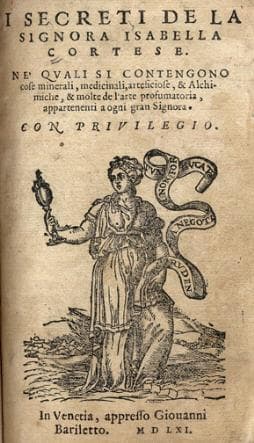
Italian · Science · Literature · Medicine
Isabella Cortese
1530 – 1570
Introduction
Isabella Cortese (fl. mid–16th century) is an enigmatic figure of the Italian Renaissance, known almost exclusively through a single printed work: the vernacular alchemical and recipe collection I secreti della signora Isabella Cortese (The Secrets of Lady Isabella Cortese), first published in Venice in 1561.[2][8][10][15][18] The book offered readers a wide range of alchemical, medicinal, cosmetic, metallurgical, and household recipes, and remained popular into the seventeenth century, going through numerous Italian editions and at least one German translation.[8][10][15] Because almost no archival documentation about the author has been found, many scholars now consider "Isabella Cortese" to be either a pseudonym or a constructed authorial persona devised by her publisher, yet her text is nevertheless recognized as a landmark in the history of women and early modern science.[4][7][11][18]
Early Life and Background
No reliable primary source has yet been identified that records Cortese’s birth date, birthplace, family, or education.[2][7][10][15][18] Modern reference works generally describe her simply as an Italian or Venetian woman active in the sixteenth century, and some Spanish-language scholarship calls her a "renombrada escritora y alquimista veneciana renacentista" (renowned Venetian Renaissance writer and alchemist).[9][16] Several Wikipedia language editions list her as a sixteenth‑century Italian alchemist and writer and explicitly note that all surviving information about her comes from her book.[2][10][13][15][18]
Within I secreti itself, the prefaces and occasional first‑person statements offer tantalizing but ambiguous hints about the persona "Isabella Cortese." She presents herself as an itinerant experimenter who has learned more from travel and hands-on trials than from reading ancient authorities, and she claims to have tested the recipes she publishes.[8][16] These self‑representations suggest a woman with access to laboratories, workshops, or household spaces where alchemical and medicinal work could be conducted, but they cannot yet be tied to a documented individual in notarial or civic archives.
Because of these gaps, historians reconstruct her "early life" primarily through contextual inference. In sixteenth‑century northern Italy, women could encounter practical medical and chemical knowledge in several settings: artisanal households, convents, noble courts, and informal circles of "professori di segreti" (professors of secrets) who traded recipes and remedies.[16] It is plausible that whoever wrote under the name Isabella Cortese drew on such networks, but this remains conjectural rather than documented fact.
Authorship, Identity, and the Question of the Persona
The question of whether Isabella Cortese was a historical individual or a fictional construct has become central to modern scholarship. Early bibliographical accounts tended to treat her as a real woman, but more recent studies, particularly those focusing on the publishing practices of Venetian printers, have raised doubts.[4][11][17]
The 1574 edition of I secreti was issued by the Venetian printer Giovanni Bariletto, who specialized in popular practical manuals and "books of secrets."[11][17] Some historians argue that the combination of a noble‑sounding female name, the emphatically gendered title (della signora Isabella Cortese), and the marketing of recipes "for every great lady" point to a publisher’s strategy of using an appealing female persona to sell a compilation of recipes assembled from multiple sources.[4][5][11][17] On this reading, "Isabella Cortese" may have functioned similarly to other fictional or semi‑fictional authorities in early modern print, lending charisma and credibility without corresponding to a verifiable individual.
Others emphasize that the secrets genre often incorporated genuine practitioners’ voices and that women did, on occasion, publish under their own names. They caution against too readily erasing the possibility of a real woman simply because the archive is silent, particularly when women’s lives were less likely to be documented.[2][6][8][16] As a result, many scholars adopt a cautious middle ground: they acknowledge the likelihood of a constructed persona while still taking seriously the gendered authorial voice that I secreti projects and the fact that contemporaries would have encountered it as a woman’s text.
Regardless of where one stands on this debate, the name "Isabella Cortese" now serves as an important heuristic figure for examining how gender, authority, and anonymity intersected in the production and marketing of early modern scientific print.
Career Beginnings and Development
Cortese’s "career" is traceable primarily through the publication history of I secreti. The first known edition appeared in 1561 in Venice under the title I secreti della signora Isabella Cortese.[2][8][10][16][18] The city was then a major center of printing, especially for practical manuals that catered to artisans, physicians, and householders.
The 1561 volume presented itself as a collection of tried and tested recipes, organized into books or sections dealing with mineral operations, medicines, artifices, alchemy, and perfumery, among other topics.[5][8][10][16] Its language is Italian rather than Latin, and the style is direct and instructional, reflecting the expectations of readers in the thriving market for secrets literature. Within this milieu, Cortese’s name appears as one of several "professors of secrets" whose works promised to reveal guarded techniques and short‑cuts for healing, beautifying, dyeing, gilding, and transmuting.
Later sixteenth‑century reprints, including the 1574 edition by Bariletto, expanded and reorganized the material while retaining the framing of a female author addressing both men and women but paying particular attention to the needs of elite women—"ogni gran signora"—interested in cosmetics, perfumes, and household management.[5][11][17] The book’s continued republication into the seventeenth century, with evidence of at least eleven Venetian editions up to 1677 and a German translation, suggests that it became one of the period’s best‑selling recipe books attributed to a woman.[5][15]
Because we lack independent documents about Cortese’s life, it is impossible to reconstruct a conventional career trajectory. Instead, historians treat the evolving editions of I secreti as markers of her (or her persona’s) professional presence in the marketplace of knowledge: each new printing both responded to and shaped demand for female‑voiced technical instruction.
Major Work: I secreti della signora Isabella Cortese
Cortese’s sole known work, I secreti della signora Isabella Cortese, is a wide‑ranging compendium that fits within, yet also expands, the early modern "books of secrets" genre.[2][5][8][10][16] These books typically compiled short, practical recipes and instructions for tasks such as making medicines, preserving food, manufacturing dyes and inks, performing alchemical operations, and crafting cosmetics and perfumes. They were designed for non‑university audiences and often blurred the boundaries between artisanal, medical, and scholarly knowledge.
The contents of I secreti include:
- Alchemical and metallurgical procedures, such as methods for gilding, refining metals, and attempting transmutation, often framed as empirically tested rather than purely speculative.[2][5][10][16]
- Medicinal recipes for treating common ailments, wounds, and fevers, reflecting contemporary Galenic and Paracelsian influences as filtered through artisanal practice.[2][5][8][16]
- Cosmetic and beauty preparations, including facial waters, skin lighteners, hair dyes, and treatments for blemishes, explicitly addressed to women readers concerned with appearance.[2][5][6][10]
- Perfumery and luxury goods, with instructions for making scented waters, pomanders, and other status‑laden products associated with noble households.[5][16]
- Household and artisanal secrets, such as cleaning solutions, methods for removing stains, and recipes for dyes and pigments useful to artisans and domestic managers alike.[5][8][16]
Cortese’s prefaces emphasize repeated experimentation and the rejection of untested or fraudulent procedures. She insists that she publishes only recipes she has tried herself or has found reliable, aligning her persona with an emergent ideal of the experienced experimenter rather than the bookish theorist.[5][8] This self‑fashioning has led some historians to view her as an early example of a practical chemist, even if her operations remained embedded in the symbolic and spiritual language of Renaissance alchemy.[5][6]
The book’s vernacular language and explicit appeal to women are particularly significant. By packaging alchemical and medical know‑how in Italian and linking it to concerns about beauty, health, and household management, I secreti extended experimental practice into traditionally feminine domains, making it easier for women to engage with techniques otherwise monopolized by guilds and learned men.[5][8][16]
Reception, Editions, and Transmission
I secreti appears to have been highly successful in commercial terms. The 1561 first edition was followed by several later printings, including the notable 1574 edition printed in Venice by Giovanni Bariletto, which expanded the title to highlight its mineral, medicinal, alchemical, and perfumery content.[11][17] The work continued to be reissued into the seventeenth century; German‑language scholarship notes that there were eleven Venetian editions up to 1677 and at least one German translation, underscoring the text’s broad geographic reach.[15]
In the mid‑seventeenth century, printers such as Carlo Conzatti brought out new octavo editions, indicating ongoing demand among readers for Cortese’s recipes.[15][20] Even as the secrets genre acquired a somewhat disreputable reputation—associated with charlatanism or naive credulity—I secreti maintained enough authority and utility to warrant continual reprinting.[5][10]
Modern booksellers and digital archives continue to treat surviving copies as valuable artifacts of early modern science and book history. Rare‑book catalogues describe I secreti as one of the earliest chemical books attributed to a woman, second only to ancient figures such as Maria the Jewess and predating later early modern women chemists like Marie Meurdrac.[15][18]
Awards, Honors, and Posthumous Recognition
There is no evidence that Cortese herself received formal honors in her lifetime, which would be unsurprising given the gendered constraints of sixteenth‑century academic and court culture. However, her name and work have been the subject of various forms of posthumous recognition.
One notable honor is the naming of the Cortese crater on the planet Venus by the International Astronomical Union, reflecting a twentieth‑century practice of naming Venusian craters after notable women from history and myth.[10] This symbolic gesture inserts Cortese’s name into a celestial cartography of women scientists, artists, and leaders.
In modern scholarship, the Encyclopedia of Women in the Renaissance (ABC‑CLIO, 2007) highlighted I secreti as "the only printed book by a female alchemist in the sixteenth century," a formulation that has been widely quoted in subsequent literature on women and alchemy.[12] Academic institutions such as the University of Pennsylvania have featured the 1574 edition of I secreti in exhibitions like Defying Convention: Frontiers of Knowledge, presenting Cortese as a key figure in narratives about women expanding early modern knowledge frontiers.[12]
Digital humanities projects, blogs, and educational videos devoted to early modern alchemy and women in science now frequently include sections on Cortese, further cementing her status as a reference point for discussions of gender and experimental practice, even as they underscore the uncertainties surrounding her biography.[1][4][5][6][16]
Personal Life
No verifiable information exists about Isabella Cortese’s personal life—her marital status, children, social circle, or religious affiliation.[2][7][10][15][18] Some modern popular accounts speculate about her social position (for example, casting her as a noblewoman or an independent practitioner), but these claims are not supported by archival sources and appear to be imaginative reconstructions based on the tone and content of I secreti rather than on documentary evidence.
Within the book, the authorial persona occasionally refers to unnamed "friends" and "great ladies" who seek her advice or to whom she dedicates her secrets, suggesting that the imagined author moves in elite or aspirational social environments.[5][16] However, these rhetorical gestures are fully compatible with a literary persona designed to appeal to consumers of secrets literature, and they cannot be straightforwardly read as autobiographical.
Given this lack of documentation, responsible historians refrain from asserting specific details about Cortese’s personal relationships or domestic arrangements. Instead, they focus on how the text constructs a gendered authorial voice that both conforms to and subtly challenges contemporary expectations about women’s roles in medicine, domestic management, and artisanal work.
Legacy and Historical Impact
Despite the opacity of her life, Isabella Cortese occupies an important place in the historiography of women and science for several reasons.
First, I secreti demonstrates that a female‑attributed alchemical text could achieve significant popularity and long‑term circulation in the heart of the Renaissance print market.[5][8][10][15] Whether or not she was a historical individual, the name "Isabella Cortese" signaled to contemporary readers that a woman could appear as a public authority on matters of alchemy, chemistry, medicine, and cosmetics. This challenges older narratives that cast early modern science as an exclusively male textual domain.
Second, the work shows how vernacular print allowed practical knowledge to move across social and institutional boundaries. By translating alchemical and medical procedures into accessible Italian and embedding them in a recipe format, I secreti helped democratize experimental know‑how, enabling lay readers—including women without Latin training—to perform complex operations in domestic or workshop settings.[5][8][16]
Third, Cortese’s text has become a key case study in discussions of authorship and anonymity in early modern scientific publishing. The debate over whether she was real or constructed forces historians to reckon with the ways publishers manipulated gendered personae to market knowledge and with the possibility that women’s contributions were sometimes obscured by collective or fictive authorship.[4][11][17]
Modern scholars such as Meredith K. Ray and others use Cortese to illustrate how women participated in a broader early modern experimental culture that included not only learned natural philosophy but also artisanal practices, household medicine, and cosmetics.[3][6][16][19] She is frequently cited alongside figures like Marie Meurdrac, Anna Maria Zieglerin, and Caterina Sforza in efforts to reconstruct a more inclusive history of chemistry and alchemy.
Finally, Cortese’s survival in the historical record only through a single, mutable text underscores the fragility of evidence for women’s scientific work. Her case serves as a methodological reminder that historians must often read recipes, marginalia, and print paratexts to recover women’s presence in fields that left few formal institutional traces.
Later Life and Death
No contemporary source records the later life or death of Isabella Cortese. Some secondary or popular treatments, including certain non‑English Wikipedia entries, give a death year (sometimes 1561) without documentation, but these dates cannot be confirmed against independent archival evidence and are generally not accepted in scholarly work.[2][7][9][11][16]
Given the absence of reliable data, historians typically refrain from assigning any specific year, place, or circumstances to her death. Instead, they treat the cessation of new editions and references to I secreti in the later seventeenth century as the only "terminal" points in her textual afterlife.
In a broader sense, Cortese’s "later life" continues in the reception of her book: in the eighteenth and nineteenth centuries, as interest in alchemy waned and chemistry professionalized, I secreti gradually slipped into obscurity. Twentieth‑century historians of chemistry and rare‑book curators rediscovered the text, primarily as an example of secrets literature, and more recent feminist and gender‑studies scholarship has reframed it as an important testament to women’s technical authority in the early modern period.[3][5][10][16][19]
Conclusion
Isabella Cortese remains a paradoxical figure: an author whose book is relatively well documented yet whose life is almost entirely opaque. Her I secreti stands at the intersection of alchemy, domestic practice, and the burgeoning world of vernacular print, offering a window into how practical knowledge circulated among artisans, household managers, and curious readers in Renaissance Italy.
Whether she was a living woman, a composite persona, or a purely fictional marketing device, the name "Isabella Cortese" has come to signify the possibility of female authorship in early modern science. Her enduring presence in scholarship, exhibitions, and even planetary nomenclature attests to the powerful afterlives that such fragile textual traces can generate, especially when historians of women’s history work to bring them back into view.
Dated achievements
7 indexed.
- Jan011561Science
Publication of I secreti della signora Isabella Cortese in Venice
Cortese's vernacular handbook of alchemical, medical, cosmetic, and household 'secrets' first appeared in print in Venice in 1561.
View details Scientific Women: Isabella Cortese - Jan011574