← All women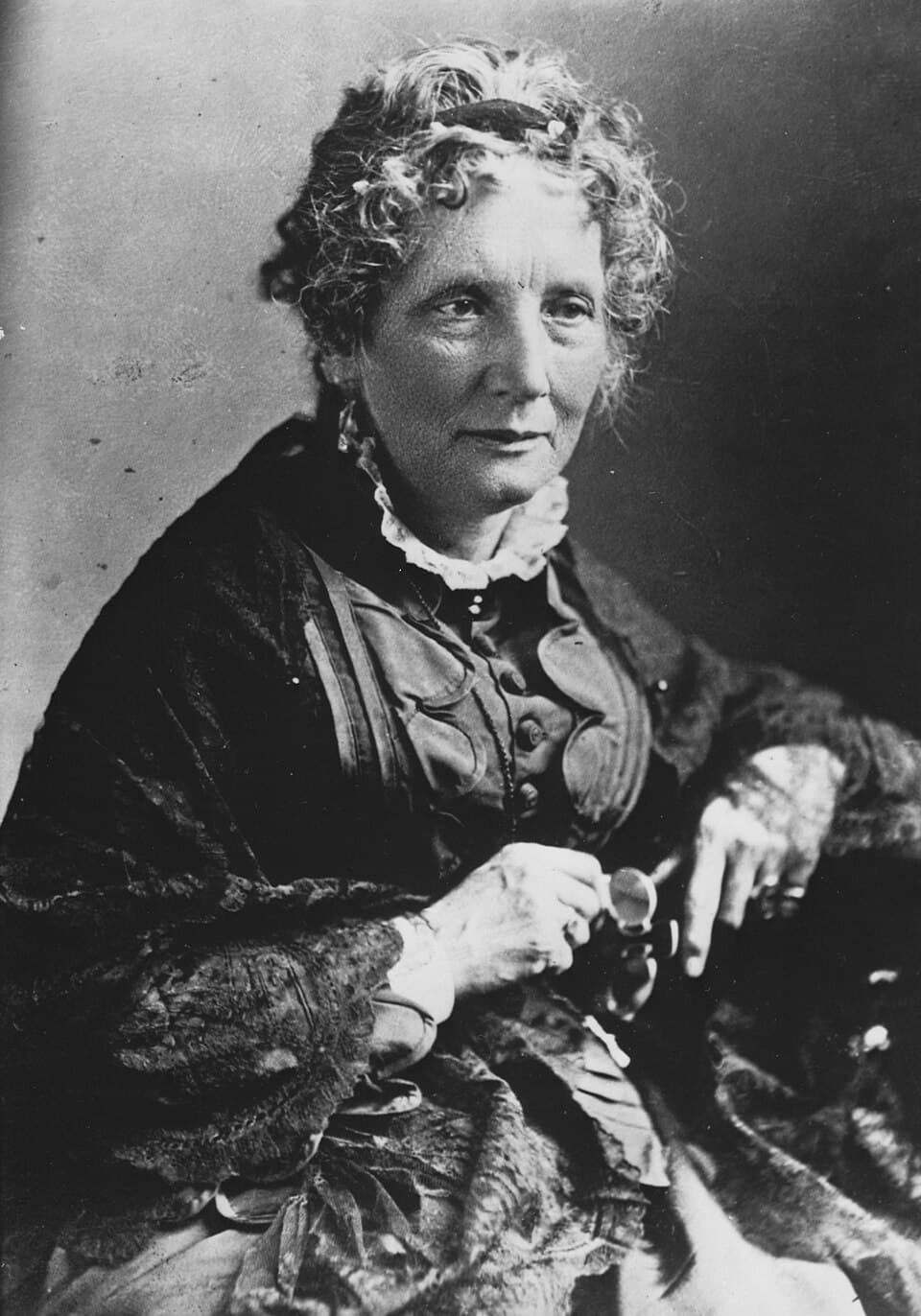
American · Literature · Activism · Arts · Politics
Harriet Beecher Stowe
June 14, 1811 – July 1, 1896
Early life and family background
Harriet Elisabeth Beecher Stowe was born on June 14, 1811, in Litchfield, Connecticut, into the prominent Beecher family, one of the best-known ministerial and reform-minded families in nineteenth-century America. Her father, Lyman Beecher, was a leading Congregational minister, and her mother, Roxana Foote Beecher, came from a family with artistic and professional connections. Harriet was one of several children in a household marked by religion, discipline, and public engagement. Her siblings included Catharine Beecher, a noted educator and reformer, and Henry Ward Beecher, a famous preacher and abolitionist.
Stowe’s early life was shaped by the evangelical culture of New England and by the educational expectations of her family. She attended school in Hartford and later benefited from the intellectual environment around the Beecher household. Her sister Catharine’s Hartford school exposed her to teaching and to a model of women’s work outside the home. These experiences helped form the habits of reading, writing, and moral argument that would later define her career.
The Beecher family was deeply involved in the moral reform movements of the early republic, including temperance, education, and religious revivalism. Stowe inherited this world but later translated it into literature, especially through her treatment of slavery, domestic life, and Christian conscience. The combination of strict religious upbringing and strong intellectual ambition gave her a distinctive voice that merged feeling with moral urgency.
Education and early writing
Stowe was educated in the tradition available to intelligent girls of her class, though formal higher education was largely closed to women in her era. She showed an early gift for language and composition, and her surroundings encouraged both teaching and writing as respectable forms of women’s labor. In 1832, she moved with her family to Cincinnati, Ohio, a major inland city that placed her near the Kentucky border and thus in direct contact with the realities of slavery.
Cincinnati was crucial to Stowe’s development. Living there, she encountered enslaved and formerly enslaved people, witnessed the tensions of a border city, and absorbed the arguments of both abolitionists and slaveholders. This experience broadened her understanding of slavery beyond abstract principle. It also gave her access to the sectional divisions that would later animate Uncle Tom’s Cabin.
In 1833, Stowe published her first book, Primary Geography, and also saw her first writings appear in the Western Monthly Magazine. These early works established her as a professional writer. Although they were not the publications that made her famous, they demonstrate that Stowe’s literary career began well before her antislavery novel. She wrote in multiple genres over the course of her life, including fiction, essays, travel writing, and reform commentary.
Marriage, motherhood, and teaching
In 1836, Stowe married Calvin Ellis Stowe, a biblical scholar and educator who supported intellectual life and encouraged her writing. Calvin’s career eventually took the family to different places, including Ohio and Maine, and the marriage connected Harriet to another learned Protestant household. Their partnership was shaped by shared religion, scholarship, and a commitment to education.
The couple had several children, and Stowe’s life included the ordinary burdens of motherhood, household management, and grief. One of the most influential experiences of her later career was the death of her young son Samuel Charles Stowe in 1849. Stowe later associated her emotional response to that loss with a powerful imaginative and spiritual crisis. She also drew on her understanding of maternal feeling and family separation when constructing the emotional core of Uncle Tom’s Cabin.
Like many women writers of her time, Stowe combined domestic responsibilities with intellectual work. She taught school, wrote for periodicals, and developed a prose style that could speak to both religious readers and the broader public. Her writing emerged from lived experience rather than from formal literary institutions, which had only limited access for women in the nineteenth century.
Rise to national prominence
Stowe’s national breakthrough came in 1851 when Uncle Tom’s Cabin began appearing in The National Era as a serial. The novel was inspired by the Fugitive Slave Act, by Stowe’s religious convictions, and by her exposure to slavery and its human consequences. When the book form appeared in 1852, it immediately became a sensation. Readers responded to its vivid characters, emotional power, and moral clarity, and its success quickly crossed national boundaries.
Uncle Tom’s Cabin was more than a literary success; it became a political event. Abolitionists praised it, while defenders of slavery attacked it as inaccurate and inflammatory. The novel contributed to a widening antislavery consciousness in the North and provoked intense debate in the South. Its influence was so great that it came to be cited among the causes of the American Civil War. Even when later readers criticized its racial stereotypes and sentimental techniques, its historical role in shaping public opinion remained undeniable.
Stowe’s fame brought both acclaim and scrutiny. She was one of the few women of her day to gain worldwide renown primarily through literary authorship. Her achievement was especially notable because she entered the public sphere at a time when women were often expected to limit themselves to the domestic and private. Instead, she used the language of home, family, and Christian moral duty to intervene in national politics.
Meeting with Lincoln and international celebrity
In 1853, Stowe traveled to Europe for the first time, expanding her international readership and reputation. That same year, she met Abraham Lincoln at the White House on August 11, 1853. The famous anecdote that Lincoln greeted her as the woman who had written the book that started the Civil War entered American folklore and has long symbolized the cultural force of her novel.
Whether or not the exact wording of the greeting is verifiable, the meeting itself mattered because it placed Stowe at the center of national political memory. A woman writer was being acknowledged as an actor in the public crisis over slavery. Her fame was unusual not simply because she was a bestselling author, but because her book had become a political force discussed by presidents, reformers, and ordinary readers alike.
The international success of Uncle Tom’s Cabin also strengthened Stowe’s platform for later work. She remained a highly visible public intellectual, and her books were read on both sides of the Atlantic. Her celebrity reflected not just literary talent but the nineteenth century’s growing hunger for morally charged fiction that could interpret contemporary life.
Later novels and continuing reform interests
Stowe continued to write prolifically after Uncle Tom’s Cabin. Her antislavery novel Dred: A Tale of the Great Dismal Swamp appeared in 1856 and extended her critique of slavery in a new fictional mode. In 1859, she published The Minister’s Wooing, her first New England-based novel, and in 1862 she published The Pearl of Orr’s Island: A Story of the Coast of Maine.
Her work after the great antislavery novel showed both continuity and range. She wrote about religion, domestic life, New England history, and moral controversy. In 1870, she published Lady Byron Vindicated, entering a fierce literary dispute over Lord and Lady Byron. Later, in 1878, she published Poganuc People, a novel concerned with New England village life. These works reveal that Stowe was not a one-book author, even though one book defined her public memory.
Stowe also remained involved in educational and cultural initiatives. In 1873, she helped found the Hartford Art School, supporting women’s artistic education and the development of cultural institutions in her adopted city. This activity fit her broader pattern of reform-minded engagement. Throughout her life, she used her position to endorse education, moral improvement, and women’s intellectual participation.
Personal life and family
Stowe’s marriage to Calvin Stowe was central to her life, but her personal history was also marked by recurring loss and responsibility. The couple raised a family while moving through several academic and literary environments. Her husband’s scholarly career and her own writing often overlapped in a household that valued learning. At the same time, Stowe’s experiences as a wife and mother gave her first-hand insight into dependence, vulnerability, and grief, which deeply informed her fiction.
Her family life included the burden of bereavement. The death of her son Samuel was a turning point, and she later endured other losses, including the death of her father, Lyman Beecher, in 1863. In 1864, she moved with her family to Hartford, Connecticut, which became her final residence. Hartford remained associated with her later career and final years.
Although Stowe is remembered primarily as a public figure, her private life mattered to her work. She drew on domestic relationships, religious conviction, and maternal experience to create fiction that resonated with ordinary readers. Her ability to convert private feeling into public argument is one reason her writing achieved such lasting power.
Legacy and historical impact
Stowe’s legacy rests above all on Uncle Tom’s Cabin, which helped transform anti-slavery sentiment into a mass cultural force. The novel’s influence was immediate, controversial, and enduring. It demonstrated that fiction could function as political intervention and that women writers could shape the public imagination on a national scale. For many readers in the nineteenth century, it changed how slavery was understood emotionally and morally.
Her career also matters in the history of women’s authorship. Stowe worked in an era when women’s literary labor was often expected to remain secondary to domestic life. She nevertheless built a public voice that reached across gender, class, and national boundaries. She wrote more than thirty books and a large body of shorter work, proving herself a prolific and adaptable author as well as a cultural icon.
Stowe’s influence has been interpreted in multiple ways by later historians and literary critics. Some emphasize her role in the abolitionist movement; others examine the racial limitations of her language and characterization. Both perspectives affirm her importance. She remains a central figure in American literary history because her work did not merely reflect its age; it helped define the moral arguments of the age.
Death
Harriet Beecher Stowe died on July 1, 1896, in Hartford, Connecticut, where she had spent her final years. She was buried at Phillips Academy Cemetery in Andover, Massachusetts, alongside her husband. Her death closed the life of a woman whose fiction, reform work, and public reputation made her one of the most consequential authors in American history.
By the end of her life, Stowe had become part of the national memory of slavery, the Civil War, and reform literature. Her career showed that a woman’s writing could move beyond the expected boundaries of sentiment and domesticity to intervene in the most urgent political questions of the century. That achievement secures her lasting place in the history of women’s literature and American abolitionism.
Dated achievements
6 indexed.
- Jun141811Literature
Birth of Harriet Beecher Stowe
Birth of Harriet Beecher Stowe in Litchfield, Connecticut, into the Beecher reform family.
View details Harriet Beecher Stowe - Wikipedia - Jun051851Literature
First installment of Uncle Tom’s Cabin serialized
First installment of Uncle Tom’s Cabin appears in The National Era, launching Stowe’s most influential work.