← All women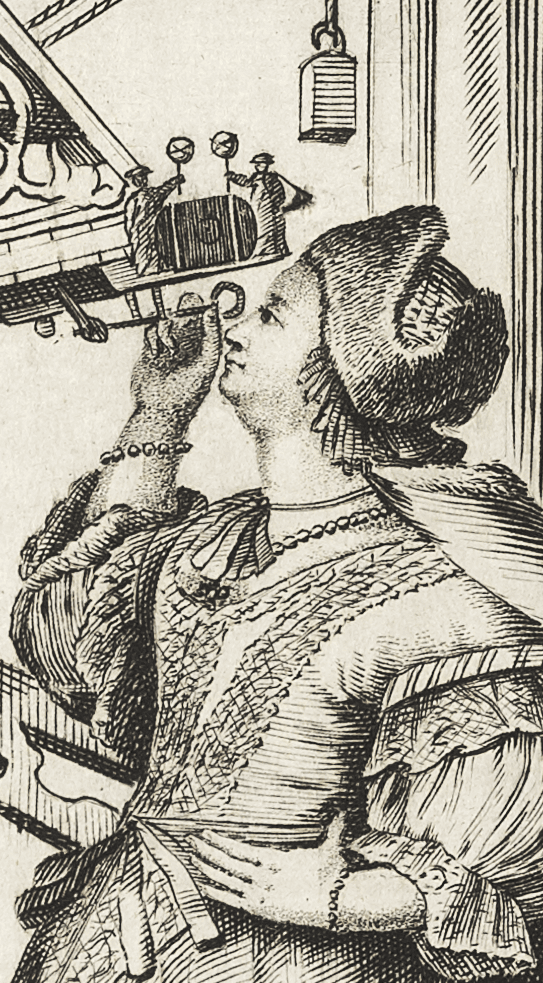
Danzig, Dutch, German, Polish · Science
Elisabetha Koopman Hevelius
January 17, 1647 – December 22, 1693
Early life and background
Elisabetha Catherina Koopman Hevelius was baptized in Danzig (Gdańsk) on 17 January 1647, a date commonly used as her birth date in biographical reference works. She came from a wealthy merchant family in a city that was then part of the Polish–Lithuanian Commonwealth and also a major Baltic trading center with strong German, Dutch, and Polish connections. Her father is identified in sources as a merchant, and her mother came from an Amsterdam family, placing Elisabetha in a culturally cosmopolitan environment that gave her access to education unusual for women of the period.
Biographical accounts describe her as a well-educated young woman, fluent in foreign languages, including Latin, and familiar with literature, the arts, and scientific culture. That background mattered because astronomy in the seventeenth century was not yet a profession open to women in any formal sense. For a woman to participate meaningfully in the field, she usually had to do so through family networks, private instruction, or domestic scientific households. Elisabetha’s upbringing in Danzig gave her both the social standing and the intellectual preparation that later allowed her to work within one of Europe’s most important observatory households.
Marriage to Johannes Hevelius
Elisabetha married the astronomer and brewer Johannes Hevelius in Danzig in 1663; a commonly cited marriage date is 3 February 1663, although some sources give only the year. Hevelius was considerably older than Elisabetha and already established as an international scientific figure, with a celebrated observatory complex in the city. The marriage brought Elisabetha into close daily contact with astronomical work, instruments, correspondence, and manuscript preparation.
Sources consistently emphasize that Elisabetha was not merely a household spouse but an active helper in the observatory. She assisted Johannes with observations, helped manage the practical routine of the observatory, and contributed to data reduction and the preparation of illustrations and engravings. In an era when women’s intellectual work was usually left uncredited, the Hevelius marriage created a setting in which her scientific participation could be sustained over decades. The partnership also made her a visible member of the learned sociability that surrounded the observatory, including visits from other astronomers.
The marriage has often been remembered because of the sharp age difference between the couple and because it linked a young woman from a merchant family to one of the leading natural philosophers of the age. More importantly, however, it was a scientific collaboration. The household became a site where astronomy, publishing, engraving, and scholarly exchange overlapped. Elisabetha’s role in that system would prove decisive after her husband’s death.
Work in the observatory
Throughout her married life, Elisabetha helped support Johannes Hevelius’s observing program in Danzig. Reference works describe her as assisting with observations and with the reduction of astronomical data, tasks that required patience, numeracy, and sustained attention. She is also associated with the preparation of atlas engravings and with the management of the observational estate that underpinned the Hevelius publications. These were not casual chores; they were integral to the production of seventeenth-century astronomical knowledge.
Her role should be understood in the context of early modern astronomy, where much work occurred in private observatories rather than universities or formal scientific institutes. The practical labor of measuring, copying, checking, engraving, and organizing observations was essential. Women who participated in such work were often treated as assistants rather than authors, but their contributions shaped the scientific record. Elisabetha’s career illustrates this pattern with unusual clarity because later sources explicitly note her role in the observation pipeline and in the publication process.
Some later writers have referred to her as one of the first female astronomers, and she is often described more cautiously as one of the earliest documented women in astronomy or the first female astronomer in Poland. Those labels reflect her visibility in the historical record rather than a claim that she was the earliest woman ever to engage in astronomical study. Her importance lies in the combination of documentation, technical labor, and publication leadership that her career reveals.
The star catalog and posthumous publications
The best-known achievement connected to Elisabetha Hevelius is the publication of the great Hevelius star catalog. Sources identify the catalog of 1,564 stars as a major astronomical accomplishment and note that it was published in 1688. The catalog is historically notable because it represented the culmination of pre-telescopic observational astronomy. It was one of the most extensive star lists of its time and became a landmark reference for later astronomical work.
After Johannes Hevelius died in 1687, Elisabetha continued the work of the observatory and became responsible for bringing out his unfinished scientific books. In 1690 she edited and published Prodromus astronomiae and Firmamentum Sobiescianum, sive Uranographia. These two works are the most important publications associated with her name. Prodromus astronomiae presented the Hevelius catalog of stars, while Firmamentum Sobiescianum offered an atlas of constellation plates.
The significance of these books extends beyond bibliography. In the seventeenth century, a scientific manuscript could easily be lost, delayed, or altered after an author’s death. Elisabetha’s editorial labor preserved a major research program and ensured that the Hevelius observations entered the European scientific record in printed form. Her work therefore combined archival stewardship, technical editing, and public scientific communication. In this sense, she did not merely safeguard her husband’s legacy; she actively made that legacy available to posterity.
Recognition and historical status
Elisabetha’s recognition was limited in her own lifetime, which reflects the gendered structure of early modern science. Women who contributed to research rarely received formal titles, society memberships, or public honors. Nevertheless, later historians have increasingly recognized her as a significant astronomical figure. Reference works describe her as one of the first documented female astronomers, and some sources refer to her as the first woman astronomer in Poland.
Her posthumous recognition also includes astronomical naming honors. Later sources note that a crater on Venus and an asteroid were named after her, a sign that modern astronomy eventually acknowledged the historical importance of her work. Such honors matter because they transform an obscured contributor into a remembered scientific figure, placing her within the naming traditions of planetary science and small-body astronomy.
At the same time, historians have been careful not to overstate her status. Claims that she was the “first female astronomer” in an absolute sense are too broad. The better supported and more precise historical conclusion is that she was among the earliest women for whom substantial documentation survives and one of the first women in Europe whose astronomical contributions can be traced through surviving publications and archival records.
Personal life and family
Elisabetha’s personal life is inseparable from her scientific work, but it should not be reduced to it. She lived in a merchant household, married a much older widower, and became part of an extended domestic and intellectual environment in Danzig. Some biographical traditions indicate that the marriage produced children, although the exact family details are less consistently documented in the supplied sources than her scientific role.
Her role as hostess also mattered. Accounts of the Hevelius household note that Johannes entertained visiting astronomers there, and Elisabetha helped sustain that learned social world. In early modern science, hospitality was part of scholarly exchange: visitors brought news, observations, criticism, and reputation. A woman in Elisabetha’s position could therefore shape the scientific culture of a household even when not formally credited as an author.
Later life and death
Johannes Hevelius died in 1687, after which Elisabetha took responsibility for bringing his work to completion. She lived another six years, long enough to publish the major posthumous works that secured the Hevelius name in astronomy. Elisabetha died in Danzig on 22 December 1693 and was buried there on 23 December 1693. These dates close a life spent largely in the same city in which it began, though the consequences of her work reached far beyond Danzig.
Her death did not end her scientific legacy. The books she edited remained part of the astronomical literature, and later historians continued to reassess her contribution. In contemporary scholarship she is valued not only as the wife of Johannes Hevelius but as a collaborator, editor, and scientific worker in her own right. That reevaluation is especially important because it restores to the history of astronomy a woman whose labor was long obscured by older conventions of authorship and credit.
Legacy
Elisabetha Hevelius’s legacy rests on a combination of collaboration, preservation, and publication. She helped maintain one of Europe’s leading private observatories, contributed to the production of a major star catalog, and ensured that the astronomical work of Johannes Hevelius survived in print after his death. Her career illustrates how women could participate in early modern science through domestic and editorial labor, even in the absence of formal access to academic institutions.
She is now remembered as a significant figure in the history of astronomy, especially in studies of women in science. The story of her life also broadens the historical understanding of scientific authorship. The production of a star catalog or celestial atlas required many forms of expertise, not only observation at the eyepiece but also calculation, correction, engraving, and publication management. Elisabetha Hevelius stands as a clear example of how those tasks could be performed by a woman whose name, for centuries, received less attention than it deserved.
Dated achievements
7 indexed.
- Jan171647Science
Birth/baptism of Elisabetha Koopman Hevelius in Danzig
Baptized in Danzig; this date is commonly used as Elisabetha Koopman Hevelius’s birth date.
View details Biographical Encyclopedia of Astronomers / Wikipedia - Feb031663Science
Marriage to Johannes Hevelius
Marriage to Johannes Hevelius in Danzig, beginning her long collaboration in astronomy.