← All women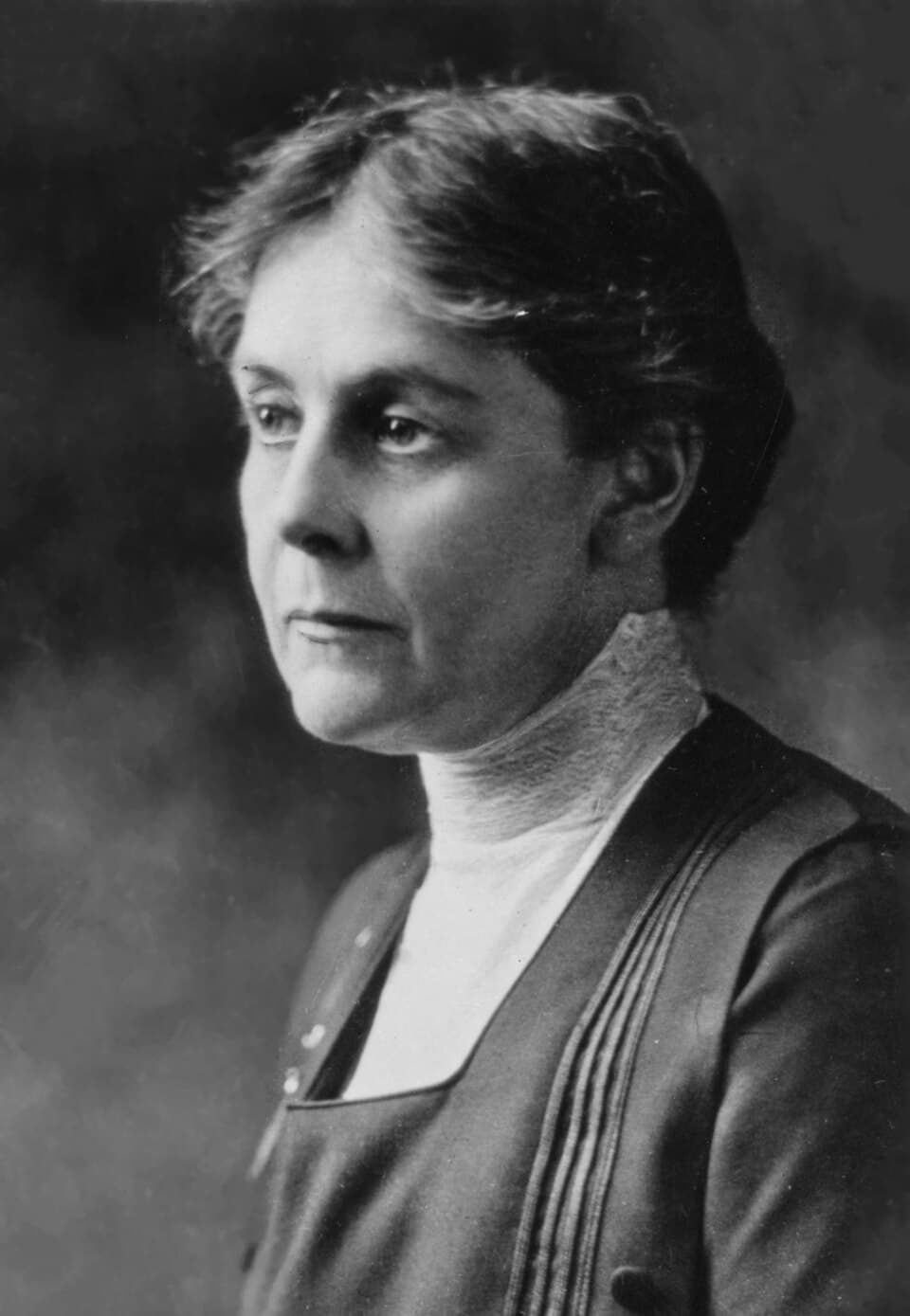
American · Medicine · Science · Activism
Dr. Alice Hamilton
February 27, 1869 – September 22, 1970
Early Life and Family Background
Alice Hamilton was born on February 27, 1869, in Manhattan, New York City, to Montgomery Hamilton and Gertrude Pond Hamilton.[1][4][6][12] Although born in New York, she was raised in Fort Wayne, Indiana, where the Hamiltons were among the town’s founding families.[5][9][10] The household was financially comfortable, culturally oriented, and intellectually demanding. Her parents encouraged reading, independent thought, and a sense of social responsibility.
Alice was one of five surviving children. Her sister Edith Hamilton became a renowned classicist and author, while sisters Margaret and Norah, and cousin Agnes Repplier, were also engaged in artistic or intellectual pursuits.[2][5][10][12] Growing up in this environment, Alice developed keen observational skills and a strong moral framework. She later recalled that her family’s awareness of social standing was paired with a belief that privilege carried obligations toward those less fortunate.[9][10]
Hamilton’s early education took place largely at home and in private schools, as higher education for women was only beginning to open in the late 19th century.[1][5][10] She later attended Miss Porter’s School in Farmington, Connecticut, a finishing school for young women, but soon decided that a conventional social path was not for her. Instead, she aspired to a life of meaningful work—initially envisioning herself as a medical missionary—at a time when relatively few women entered professional careers, and even fewer pursued medicine and scientific research.[1][5][10]
Medical Education and Advanced Training
Determined to become a physician, Hamilton enrolled at the University of Michigan Medical School, one of the first major U.S. medical schools to admit women.[1][6][10][12] She earned her medical degree in 1893, joining a small but growing cohort of women physicians in the United States.[2][4][6][10][12] Her choice of Michigan reflected both its relative openness to women and its emerging strength in scientific medicine.
After graduation, Hamilton pursued further training in bacteriology and pathology, both cutting-edge fields in the 1890s. She undertook postgraduate study at Johns Hopkins University, where the influence of modern laboratory medicine was strong, and then conducted advanced work in laboratories in Germany, including in Munich and Frankfurt.[1][5][6][10][12] These experiences familiarized her with European methods of experimental pathology and laboratory investigation, which she would later adapt to the study of industrial disease.
The early years of Hamilton’s medical career were characterized by a tension between traditional expectations for women physicians—such as general practice or pediatrics—and her growing fascination with scientific research and public health. She briefly held internships and teaching posts at women’s medical institutions, gaining experience in both clinical work and laboratory investigation.[1][10][12] By the late 1890s, however, she was drawn increasingly toward social medicine and the health problems of the urban poor.
Hull House and the Turn Toward Industrial Health
In 1897, Hamilton accepted a faculty position in pathology at the Woman’s Medical School of Northwestern University in Chicago.[2][4][10][12] That same year she moved into Hull House, the pioneering settlement house founded by Jane Addams and Ellen Gates Starr on Chicago’s Near West Side.[2][4][5][9][10] Hull House served immigrant and working-class communities, offering education, childcare, recreational activities, and social services.
Residence at Hull House proved transformative. Treating working-class patients in the neighborhood, Hamilton directly observed the link between poverty, hazardous working conditions, and ill health.[2][4][5][10][12] She encountered young laborers suffering from unexplained neurological symptoms, chronic pain, or fatal illnesses—patterns that did not fit neatly into the textbooks she had studied. Conversations with workers, visits to factories, and collaboration with other reformers at Hull House awakened her to the importance of industrial conditions as determinants of health.
During this period, Hamilton began to cultivate what became her distinctive investigative style: she combined meticulous clinical observation with social inquiry and on-site inspection of workplaces. She described her work as a kind of “shoe-leather epidemiology”, emphasizing direct investigation of workplaces and communities rather than reliance solely on hospital records.[2] Her early Hull House experiences laid the groundwork for her future as a leading expert on occupational disease and industrial toxicology.
Emergence as a Pioneer of Occupational Medicine
By the early 20th century, the rapid industrialization of the United States brought with it a high toll of workplace injuries and chronic illness, yet systematic study of occupational disease was minimal. Hamilton stepped into this void. In 1908, she published her first major article on occupational disease in the United States, focusing attention on conditions that had been largely ignored in American medical literature.[2][10][11][12] This work helped establish her national reputation as a physician willing to investigate dangerous workplaces and confront powerful industrial interests.
Hamilton’s approach to occupational disease combined several elements:
- Field investigations in factories, mines, and workshops
- Clinical observation of affected workers
- Laboratory analysis of blood, tissues, and environmental samples
- Historical and documentary research, including company records and accident reports
- Policy advocacy, translating findings into recommendations for legislation and regulation
Her research centered on the toxic effects of substances such as lead, mercury, arsenic, carbon monoxide, and explosives, among others.[2][5][6][10][11][12] In each case, she documented patterns of symptoms, routes of exposure, and preventable hazards, arguing that workplace illness was neither inevitable nor acceptable.
The Illinois Survey and Landmark Occupational Disease Work
Hamilton’s most influential early work came through her collaboration with the State of Illinois. In 1910, Illinois established the Commission on Occupational Diseases—the first state-level body in the United States specifically charged with investigating industrial illnesses.[10][12] Hamilton served as the Commission’s leading medical expert and effectively its medical director. She conducted extensive field investigations in smelters, paint factories, lead works, and other hazardous industries.
The Commission’s 1911 report documented widespread occupational poisoning, especially from lead, and provided detailed case histories linking specific factory practices to disease.[10][12] It has been described as the first state report in the United States to clearly demonstrate the causal connection between occupation and illness and to recommend systematic regulatory remedies. Hamilton’s findings contributed to the passage of workers’ compensation laws and early occupational disease legislation in Illinois and influenced reforms in other states.[10][12]
Through this work, Hamilton emerged as the foremost U.S. authority on industrial lead poisoning. She identified sources of exposure in paint, pottery, smelting, and other industries; described clinical manifestations ranging from anemia and colic to neurological damage; and proposed practical measures such as ventilation, process changes, and medical surveillance.[2][10][11][12] Her Illinois investigations solidified the field of industrial medicine as an area of scientific inquiry and public policy.
Federal Service and International Work
Hamilton’s expertise quickly attracted national attention. In the 1910s and 1920s, she served as a special investigator of industrial poisons for the U.S. Bureau of Labor Statistics (BLS) and later for the U.S. Public Health Service and the Department of Commerce.[1][2][9][10][12] For BLS she conducted a series of influential surveys on conditions in industries using white lead, explosives, viscose rayon, rubber, and other hazardous materials, producing detailed governmental reports that informed policy debates.
Her federal investigations took her to factories and mines across the country, where she observed firsthand the impact of unregulated industrial processes on workers’ health. She documented not only chemical intoxications but also social factors such as migration, language barriers, and gendered division of labor that shaped occupational risk.[2][9][10][12] Her reports were characterized by clear prose, careful documentation, and a refusal to minimize hazards in deference to industrial interests.
Hamilton’s reputation extended beyond the United States. In the 1920s she served as an expert for the Health Organization of the League of Nations, participating in international efforts to standardize industrial hygiene practices and share knowledge about occupational disease.[11][12] Her work contributed to the early globalization of occupational health standards and aligned with the broader interwar movement to address industrial hazards as an international public health concern.
Harvard Medical School and Academic Career
In 1919, Hamilton was appointed Assistant Professor of Industrial Medicine at Harvard Medical School, in the newly created Department of Industrial Medicine.[1][2][4][5][6][10][12] This appointment made her the first woman on the faculty of Harvard University, a barrier-breaking position that symbolized both the slow opening of elite institutions to women and the growing recognition of industrial medicine as a legitimate academic field.
Despite her faculty status, Hamilton’s position at Harvard came with notable constraints. She was excluded from the all-male social clubs, denied access to certain faculty facilities, and initially barred from marching in academic processions.[1][4][5][10][12] She later recalled that she was treated "as a stranger" in some institutional settings, even as students and many colleagues welcomed her teaching and research. Her appointment underscored the gender inequalities of early 20th-century academic life, yet also provided a platform from which she could train future physicians in industrial health.
At Harvard, Hamilton taught courses on occupational disease, industrial hygiene, and public health, using case studies from her field investigations. She continued to conduct research for government agencies and industry, emphasizing the need for independent scientific assessment of workplace hazards.[1][5][10][12] She remained on the Harvard faculty until 1935, when she retired as professor emerita, although she continued writing and advising long after formal retirement.
Major Writings and Intellectual Contributions
Hamilton’s scholarly and public writings were crucial in shaping both professional and lay understanding of occupational health. Among her most important works were her governmental reports for the U.S. Bureau of Labor Statistics and other federal bodies, which provided the first systematic descriptions of many industrial hazards.[2][9][10][12]
In 1934 she co-authored the textbook Industrial Toxicology (with coauthor Harriet Hardy in later editions), which became a foundational reference in the field.[6][9][12] The book synthesized decades of research on the toxic effects of industrial substances, emphasizing both clinical manifestations and preventive measures. It remained influential through multiple editions and helped standardize industrial toxicology as a specialty.
Hamilton also wrote extensively for broader audiences. Her autobiography, Exploring the Dangerous Trades, published in 1943, recounted her investigative work in factories and mines, her experiences at Hull House and Harvard, and her reflections on social justice and public health.[6][10][12] Written in accessible prose, the book served both as a personal memoir and as a historical document of the Progressive Era and the development of occupational medicine.
Across her publications, Hamilton advanced several core principles:
- Industrial disease is preventable, not an inevitable cost of production.
- Physicians must consider workplace and environmental factors in diagnosis.
- Effective prevention requires both technical solutions and legal protections for workers.
- Scientific integrity demands independence from corporate influence and transparency in reporting hazards.
Activism, Social Reform, and Political Engagement
Hamilton’s career was deeply intertwined with broader movements for social reform. Her residence at Hull House brought her into contact with leading Progressive reformers, including Jane Addams and Florence Kelley. She supported efforts to limit child labor, improve housing and sanitation, and expand access to healthcare for immigrants and the working poor.[2][4][9][10][12]
She was an advocate of the birth control movement, seeing control over reproduction as essential to women’s health and autonomy, particularly for poor and immigrant women whose lives were shaped by industrial labor and high fertility.[11][12] Her support aligned her with contemporaries such as Margaret Sanger, though Hamilton’s own activism remained rooted in medical and public health discourse rather than organized feminist politics.
Hamilton was also active in the peace movement, particularly during and after World War I. She criticized militarism and authoritarian regimes, later expressing concern over fascism and Nazism in Europe.[4][10][12] Her political writings and public lectures emphasized the connections between social justice, public health, and democratic governance.
Awards, Honors, and Recognition
Over the course of her long life, Hamilton received numerous honors recognizing her pioneering work. She was widely referred to as the “mother of occupational medicine” in the United States, reflecting her foundational role in establishing the field.[2][6][10][11][12] Professional societies in public health, industrial hygiene, and occupational medicine frequently cited her as a model for integrating scientific rigor with social responsibility.
She received several honorary degrees from American universities in recognition of her contributions to medicine, public health, and social reform.[10][12] Professional organizations, including the American Public Health Association and occupational health societies, acknowledged her leadership through lectureships and awards. Later historical assessments—by the National Library of Medicine, the Science History Institute, the American Chemical Society, and state and regional women’s halls of fame—have commemorated her as a central figure in the history of industrial health.[1][3][5][9][12]
Although her work intersected with major scientific developments of the 20th century, Hamilton’s recognition was sometimes limited by gender bias and her critical stance toward powerful industries. Nonetheless, by the end of her life and in subsequent decades, historians and public health scholars came to view her as one of the most important physician–reformers of the Progressive Era.
Personal Life and Character
Hamilton never married and had no children, a choice that gave her considerable autonomy at a time when professional women were often expected to relinquish careers upon marriage.[1][5][10][12] She maintained close relationships with her sisters—particularly Edith, with whom she traveled and shared intellectual interests—and with colleagues from Hull House and the public health community.
Contemporaries described Hamilton as modest in manner but tenacious in pursuit of evidence. She often downplayed her personal achievements, focusing instead on the impact of her investigations on workers’ lives. Yet her field notes and autobiography reveal a person of strong convictions, moral courage, and sometimes sharp criticism of negligence or exploitation by employers and officials.
Hamilton was also an avid traveler and observer of people and places. Her international work and later travels in Europe and Latin America deepened her comparative understanding of industrial systems and social policy. Even in old age, she remained intellectually active, reading widely and following developments in public health and politics.[10][12]
Later Life, Longevity, and Death
After retiring from Harvard in 1935, Hamilton settled for much of the year in Hadlyme, Connecticut, while maintaining connections to academic and reform circles.[3][4][10][12] She continued to write, lecture, and consult on occupational health, environmental hazards, and public policy. During World War II and the postwar period, she voiced concern about the health implications of new chemicals and industrial processes, anticipating later debates about occupational carcinogens and environmental toxins.
Hamilton lived to see the emergence of modern regulatory frameworks that reflected many of the principles she had advocated throughout her career. Although she did not directly participate in the drafting of the Occupational Safety and Health Act of 1970, her investigations and writings helped build the intellectual and political foundation for federal responsibility over workplace safety.[2][8][9]
She died in Hadlyme on September 22, 1970, at the age of 101.[2][4][6][12] Her death came at a symbolic moment, just as occupational safety and health were being formalized at the national level in the United States, confirming the long arc of her influence from early Progressive Era reforms to modern labor and environmental policy.
Legacy and Historical Impact
Alice Hamilton’s legacy is multifaceted, spanning medicine, public health, social reform, and women’s history. She is widely regarded as the founder of occupational medicine in the United States and an early architect of industrial hygiene and occupational epidemiology.[2][6][10][11][12] Her work demonstrated that rigorous scientific investigation could be combined with a commitment to social justice and workers’ rights.
In industrial health, Hamilton’s contributions include:
- Systematic documentation of industrial lead poisoning and other toxic hazards
- Development of field-based investigative methods that integrated clinical, laboratory, and social data
- Translation of research into practical preventive measures and regulatory proposals
- Influence on workers’ compensation laws and factory safety regulations in multiple states
In public health and policy, she helped to shift understanding of occupational illness from an individual misfortune to a structural problem requiring collective solutions—legislation, regulation, and corporate responsibility. Her insistence that industrial disease was preventable laid intellectual groundwork for later environmental and occupational health movements.[2][5][9][10][12]
In the history of women in science and medicine, Hamilton’s appointment as the first female faculty member at Harvard University stands as a landmark, symbolizing both progress and the persistence of institutional barriers.[1][2][4][5][6][10][12] Her career helped legitimate women’s participation in scientific research and academic medicine and provided a model for later generations of women physicians and public health professionals.
Institutions including the National Library of Medicine, the Science History Institute, the American Chemical Society, and regional women’s halls of fame have commemorated Hamilton’s life and work through exhibitions, biographies, and historic landmarks.[1][3][5][9][12] Scholars continue to study her contributions as central to the history of occupational health and Progressive Era reform. Her writings remain in use, both as historical sources and as inspiration for those who view medicine as a tool for advancing social justice.
Across more than a century of life, Alice Hamilton combined scientific innovation, fearless investigation, and moral conviction to transform American workplaces and to establish occupational health as a vital domain of medicine and public policy. Her work continues to inform contemporary debates about worker protection, environmental toxins, and the ethical responsibilities of scientists and physicians in industrial societies.
Dated achievements
8 indexed.
- Feb271869Medicine
Birth of Alice Hamilton
Alice Hamilton was born in Manhattan, New York City, into a prominent family that would later relocate to Fort Wayne, Indiana.
View details Changing the Face of Medicine: Alice Hamilton - Jan011893Medicine
Graduates from University of Michigan Medical School
Hamilton earned her medical degree from the University of Michigan Medical School in 1893, launching her career in medicine and public health.