← All women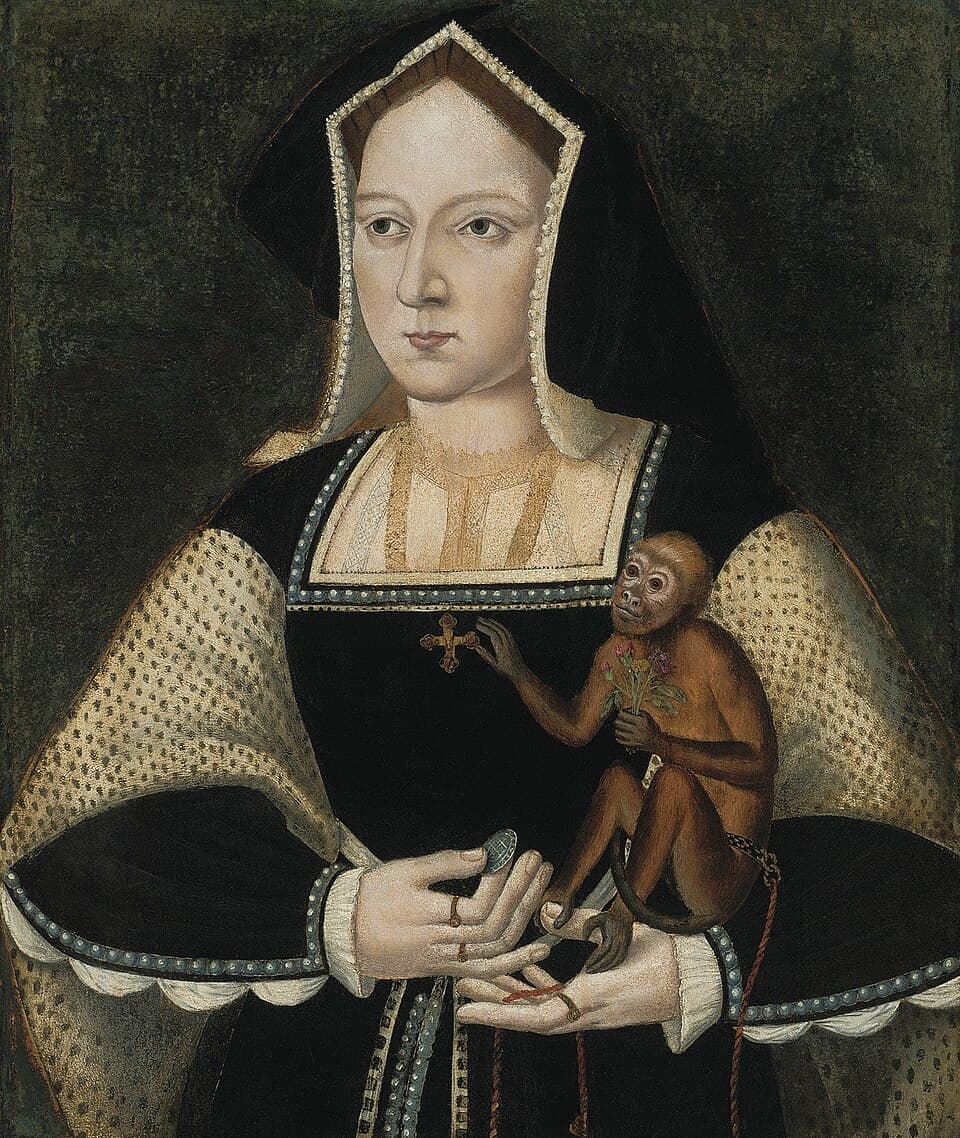
Spanish, English · Politics
Catherine of Aragon
December 16, 1485 – January 7, 1536
Early Life and Background
Catherine of Aragon (Spanish: Catalina de Aragón; 16 December 1485 – 7 January 1536) was born in Alcalá de Henares, near Madrid, the youngest surviving child of the Catholic Monarchs, Ferdinand II of Aragon and Isabella I of Castile.[2][5][15] Her birth occurred in the year Henry Tudor seized the English throne as Henry VII, linking her life from the outset to the new Tudor dynasty she would later join.[2]
As an infanta of Spain, Catherine grew up in one of Europe’s most powerful courts. Her parents’ joint rule had completed the Reconquista with the conquest of Granada and launched the Spanish monarchy on an imperial trajectory, including sponsoring Christopher Columbus’s voyages.[5] Catherine’s upbringing was marked by strong Catholic piety, exposure to warfare and statecraft, and the example of a reigning queen, Isabella, whose authority profoundly shaped her daughter’s understanding of women’s capacity to rule.[3][8]
Catherine received an education considered exceptional for a woman of her time. She studied Latin, theology, history, literature, and arithmetic, and was trained in courtly skills such as music and needlework.[3][8] Humanist currents in Spain influenced her intellectual formation; she would later support scholars and promote learning, including for women. From an early age she understood that her destiny lay in marriage diplomacy, and her tutors prepared her to move between languages and cultures.
Dynastic Betrothal and First Marriage
In 1489, the Treaty of Medina del Campo between Spain and England arranged Catherine’s future marriage to Arthur, Prince of Wales, heir to Henry VII.[2][5] On 27 March 1489, a marriage contract signed at Medina del Campo formally betrothed the three-year-old Catherine to Arthur, cementing a major Anglo-Spanish alliance.[2] The match aimed to contain France, enhance Tudor legitimacy, and confirm Spain’s prominence.
Catherine’s childhood education was shaped by this betrothal. She learned English, studied English customs and law, and prepared to serve as a bridge between two monarchies.[3] After years of negotiations and delays, she departed Spain on 2 October 1501 from the port of Laredo, sailing to England with a large entourage and significant dowry.[2] Her arrival was greeted with elaborate pageantry in London.
On 14 November 1501, Catherine married Arthur at St Paul’s Cathedral in a splendid ceremony that publicly celebrated the Anglo-Spanish alliance and elevated Catherine to the title Princess of Wales.[2][5] The young couple took up residence at Ludlow, the traditional seat of the Prince of Wales. Yet their marriage was short-lived: on 2 April 1502, Arthur died, probably of illness, leaving Catherine widowed before her seventeenth birthday.[2][5]
Arthur’s death created political and personal uncertainty. Catherine remained in England, but her status and finances were contested while Spain and England renegotiated terms. Discussions began about her marrying Arthur’s younger brother, Prince Henry, but disputes over dowry and papal dispensation stalled progress.[5] For several years she lived in relative limbo, maintaining her dignity and piety despite reduced resources.
Widowhood, Ambassadorship, and Path to Queenship
During the long negotiations following Arthur’s death, Catherine became an active political figure in England. Around 1507, she served as ambassador of the Aragonese crown to the English court, widely regarded as the first known female ambassador in European history.[2][7][11] Acting on her father Ferdinand’s behalf, she engaged in diplomatic correspondence and negotiations over her dowry, alliance terms, and English foreign policy.
This ambassadorial role was highly unusual in a male-dominated diplomatic sphere and showcased Catherine’s competence in languages, legal argument, and cross-cultural negotiation.[7][11] It drew upon her mother’s precedent of female rule and helped secure her continued presence and influence at the English court, despite her precarious financial situation.
The political landscape changed when Henry VII died in April 1509 and his son Henry VIII ascended the throne. The new king, fond of Catherine and keen to honour his father’s earlier plans, swiftly decided to marry her. With papal dispensation already obtained to permit marriage to his brother’s widow, Henry wed Catherine on 11 June 1509 at Greenwich.[2][5][15] On 24 June 1509, they were jointly crowned at Westminster Abbey as king and queen of England.[2]
Queenship, Patronage, and Regency
Catherine’s early years as queen were marked by political partnership with Henry and broad popularity among the English people.[5][16] She presided over the royal household, influenced court appointments, and maintained close ties with Spain. Her piety and charity made her a respected moral figure; even the later royal minister Thomas Cromwell would remark that "if not for her sex, she could have defied all the heroes of history."[16]
As queen, Catherine patronized religious institutions and humanist scholars. She supported the Spanish humanist Juan Luis Vives, commissioning him in 1518 to write a treatise on the education of women, including a plan for her daughter Mary’s schooling.[6][15][17] This reflected her interest in female learning and her desire for Mary to be intellectually prepared for potential rule.
Catherine also demonstrated political acumen in high office. In 1513, when Henry VIII launched a campaign against France, he appointed her regent of England. On 1 August 1513 he departed for France, leaving Catherine formally in charge of governance and defense.[2][5][6] She chaired the council, managed finances, and oversaw preparations against the expected Scottish invasion allied to France.
Her regency reached a dramatic moment with the Battle of Flodden on 9 September 1513, when English forces under the Earl of Surrey defeated and killed James IV of Scotland.[2][5][6] Although Catherine was not physically present on the battlefield, her role in organizing the realm’s defenses and her reported dispatch of James’s bloodstained coat to Henry as a trophy contributed to her reputation as a "warrior queen," echoing her mother Isabella’s martial leadership.[6][18]
Marriage, Motherhood, and Dynastic Anxiety
Central to Catherine’s queenship were issues of fertility and succession. She experienced multiple pregnancies. A stillborn daughter in 1510 and the birth and death in infancy of a son, Henry, Duke of Cornwall, in 1511 deepened anxiety about the failure to secure a male heir.[2][5][15] Several further pregnancies ended in miscarriages or stillbirths.
On 18 February 1516, Catherine gave birth at Greenwich Palace to a healthy daughter, Mary, later Mary I of England.[2][5][6][15] While the birth of a surviving child was cause for celebration, Henry’s disappointment that the baby was female foreshadowed later tensions. Catherine, however, embraced Mary as a blessing and devoted herself to her education, ensuring the princess learned Latin, theology, and the liberal arts.
Despite the lack of a male heir, Catherine remained influential at court through the 1510s. She advised on diplomatic matters, maintained correspondence with relatives in Spain, and continued her religious and charitable work.[3][6] Yet by the mid-1520s, Henry’s frustration grew, compounded by his infatuation with Anne Boleyn.
By 1525, Henry began distancing himself from Catherine socially and emotionally.[2][5][6] The king’s obsession with securing the succession made him increasingly receptive to theological arguments suggesting his marriage to his brother’s widow might be invalid under biblical law. This shift marked the beginning of Catherine’s long struggle to defend her status and her daughter’s rights.
The "King’s Great Matter" and Catherine’s Resistance
In 1527, Henry formally initiated efforts to secure an annulment of his marriage to Catherine.[2][5][6] He argued that their union contravened biblical prohibitions against marrying a brother’s widow, pointing to a passage in Leviticus, and claimed that the lack of a male heir proved God’s displeasure. Catherine countered that their marriage was lawful under canon law and that she had been a virgin when betrothed to Henry, making the papal dispensation valid.
The matter was brought before papal and legatine courts. The Pope, constrained by political considerations, including pressure from Catherine’s nephew Charles V, Holy Roman Emperor, delayed and hedged.[5] A legatine court convened at Blackfriars in London in 1529, presided over by Cardinals Wolsey and Campeggio, to hear the case.
On 21 June 1529, Catherine made a dramatic personal appearance at Blackfriars and delivered a famous speech. Kneeling before Henry, she reminded him of their long marriage, her royal descent, and her duty fulfilled as wife.[2][5][14] She insisted she had been a virgin when they wed and appealed to him to consider her honesty and their shared conscience. Her eloquence and visible distress swayed public opinion; many observers sympathized with her stand against being set aside.
The legatine court ultimately failed to grant Henry the annulment he sought, and the case was referred back to Rome.[2][5] Frustrated, Henry turned to a strategy of asserting greater control over the English church and legal system, paving the way for the English Reformation.
Break with Rome and Legal Re-definition of Catherine’s Status
A key development came with the rise of reform-minded clerics and lawyers willing to support royal supremacy. Thomas Cranmer, influenced by evangelical ideas, was appointed Archbishop of Canterbury and consecrated on 30 March 1533.[2][5][6] Cranmer quickly established a court to examine Henry’s marriage outside direct papal control.
On 23 May 1533, Cranmer’s court declared Henry’s marriage to Catherine null and void, ruling that the papal dispensation had been contrary to divine law.[2][5][6] This annulment legally ended Catherine’s status as queen consort and validated Henry’s secret marriage to Anne Boleyn, who was already pregnant.
Catherine steadfastly refused to accept the judgment. She maintained that she was Henry’s true wife and continued to style herself queen. The regime, however, demoted her to "Princess Dowager of Wales," emphasizing her prior marriage to Arthur.[5][6] Her income and household size were reduced, and she was increasingly excluded from court.
Parliamentary acts reinforced these changes. The Act of Succession, which received royal assent on 23 March 1534, required subjects to acknowledge the annulment and recognize Anne Boleyn’s offspring as legitimate heirs.[2][5][6] Denial of these provisions became treason. Catherine refused to endorse the act, and her daughter Mary was declared illegitimate and removed from the succession.
Later in 1534, the Act of Supremacy declared Henry VIII Supreme Head of the Church of England, crystallizing the break with Rome—a rupture rooted in the king’s determination to end his marriage to Catherine.[5][6][13] Thus Catherine’s marital case served as catalyst for far-reaching religious and constitutional transformation.
Later Life, Seclusion, and Death
From 1531 onward, Catherine was ordered to live apart from Henry and was moved between various residences, eventually settling at Kimbolton Castle.[2][5][6] She endured increasingly strict seclusion, with limited contact with her daughter Mary, whom Henry sought to control as part of his new succession arrangements. Catherine continued to write letters asserting her queenship and encouraging Mary to hold fast to Catholic faith.
Despite declining health, Catherine maintained a disciplined spiritual life, spending much time in prayer and religious observance. She refused to renounce her marriage or accept the title of Princess Dowager, considering such concessions incompatible with her conscience and understanding of sacramental indissolubility.[5][10]
Catherine died at Kimbolton on 7 January 1536, around the age of fifty.[2][5][6][15] Contemporary reports described symptoms suggestive of heart disease or cancer, though the precise cause remains uncertain.[6] Her death reportedly affected Henry and Mary emotionally, though Henry did not permit a reunion between mother and daughter in her final illness.
Her funeral was held at Peterborough Abbey (now Peterborough Cathedral) on 29 January 1536.[2][5][15] She was buried with the style "Princess Dowager," not as queen, reflecting Henry’s legal stance. The ceremony, though respectful, lacked the full honours associated with a reigning queen and underscored her official displacement. Over time, however, Peterborough became a site of remembrance where Catherine is now commemorated as a queen.
Personal Life and Character
Catherine’s personal life was dominated by her two marriages, motherhood, and her relationship with faith. Her first marriage to Arthur was brief and largely overshadowed by later controversies about consummation, yet contemporary evidence suggests she regarded him with respect and fulfilled expected duties.[2][5]
Her second marriage to Henry VIII lasted more than two decades and, for much of that period, appeared affectionate and cooperative. Catherine shared in Henry’s interest in chivalry and courtly display, participated in tournaments and festivities, and offered counsel on foreign policy.[3][6] Yet the failure to produce a surviving son strained the relationship and ultimately led to her repudiation.
Catherine bore at least six pregnancies, with only Mary surviving to adulthood.[2][5][15][17] These experiences, along with the emotional toll of lost infants, shaped her spirituality and her deep attachment to Mary. She advocated for her daughter’s strong education and future role, anticipating the possibility of a woman ruling England in her own right.
Contemporaries and later historians have emphasized Catherine’s virtues: her steadfastness, modesty, learning, and courage. Even those who opposed her politically recognized her integrity. Her religious devotion remained unwavering; she died within the Roman Catholic faith, considering herself a defender of traditional sacramental marriage against what she saw as unjust innovation.[3][10]
Awards, Honours, and Recognition
In her lifetime, Catherine’s honours were primarily titles and ceremonial roles rather than formal awards. As Princess of Wales and later Queen of England, she enjoyed precedence and authority at court.[2][5] Henry’s appointment of her as regent in 1513 was itself a recognition of her political competence.
Posthumously, Catherine has been honoured in historical scholarship, public memory, and cultural representations. Modern historians emphasize her role as a key actor in the origins of the English Reformation, a patron of humanist education, and a pioneer in female diplomacy.[6][7][9] Peterborough Cathedral now commemorates her as a queen, with annual events and interpretive materials celebrating her life.
In feminist historiography, Catherine is increasingly presented as a figure of resistance to patriarchal and political coercion—a woman who refused to accept an unjust annulment and who insisted on her own and her daughter’s legitimacy despite intense pressure.[7][9] Her story features prominently in museum displays, documentaries, and biographies that highlight women’s contributions to political and religious change.
Legacy and Historical Impact
Catherine of Aragon’s legacy is vast, touching monarchy, religion, diplomacy, and women’s history. Her refusal to acquiesce quietly to Henry VIII’s desire for annulment compelled the king to seek extraordinary solutions, thereby accelerating the break with Rome and the formation of the Church of England under royal supremacy.[5][6] In this sense, Catherine was, as some historians note, an unintentional architect of the English Reformation.
Her daughter Mary’s eventual accession in 1553 as Mary I, the first queen regnant to rule England in her own right, was deeply shaped by Catherine’s insistence on Mary’s legitimacy and thorough education.[6] Mary’s Catholic restoration and her complex reputation cannot be understood apart from Catherine’s formative influence and the trauma of their joint demotion and separation.
Catherine’s role as ambassador in 1507 and as regent in 1513 have made her a key example of early modern female political agency. She demonstrated that a queen consort could act effectively in diplomacy and governance, drawing on familial models of female rulership and challenging contemporary assumptions about gender and power.[2][6][7]
Her patronage of Juan Luis Vives and her commitment to Mary’s education contributed to wider debates about women’s intellectual capacities and the desirability of learned women at court. These initiatives helped pave the way for later educated queens and noblewomen who would participate in religious and political discourse.[6][15]
In cultural memory, Catherine is often contrasted with Anne Boleyn, representing traditional Catholic virtue against reformist ambition. Yet modern scholarship emphasizes her complexity: she was both conservative in theology and innovative in her diplomatic and political roles. Her story resonates in discussions about marital rights, the intersection of personal conscience with state policy, and the ways women’s bodies and fertility are politicized in dynastic regimes.
Conclusion
Catherine of Aragon’s life—from her birth in Alcalá de Henares in 1485 to her death at Kimbolton in 1536—illustrates the profound impact a single woman could have on the course of national and religious history. As Spanish infanta, twice royal bride, queen, regent, diplomat, and ultimately embattled consort, she navigated structures of power that both constrained and enabled her agency.
Her steadfast defense of her marriage and her daughter’s rights, even at the cost of comfort and security, left indelible marks on the English monarchy and church. In the broader arc of women’s history, Catherine stands as a figure of courage and conviction whose life challenges simplistic narratives of passive queenship and highlights the complex ways women shaped, and were shaped by, the turbulent politics of the early sixteenth century.
Dated achievements
17 indexed.
- Dec161485Politics
Birth of Catherine of Aragon
Birth of Catherine of Aragon (Catalina de Aragón), daughter of Ferdinand II of Aragon and Isabella I of Castile, at Alcalá de Henares, Spain.
View details Wikipedia - Catherine of Aragon - Mar271489Politics
Betrothal to Arthur, Prince of Wales
Catherine of Aragon is formally betrothed to Arthur, Prince of Wales, at the age of three.