← All women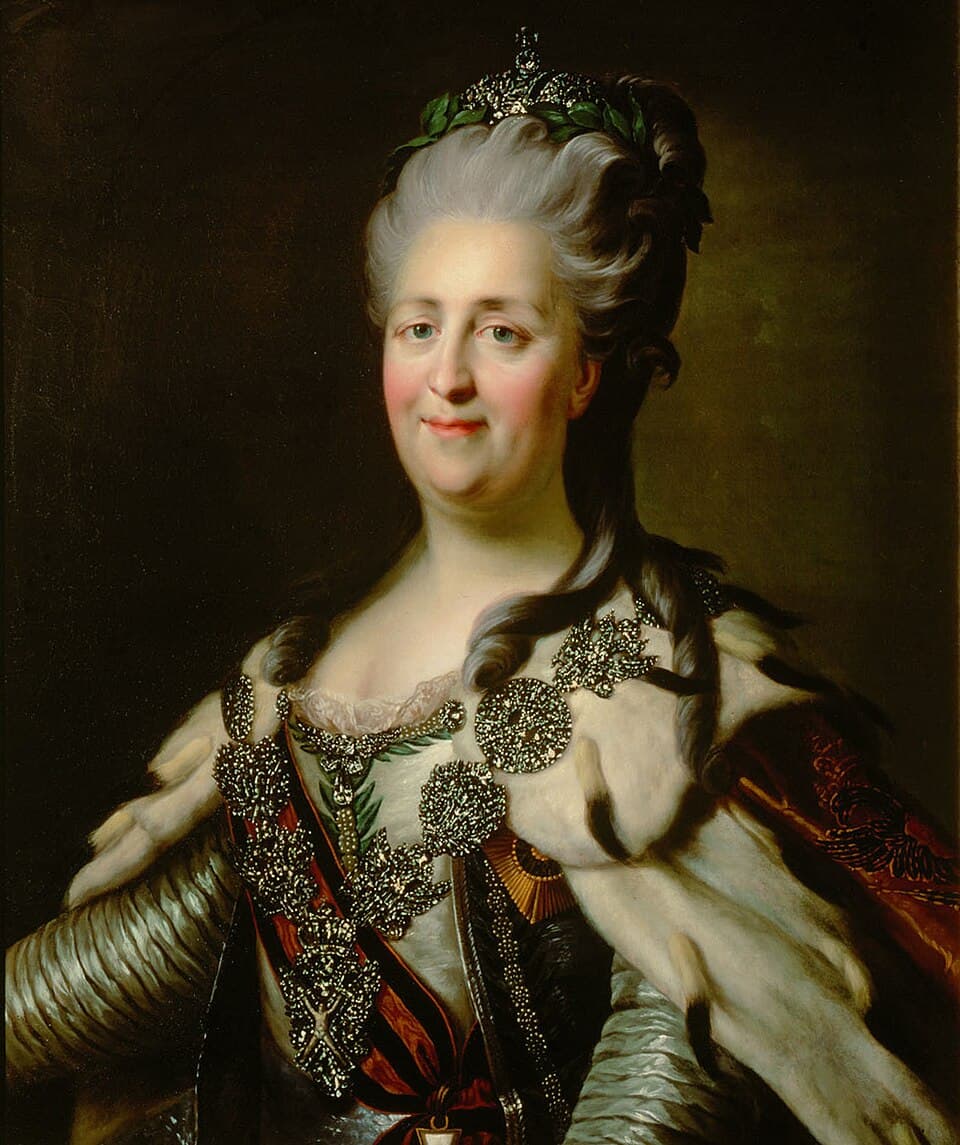
Russian · Politics
Catherine II
May 2, 1729 – November 17, 1796
Early life and background
Catherine II was born Princess Sophie Friederike Auguste von Anhalt-Zerbst on 2 May 1729 in Stettin, in the Kingdom of Prussia. She came from a minor German princely house rather than from one of Europe’s great ruling dynasties, a background that made her rise to imperial power unusual even by eighteenth-century standards. Her father, Christian August, served as a Prussian officer and provincial governor; her mother, Johanna Elisabeth, came from the house of Holstein-Gottorp. Catherine’s early environment was therefore shaped by court culture, dynastic ambition, and the constraints placed on younger princely daughters in a Europe organized around marriage politics.
As a child and adolescent, Catherine received the kind of education typically expected of a princess of her rank, with instruction in religion, languages, and etiquette. She later showed an aptitude for reading and self-formation that would become central to her political identity. Her intellectual development was influenced by the broader European Enlightenment, and as a young woman she became especially interested in French language and thought. Although she was not raised as a Russian subject, her life changed when she was selected for marriage into the Russian imperial family, a decision that placed her on a path to the throne.
In 1744 she traveled to Russia, converted to Orthodoxy, and took the name Yekaterina Alekseyevna. In 1745 she married the heir to the Russian throne, Grand Duke Peter, later Peter III. The marriage was politically important but personally unhappy. Catherine spent years learning to survive the intense competition of the Russian court, where foreigners, favorites, factions, and dynastic uncertainty all shaped her position. Her ability to adapt to these pressures helped prepare her for later rule.
Rise to power
Catherine’s route to sovereignty depended on court politics, military support, and her own political skill. By the time Peter III inherited the throne in 1762, he had alienated many powerful groups. Catherine became the focal point of opposition and, with support from key military and elite figures, moved against her husband. On 9 July 1762 she was proclaimed Empress of Russia after Peter’s overthrow. The coup was a turning point in Russian history and marked the beginning of one of the longest and most consequential reigns in the empire’s history.
Catherine’s accession was not merely a transfer of title. It required her to present herself as a legitimate sovereign, secure loyalty from the army and the nobility, and stabilize a regime born from crisis. She was a woman ruling in a political culture that associated legitimate autocracy with male dynastic succession, yet she managed to establish authority through a combination of force, ceremony, and policy. Once enthroned, she cultivated an image of enlightened monarchy, corresponding with philosophers and presenting herself as a reforming ruler devoted to the common good.
Government, reform, and Enlightenment rule
Catherine’s reign is often associated with enlightened absolutism: a style of monarchy that claimed to promote reason, order, and improvement while preserving strong autocratic power. She was deeply interested in law, administration, education, and the arts. One of her best-known early reforms was the decree of 21 June 1763 founding the Smolny Institute of Noble Maidens, the first state-financed higher education institution for women in Europe. Although its curriculum remained shaped by elite and gendered expectations, the institute represented a major step in women’s education and a lasting symbol of Catherine’s reforming ambitions.
She also pursued administrative and ecclesiastical centralization. In 1764 she secularized large church landholdings and abolished the Ukrainian hetmanate, strengthening imperial control. The same decade saw the creation of the Assignation Bank and the introduction of Russia’s first government paper money, evidence of Catherine’s willingness to modernize state finance. Her reign also saw growing support for institutions that promoted knowledge, including the Free Economic Society and the expansion of scientific and educational life in the empire.
Catherine’s domestic policies were marked by a tension between reform and hierarchy. She praised enlightened principles and corresponded with major European thinkers, but she also relied on the loyalty of the nobility. Serfdom remained central to the Russian social order and in some respects deepened under her reign. Her government extended noble privilege, and the unequal structure of rural life remained largely intact. This contradiction has shaped historical interpretations of her rule ever since.
Foreign policy and territorial expansion
Catherine’s foreign policy made Russia a leading continental power. Her reign was defined by war, diplomacy, and territorial expansion, particularly to the south and west. During the Russo-Turkish conflicts, Russian armies and fleets pushed toward the Black Sea, and the Treaty of Küçük Kaynarca in 1774 substantially improved Russia’s strategic position. The annexation of Crimea in 1783 was one of the most consequential acts of her reign, consolidating Russian control of the northern Black Sea region and setting the stage for further expansion.
She also played a major role in the partitioning of the Polish-Lithuanian Commonwealth. Over the course of her reign, Russia gained territory through the three partitions of Poland, which dramatically altered the map of Eastern Europe. These acquisitions enlarged the empire and intensified Catherine’s reputation as an ambitious strategist. Her diplomacy extended beyond conquest: in 1780 she issued the Declaration of Armed Neutrality, protecting neutral shipping rights during the American War of Independence and demonstrating Russia’s growing influence in international law and maritime politics.
Her expansionist policies were not simply military successes; they were part of a larger imperial vision. Catherine sought to integrate new lands, manage diverse populations, and project Russia as a major European state. The annexation of territories with Orthodox Christians, Muslims, Poles, Ukrainians, and others required flexible governance and new administrative approaches. Her reign thus reshaped the empire’s ethnic and confessional complexity as well as its borders.
Religion, empire, and cultural policy
Catherine’s government was notable for its management of a multiethnic empire. She balanced coercion and accommodation, especially in relation to religion. The first full Arabic Qur’an printed in Russia, ordered in 1787 for free distribution to Muslim subjects, exemplified her use of state patronage to address religious diversity. This was an imperial first that linked print culture to governance and signaled the state’s interest in the religious life of its Muslim population.
She also promoted public health in a highly visible way. In October 1768 she underwent smallpox variolation, becoming the first person in Russia known to do so. Her decision was an Enlightenment-era gesture of leadership through example, intended to increase confidence in a preventive medical procedure that many people still regarded with suspicion. It reflected her broader tendency to use sovereign authority to normalize innovation.
Catherine was an energetic patron of the arts and an important collector. Under her patronage, the foundations of what became the Hermitage art collection were laid, and she helped make Saint Petersburg a major cultural capital. She valued painting, sculpture, theater, and architecture, using culture to project imperial prestige. Her court became a center of artistic and intellectual life, and her cultural program helped define the image of Russia as a European power with refined tastes and serious intellectual ambitions.
Personal life
Catherine’s marriage to Peter III was central to both her public rise and private life. The union produced one legitimate son, the future Paul I, though their relationship was politically and emotionally strained. Rumors about Catherine’s romantic life circulated widely during and after her reign, and later popular memory often reduced her to a figure defined by lovers. Such accounts have sometimes obscured the reality that she remained a highly effective sovereign who ruled through administration, diplomacy, and political calculation rather than through personal relationships alone.
Her court life, however, was inseparable from politics. Favorites and confidants could gain influence, and personal alliances often overlapped with state affairs. This was typical of eighteenth-century European courts, where intimate relationships, patronage, and power were closely intertwined. Catherine used the structures of court life to consolidate authority, reward loyalty, and manage the nobility. Her personal autonomy, though constrained by the expectations placed on women, was one of the most remarkable features of her career.
Later reign and final years
In the 1790s Catherine remained active in governance, but her later years were marked by the burdens of a long reign. She continued to direct imperial policy, and in 1795 she made a massive grant of serfs, a stark reminder of the social order on which the empire depended. She also saw the final partition of Poland, which completed the disappearance of the Polish-Lithuanian Commonwealth as an independent state. By then, Russia had become one of the principal powers of Europe, and Catherine’s legacy was inseparable from that transformation.
On 16 November 1796 she suffered a stroke and fell into a coma. She died the next day, 17 November 1796, in Saint Petersburg, ending a reign of 34 years. Her son Paul I succeeded her. The transition closed one of the most famous and consequential chapters in Russian history, but it also exposed the fragility of personal monarchy: when the sovereign died, the state’s direction could change abruptly.
Legacy and historical impact
Catherine the Great remains one of the most studied women in world history. She is remembered as a ruler who expanded Russian territory, promoted cultural life, supported education, and sought to modernize state institutions. She also stands as a paradoxical figure: a patron of Enlightenment ideals who presided over the consolidation of serfdom; a foreign-born woman who commanded an autocratic empire; and a reformer who used coercive power to build a stronger state.
Her legacy is visible in the development of Russian imperial identity, the growth of Saint Petersburg as a cultural center, and the long memory of Russia as a major European power. The Smolny Institute became an emblem of women’s education; her support for public health and print culture reflected the possibilities of enlightened rule; and her expansionist policies permanently changed the map of Eastern Europe and the Black Sea region. For women’s history in particular, Catherine’s life demonstrates how a woman could overcome barriers of birth, nationality, and gender to dominate the political stage of an empire.
Historians continue to debate the balance between Catherine’s achievements and the costs of her reign. What is not in dispute is her historical significance. She governed at the intersection of empire, reform, and Enlightenment politics, and her influence endured long after her death. Catherine II remains a defining example of female sovereignty in the early modern world.
Dated achievements
13 indexed.
- May021729Science
Birth of Princess Sophie of Anhalt-Zerbst (future Catherine II)
Born Princess Sophie Friederike Auguste von Anhalt-Zerbst in Stettin, Pomerania (Prussia), on 2 May 1729.
View details Catherine the Great - Wikipedia - Jul091762Science
Accession as Empress of All Russia
After deposing her husband Peter III in a coup, Catherine is proclaimed Empress of Russia on 9 July 1762.