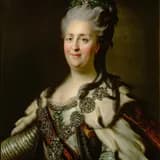
Catherine II dies in Saint Petersburg on 17 November 1796 at age 67, ending her 34-year reign as Empress of Russia.
Catherine II died in Saint Petersburg on 17 November 1796 (6 November Old Style), at age 67, following the stroke she had suffered the previous day. Her death marked the end of a 34-year reign, one of the longest and most transformative in Russian imperial history.
Under her rule, Russia had expanded its territory significantly through the partitions of Poland and wars against the Ottoman Empire, gained crucial access to the Black Sea, modernized aspects of its administration, economy, and legal system, and become a major cultural and intellectual center engaged with the European Enlightenment. She corresponded with philosophers such as Voltaire and Diderot, amassed the art collection that would become the core of the Hermitage Museum, and sponsored educational and public health initiatives including the Smolny Institute and smallpox variolation.
She was succeeded by her son, Paul I, whose troubled relationship with his mother and disagreement with many of her policies led him to reverse or dismantle several of her initiatives during his own brief reign. Catherine was buried in the Peter and Paul Cathedral in Saint Petersburg, the traditional burial site of Russian emperors.
Her legacy as Catherine the Great endures as one of history's most powerful and consequential female rulers, remembered for both her extraordinary political achievements and expansion of the Russian Empire, and for the contradictions of her reign, including the expansion of serfdom even as she engaged with Enlightenment ideals of liberty and reason.