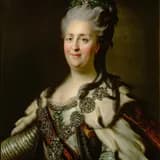
After deposing her husband Peter III in a coup, Catherine is proclaimed Empress of Russia on 9 July 1762.
On 9 July 1762 (Gregorian), Catherine achieved one of the most dramatic power seizures in European royal history. Her husband, Peter III, had become deeply unpopular during his brief six-month reign due to his admiration for Prussia, disdain for Russian customs, and withdrawal of Russia from the Seven Years' War against Frederick the Great—actions seen as a betrayal of Russian interests.
With the backing of the Imperial Guard regiments, key nobles, and her lover Grigory Orlov, Catherine marched into Saint Petersburg wearing a guards' uniform and was proclaimed autocratic Empress of Russia. Peter III abdicated days later and was killed shortly afterward under murky circumstances, likely with the complicity of Catherine's supporters, though her direct involvement remains historically debated.
This bloodless (for her) coup marked the beginning of one of the most transformative reigns in Russian history. As a foreign-born woman with no direct hereditary claim to the Russian throne, Catherine's accession was itself a remarkable political achievement, requiring exceptional strategic acumen, charisma, and the cultivation of military loyalty. Her 34-year reign that followed would see Russia's territory, prestige, and cultural sophistication expand dramatically, cementing her legacy as Catherine the Great.