← All women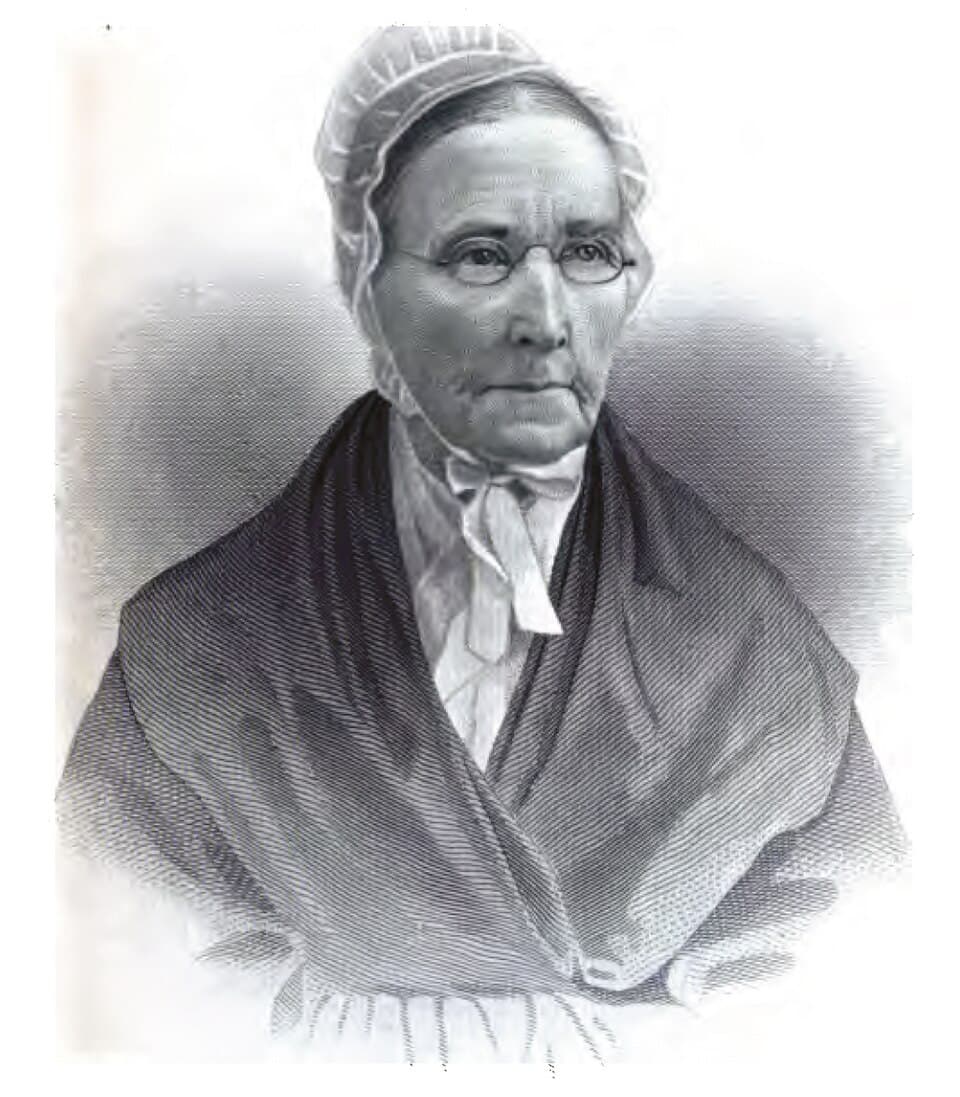
American · Activism
Catharine Coffin
September 10, 1803 – May 22, 1881
Early Life and Background
Catharine (Catherine) White Coffin was born on September 10, 1803, in Guilford County, North Carolina, to Stanton and Sarah White, members of the Religious Society of Friends (Quakers).[2][8][9] She grew up in a rural community where slavery was legally entrenched but where Quaker meetings increasingly condemned the institution on religious grounds. Quaker belief in the spiritual equality of all people and in peaceable conduct shaped her worldview from childhood, instilling a conviction that bondage was incompatible with Christian principles.
Sources indicate that Catharine’s family was part of a wider antislavery Quaker network in Guilford County, and that she was exposed early to practical efforts to aid enslaved people seeking escape.[7][18] While detailed records of her formal education are scarce, Quakers in the region commonly provided basic literacy and religious instruction, particularly to girls, so they could read Scripture and conduct household affairs. This education, combined with the quiet radicalism of Friends who refused to support slavery, laid the groundwork for her later activism.
Guilford County itself would prove significant in the history of resistance: it hosted routes used by freedom seekers and communities of free African Americans who collaborated with sympathetic whites. The environment in which Catharine came of age thus presented a stark contrast between the brutality of slavery and the moral witness of her faith community. These formative experiences helped make her willing, as an adult, to take personal risks in assisting enslaved people to claim their freedom.
Marriage and Partnership with Levi Coffin
On October 28, 1824, Catharine White married Levi Coffin, another Guilford County Quaker, at the Hopewell Friends Meetinghouse (Hopewell Church).[2] Their marriage united two families deeply opposed to slavery and created a partnership that later observers would call the "Parents of the Underground Railroad."[3] Quaker marriage customs, emphasizing equality and mutual consent, meant that Catharine entered the union not as a subordinate but as a spiritual and practical co-worker.
Levi’s later autobiography recounts his early involvement in aiding escapees, but contemporary scholarship stresses that Catharine shared these commitments and would prove indispensable to every phase of their work.[5][11] Shortly after their marriage, rising hostility toward antislavery sentiment in North Carolina, along with economic opportunities elsewhere, led the couple to consider relocation. They faced the challenge of leaving a familiar community for a region where they hoped to live without complicity in slavery and with greater freedom to assist escapees.
The 1824 marriage is therefore more than a family milestone; it marks the beginning of an organized, long-term joint campaign against slavery. Over the following decades, the Coffins’ household became both a family home and a carefully managed shelter for fugitives, with Catharine at the center of its daily operations.
Relocation to Indiana and the "Grand Central Station"
By 1826, Catharine and Levi Coffin had relocated from North Carolina to Newport, Indiana, a small town in Wayne County that would later be renamed Fountain City.[2][14] The couple opened a general store and settled into an eight-room brick house that they soon adapted for clandestine purposes. Located in a free state but within reach of key escape routes from Cincinnati, Madison, and Jeffersonville, Newport offered a strategic position along the emerging Underground Railroad.[5]
From their Indiana home, Catharine and Levi offered safe haven to enslaved African Americans fleeing bondage. According to later historical estimates, the Coffins assisted approximately 2,000 freedom seekers during their twenty years in Indiana.[2][5][6][17] Levi’s autobiography describes how "seldom a week passed" without new "passengers" arriving, highlighting the continuous nature of the work.[5] Catharine’s role was less publicly documented at the time but was central to these operations: she prepared food, managed sleeping arrangements, tended to the sick and injured, supervised children, and maintained secrecy.
The Coffin house in Newport featured concealed spaces and structural adaptations that made it difficult for slave catchers to locate fugitives. Local lore and later scholarship recount that one refuge who stayed there inspired the character Eliza, the heroine in Harriet Beecher Stowe’s Uncle Tom’s Cabin, and that Levi and Catharine were likely models for the fictional abolitionist couple Simeon and Rachel Halliday.[2][12] Whether or not the literary connection can be proven definitively, the association underscores the prominence of their work in antislavery memory.
Over time, the Coffin home earned the nickname "Grand Central Station" of the Underground Railroad, and Levi was dubbed the "President of the Underground Railroad."[5][6][18] Yet these titles obscure the fact that the house’s effectiveness depended heavily on Catharine’s daily labor and organizational skills. In practice, she transformed domestic responsibilities into instruments of resistance, coordinating with free Black neighbors and other Friends to move fugitives along the route to northern states and Canada.
Move to Cincinnati and Expansion of Abolitionist Work
In 1847, the Coffins left Indiana and moved to Cincinnati, Ohio, a growing river city situated opposite slaveholding Kentucky.[7][14] There they opened a "Free Produce" store designed to sell only goods not produced by enslaved labor, including textiles and groceries. This enterprise linked economic choices to moral conviction, inviting customers to participate in abolitionist principles through their purchases.
Operating a free produce business was financially precarious, given the higher cost and limited supply of such goods. Nonetheless, it represented an important experiment in ethical commerce. Catharine was closely involved in its operation, and the store became a gathering point for local abolitionists and reformers.[9][14] At the same time, the Coffins continued to offer shelter and assistance to fugitives in Cincinnati, now closer to the Ohio River crossings heavily used by escapees.
In Cincinnati, Catharine took on a more visible role in organized women’s activism. She joined the Cincinnati Anti-Slavery Sewing Circle, a female association that produced clothing for freedom seekers whose worn garments could reveal them as fugitives.[14][16] Members also sewed garments that functioned as disguises, helping escapees blend into free communities. Through sewing circles and antislavery fairs, Catharine helped raise funds for the broader abolitionist cause.
The move to Cincinnati thus marked an expansion of her work from household-based aid to leadership within women’s reform networks. Her participation demonstrates how women used conventional skills—needlework, caregiving, social organization—to enact radical challenges to slavery, operating at the intersection of domestic life and public activism.
Civil War Era and Aid to Freedpeople
During the 1860s, as the United States descended into and emerged from the Civil War, Catharine and Levi Coffin adapted their efforts to new circumstances. With the Emancipation Proclamation and Union advances, increasing numbers of formerly enslaved people fled to Union lines and settled in contraband camps, improvised communities often marked by scarcity and disease.[14]
According to modern accounts, the Coffins turned their attention toward assisting these wartime freedom seekers, providing supplies, medical care, and organizational support. Later, they became involved with the Western Freedmen’s Aid Society, a group that sought to support formerly enslaved people through education and basic necessities.[9][14] Catharine’s experience in managing safe houses and coordinating assistance was directly applicable to this new phase of humanitarian work.
In this period, Catharine helped extend the ethos of the Underground Railroad into post-emancipation efforts, recognizing that legal freedom did not automatically bring security or opportunity. Her work with freedpeople underscores the continuity between antebellum abolitionism and Reconstruction-era social reform, and reveals how women activists adapted their roles in response to changing legal and political conditions.
Personal Life and Family
Although detailed records of Catharine’s children and extended family are limited in the main historical surveys, genealogical sources indicate that she and Levi had offspring who grew up within an environment defined by Quaker discipline and antislavery activism.[8] Life in the Coffin household was marked by constant arrivals and departures of fugitives, often at night, and by the ever-present threat of discovery by slave catchers and hostile neighbors.
Catharine’s personal relationships extended beyond family to a wide circle of abolitionists and reformers. She and Levi met and corresponded with noted figures such as Harriet Beecher Stowe and other northern activists, and their home became a node in wider networks spanning Black communities, Quaker meetings, and evangelical reform circles.[5][18] Through women’s organizations and religious gatherings, Catharine formed bonds with other female reformers who shared her commitment to ending slavery and improving conditions for African Americans.
Within her marriage, Catharine maintained a partnership based on shared principles and mutual labor. While Levi often handled public speaking and travel, she managed the domestic logistics without which their work would have failed. Later recollections by visitors and descendants emphasize her calm demeanor, practical intelligence, and willingness to take personal risks, including facing hostile interrogations and potential legal penalties under fugitive slave laws.
Later Life and Death
In the decades after the Civil War, Catharine continued to support freedpeople and maintain connections with abolitionist allies. Levi’s death in 1877 brought an end to their joint public activism, but Catharine remained a respected elder within reform circles and among their extended community.[14]
On May 22, 1881, Catharine White Coffin died in Cincinnati, Ohio.[2][9] Some local histories give May 25 as the date, but the consensus of multiple formal references, including the Indiana Commission for Women and English and French Wikipedia, supports May 22 as the most reliable date.[2][9] She was 77 years old, having lived through the rise of militant abolitionism, the war that ended legal slavery, and the troubled Reconstruction era.
Her death marked the passing of a woman whose contributions had long been overshadowed by her husband’s public reputation. Nevertheless, in the communities that had benefited directly from the Coffins’ aid, and in the memories preserved by Quaker and local historians, Catharine remained recognized as an indispensable partner in the operation of one of the most important Underground Railroad stations in the country.
Awards, Honors, and Recognition
For many decades after her death, formal recognition of Catharine Coffin lagged behind that of Levi, as public narratives often privileged male leaders. However, renewed interest in women’s roles in the Underground Railroad and antislavery movements has brought her contributions to the forefront.
In 2015, the Levi and Catharine Coffin House in Fountain City, Indiana—already designated a National Historic Landmark—continued to be interpreted as a state historic site, highlighting both partners’ roles in assisting thousands of freedom seekers.[6][7][17] Interpretive materials increasingly emphasized Catharine’s domestic and organizational labor, as well as her involvement in women’s antislavery societies.
On October 24, 2015, Levi and Catharine Coffin were formally inducted into the National Abolition Hall of Fame and Museum in Peterboro, New York, during a public ceremony that honored their Underground Railroad leadership.[13] This induction placed Catharine among a select group of abolitionists commemorated by a national institution, explicitly recognizing her as a co-equal activist.
Recognition continued to grow in the twenty-first century. On March 2, 2024, the United States Postal Service unveiled its Underground Railroad Forever stamp series at the Levi and Catharine Coffin State Historic Site, featuring Catharine as one of ten historic figures honored for aiding thousands of freedom seekers.[10][13] The stamp series, announced and celebrated in collaboration with educators and historians, represents the first time she appeared on U.S. postage, symbolically integrating her story into the national iconography of resistance to slavery.
These honors—historic-site interpretation, Hall of Fame induction, and postal commemoration—collectively mark a significant shift in public memory, bringing Catharine’s name alongside Levi’s in discussions of Underground Railroad leadership and acknowledging women’s central role in the movement.
Legacy and Historical Impact
Catharine White Coffin’s legacy rests on her extensive, if often undocumented, contributions to the Underground Railroad and to post-emancipation aid for African Americans. Historians estimate that the Coffins assisted somewhere between 1,000 and 3,300 enslaved people in their flights to freedom, with more than 2,000 passing through their Indiana home alone.[2][3][5][6] Catharine’s work—feeding, sheltering, nursing, clothing, and counseling fugitives—was indispensable to the success of these operations.
Her life highlights the critical role of women in abolitionist networks. While male activists frequently delivered speeches, published tracts, and negotiated across political arenas, women like Catharine maintained the hidden infrastructure—safe houses, supply lines, and care systems—that allowed escapees to survive the journey. Through sewing circles, antislavery fairs, and aid societies, women also raised funds and awareness, providing material support that complemented public agitation.
Catharine’s story further illuminates the interplay between religious conviction and social reform. As a Quaker, she grounded her resistance to slavery in the belief that all people possess an inner light and are equal before God. This theology justified civil disobedience against unjust laws and encouraged cross-racial cooperation. Her home became a site where Black and white collaborators enacted a different social order—one based on mutual aid and shared dignity.
Modern scholarship and public history projects, including exhibits at the Levi & Catharine Coffin State Historic Site and educational materials produced by the Indiana State Museum and historical societies, have increasingly centered Catharine’s contributions.[1][5][15][18] Podcasts, articles, and digital resources also highlight her role, countering the tendency to frame her solely as "Levi’s wife" and instead presenting her as a strategist and caregiver whose work saved countless lives.
Her inclusion in the National Abolition Hall of Fame and on the Underground Railroad stamp series reflects a broader effort to correct gender imbalances in the historical record. For women’s history, Catharine Coffin exemplifies how domestic labor and religiously motivated compassion could become powerful tools of resistance, and how women’s contributions, long overshadowed, can be recovered and celebrated through careful research and public commemoration.
Assessment in Women’s and Abolitionist History
In historiographical terms, Catharine Coffin occupies a space at the intersection of abolitionist study, women’s history, and the history of religion in America. Her life provides a case study in how women exercised agency within the constraints of nineteenth-century gender norms, using accepted roles—wife, mother, homemaker, seamstress—to undermine the foundations of slavery.
She also demonstrates the importance of collaboration between Black communities and white allies. While sources centered on the Coffins naturally focus on their activities, the success of their station relied on free African Americans and other conductors who guided fugitives from one refuge to another. Catharine’s relationships with these collaborators, though less documented individually, were essential to the functioning of the network.[7][18]
Finally, Catharine’s delayed recognition underscores how historical memory is shaped by archival practices and narrative choices. Levi’s published autobiography and public reputation made his story easier to recover; Catharine’s contributions, embedded in domestic routines and informal networks, required more interpretive work to bring to light. The growing body of work on her life demonstrates the value of revisiting familiar stories with attention to gender, class, and race, revealing the many hands that sustained movements for justice.
Today, researchers, educators, and visitors to the Coffin historic site encounter Catharine not only as a supporting figure but as a central protagonist in the struggle against slavery. Her legacy continues to inform discussions of moral courage, civil disobedience, and the transformative power of everyday acts of care in times of profound injustice.
Dated achievements
7 indexed.
- Sep101803Activism
Birth of Catharine White Coffin
Catharine White was born to Stanton and Sarah White in Guilford County, North Carolina, future Quaker abolitionist and Underground Railroad operative.
View details Catherine White Coffin - Wikipedia - Oct281824Activism
Marriage to Levi Coffin at Hopewell Friends Meetinghouse
Catharine White married fellow Quaker Levi Coffin in Guilford County, North Carolina, forming the partnership central to their later Underground Railroad work.