← All women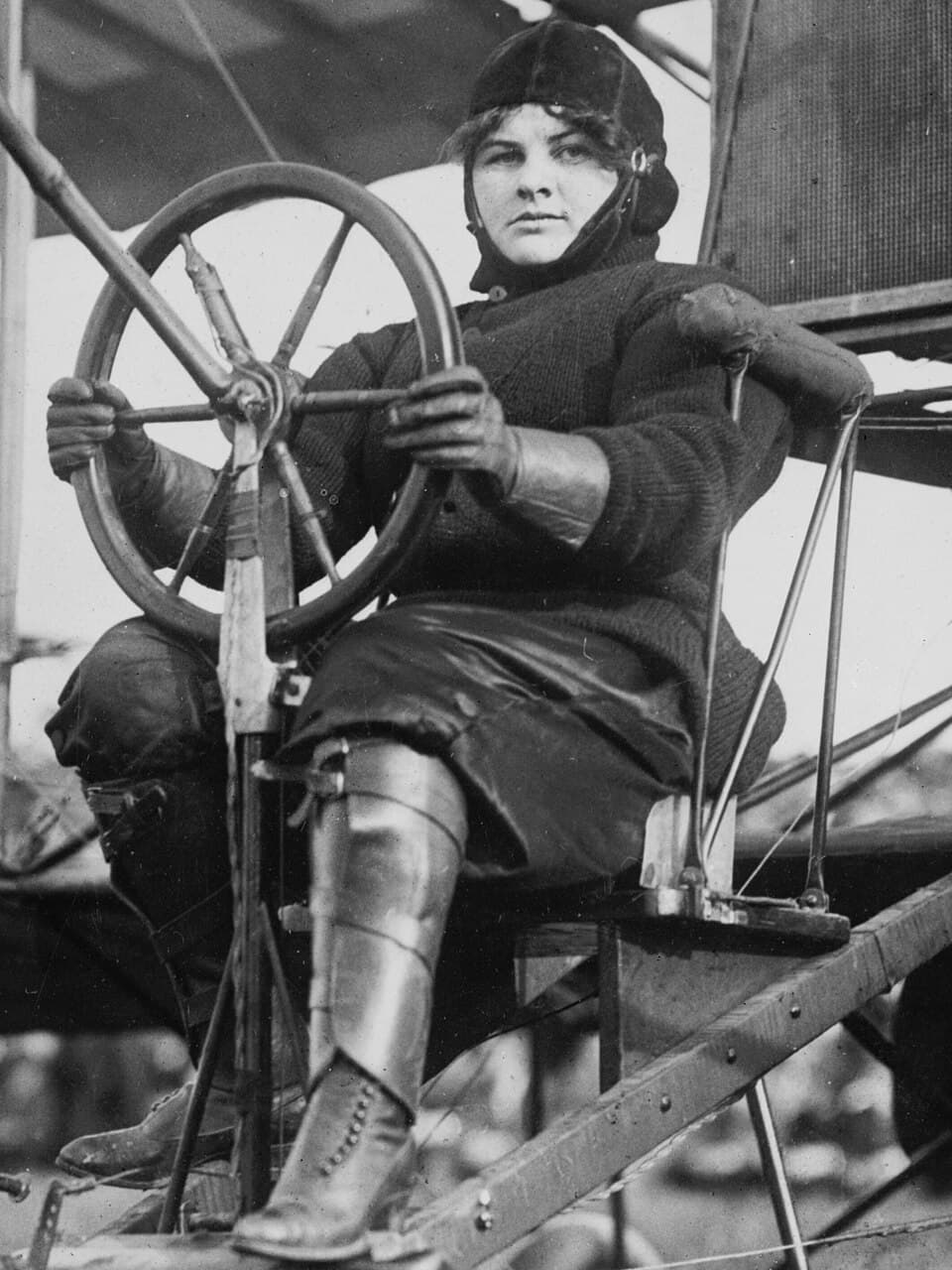
American · Aviation · Exploration
Blanche Scott
April 8, 1885 – January 12, 1970
Early life and background
Blanche Stuart Scott was born on April 8, 1885, in Rochester, New York.[1][2] Most modern biographical references—including encyclopedia entries and museum profiles—give 1885 as her birth year, although some later sources, such as certain aviation enthusiast sites and foreign-language Wikipedias, list 1889.[5][13] The weight of scholarly and institutional evidence favors 1885, and that date is now widely used in women’s‑history scholarship.
Scott grew up in a relatively well‑off family; her father operated a successful business, which meant the household could afford automobiles once they became available.[1] Biographers describe her as a spirited, mechanically curious child, fascinated by engines and driving at a time when respectable women were expected to remain passengers rather than drivers.[1][6] This early exposure to cars and machinery laid the foundation for her later embrace of automobile touring and aviation.
Little is recorded about her formal schooling, but narrative biographies emphasize her independent streak and love of speed. She reportedly learned to drive at a young age, defying prevailing norms that associated women with domesticity and caution.[1][6] Her experience maneuvering early automobiles on rough roads helped develop the confidence and technical intuition that would prove crucial when she moved into flying.
Career beginnings: Automobiles and cross-country drive
Scott’s first major public adventure came not in the air but on the road. In 1910, the Willys‑Overland Company sponsored an automobile publicity tour intended to showcase the reliability of its Overland cars.[1][4] Scott, having already demonstrated skill as a driver, was chosen to pilot an Overland from New York to San Francisco, accompanied by journalist Gertrude Buffington Phillips.[1][4]
The journey began on May 1, 1910, when Scott and Phillips departed New York.[4] Over the following weeks they navigated poor roads, inconsistent signage, and limited mechanical support.[4][6] The United States lacked the paved highway network that would emerge decades later; much of their route consisted of rutted dirt tracks or wagon roads, requiring mechanical improvisation and physical stamina. Scott’s willingness to drive long hours and handle repairs challenged public assumptions that women were unsuited to such tasks.
In July 1910, she completed the journey, arriving in San Francisco and becoming one of the earliest women to drive across the United States.[1][4] Historians emphasize that she was not the first woman to complete a coast‑to‑coast drive—Alice Huyler Ramsey had done so in 1909—but Scott’s trip was highly publicized and firmly established her as an adventurous "autoist".[1] Newspapers and advertising materials portrayed her as a modern, daring woman behind the wheel, helping to normalize women’s presence as drivers rather than passengers.
This high‑profile automobile feat proved pivotal for her career. Her visibility drew the attention of aviation promoter Jerome Fanciulli, associated with the Curtiss Exhibition Team, who perceived that Scott’s combination of mechanical skill and public appeal could translate into success in the brand‑new field of exhibition flying.[3] He approached her about learning to fly, initiating her transition from road to sky.
Training with Glenn Curtiss and early flights
Scott began flying in August 1910 at Hammondsport, New York, home base of aviation pioneer Glenn Hammond Curtiss.[1][2][4] Curtiss, a leading designer of early airplanes, was initially reluctant to teach a woman. Concerned about the risks and skeptical of women’s place in aviation, he reportedly inserted a wooden block behind the throttle to limit Scott’s power during training.[3][6]
Despite these constraints, Scott quickly developed proficiency. On September 2, 1910, at Lake Keuka Field in Hammondsport, she made a short solo hop in a Curtiss biplane.[12] Accounts describe a gust of wind lifting the airplane into the air while she was practicing, but Scott maintained control long enough to land safely. The flight was brief, yet it is widely credited by museum and aviation historians as the first solo airplane flight by an American woman.[4][6][12] Some scholars note that the flight was considered "unofficial" at the time, but it nonetheless marked a watershed moment in women’s aviation.
Just a few days later, on September 6, 1910, she made a more clearly controlled flight at Hammondsport.[2] The Federal Aviation Administration’s historical profile reports that a gust of wind lifted her aircraft to about 40 feet, and she successfully maneuvered and landed.[2] This event is often cited as the point at which Scott became the first American woman to pilot an airplane in a controlled demonstration, moving beyond accidental lift into purposeful flight.
These early flights did more than establish Scott’s personal credentials. They directly challenged prevailing gender norms in aviation. Curtiss’s initial effort to prevent her from fully opening the throttle illustrates institutional hesitation about women in the cockpit.[3] Scott’s success demonstrated that women could handle the technical demands and physical risks of piloting, helping to chip away at such resistance.
Exhibition career and "Tomboy of the Air"
Scott soon joined the Curtiss Exhibition Team, becoming the first and only woman that Curtiss personally trained.[5][11] As part of the team, she toured the United States, performing at air meets that served as major public spectacles of modern technology. She quickly gained a reputation for daring stunts.
On October 23, 1910, Scott made her first public flight at an air meet in Fort Wayne, Indiana.[1][8][11] Flying a Curtiss biplane to an altitude of about 12 feet before a crowd of thousands, she became the first woman to fly at a public event in America and the first woman aviator to make a professional appearance in the country.[1][10][11] She was billed as the "Tomboy of the Air," a nickname reflecting both her gender‑defying presence and her high‑risk performance style.
During her exhibition career, Scott performed inverted flight and dramatic "death dives," in which she would dive from altitudes up to 4,000 feet and pull out only a few hundred feet above the ground.[3][11] These stunts were extremely hazardous in the fragile aircraft of the era, and they contributed to her notoriety and earning power. Contemporary accounts suggest she could earn up to $500 a week—significant income for a woman at the time—appearing at meets alongside famous aviators such as Lincoln Beachey and Harriet Quimby.[3]
Scott’s exhibitions played a dual role. They entertained crowds hungry for technological thrills, and they functioned as proof that women could master advanced machines in public arenas. Her presence at air meets helped normalize the idea of women as pilots and performers, not merely spectators, and provided an early model for other women who would later pursue aviation careers.
Record-setting flights
Beyond stunt work, Scott also engaged in record‑setting flights that expanded the perceived capabilities of women pilots. On July 30, 1911, she set a women’s long‑distance flying record of 10 miles.[1] This flight, likely from a field in New York, required sustained control over the aircraft, including management of fuel, engine performance, and navigation over a continuous route. It marked a shift from brief demonstration hops to endurance flying.
Later that year, she reached a 25‑mile women’s distance record in August 1911.[1] Although the exact day is not documented, sources agree that she extended her range significantly beyond the 10‑mile mark. These incremental records built toward a more dramatic achievement: in 1911, Scott flew a non‑stop 60‑mile route from Mineola, New York, landing back at the field.[3][11] Women’s‑aviation historians describe this as the first long‑distance flight by a woman in America.[3][11]
Scott reportedly took off impulsively for the 60‑mile flight, staying aloft far longer than planned.[3] In the context of early aviation, when mechanical failures were common and navigational aids sparse, such a decision required considerable courage. The success of the flight demonstrated that a woman pilot could manage the physical demands and technical responsibilities of long‑distance flying, qualities that had previously been associated almost exclusively with male aviators.
These records enhanced Scott’s standing within the aviation community and provided concrete benchmarks for women’s achievements in flight. They also contributed to the emerging culture of competition in aviation, encouraging other women to pursue their own distance, altitude, and speed records.
First woman test pilot and work in film
In 1912, Scott’s career took a new turn when she joined designer and aviator Glenn L. Martin.[1][3][11] As an employee of the Martin company, she became the first woman test pilot in America, flying prototype aircraft before designs were finalized.[1][3][11] Testing prototypes was among the most dangerous assignments in aviation; it involved evaluating new configurations whose stability and reliability were not yet proven.
Scott’s work as a test pilot required a high degree of technical understanding and courage. She flew Martin prototypes in their developmental stages, providing feedback that helped refine designs before they entered production.[3] Her role placed her not just in the public eye but at the center of the design process, demonstrating that women could contribute substantively to aviation engineering and testing.
Around the same time, Scott also entered the world of motion pictures. She is credited as the first woman to pilot an aircraft in film, in the 1912 production The Aviator and the Autoist Race for a Bride.[7] In this movie, she flew on camera, using her piloting skills to help tell a comedic narrative about modern transportation. The film showcased both automobiles and airplanes, capitalizing on Scott’s expertise in both domains.
Her participation in early aviation film further broadened public exposure to women pilots. Cinema audiences saw a woman confidently controlling an airplane, reinforcing the message that aviation could be open to women and that they could be portrayed as active agents in technological modernity.
Retirement from flying and later media work
By the mid‑1910s, Scott was increasingly troubled by the nature of public interest in aviation. She disliked what she perceived as spectators’ fascination with crashes and fatalities, and she was frustrated by the lack of professional opportunities for women in technical roles such as mechanics or engineers.[1][3][11] In 1916, she retired from exhibition flying.[3][11]
After leaving active aviation, Scott moved into radio and film writing. She worked in Hollywood as a scriptwriter, film producer, and radio broadcaster.[3][5] These roles drew on the performance skills and storytelling sense she had developed as a public aviator. Her media work reflected a broader pattern among early aviators, many of whom transitioned into entertainment and communication industries that valued their adventurous reputations.
Although she no longer flew, Scott remained engaged with aviation history. In the 1950s, she served as a special consultant to the U.S. Air Force Museum at Wright‑Patterson Air Force Base in Dayton, Ohio.[3] In that capacity, she helped curate exhibits and advise on the interpretation of early aviation materials, ensuring that the stories of pioneering pilots—including women—were accurately represented.
Return to the air: first woman in a jet
Scott’s most famous post‑retirement aviation moment came in 1948. On September 6, 1948, she flew as a passenger with Major Charles E. "Chuck" Yeager in a two‑seat Lockheed TF‑80C Shooting Star (later redesignated the T‑33A).[12] This flight made her the first woman to ride in a jet‑powered aircraft.[6][12]
Yeager, already renowned for breaking the sound barrier in 1947, invited Scott to fly in recognition of her pioneering status. The flight symbolically linked the earliest era of American aviation—represented by Scott’s 1910 biplane hops—with the cutting‑edge jet technology of the postwar Air Force.[6][12] For Scott, who had first flown in open‑cockpit, fabric‑covered machines, taking off in a sleek, high‑speed jet underscored the dramatic technological changes she had witnessed over her lifetime.
Her jet ride also carried gender significance. Military jets were overwhelmingly male domains, and women’s access to such aircraft as pilots or passengers was highly restricted. Scott’s presence in Yeager’s cockpit signaled growing institutional recognition of women’s contributions to aviation and provided a powerful image of continuity between early women aviators and the modern aerospace era.
Awards, honors, and recognition
Scott’s contributions have been honored by numerous organizations and institutions. She has been inducted into the National Women’s Hall of Fame, which highlights her status as one of the first women to drive across the United States and the first woman to fly in America.[1] The Hall’s profile emphasizes her cross‑country drive, her Hammondsport flights, and her professional exhibition career.
The Federal Aviation Administration features her in its list of aviation pioneers, crediting her as the first American woman to fly, the first woman to fly publicly at a professional event, and the first woman to ride in a jet.[2] The Women in Aviation International Pioneer Hall of Fame also recognizes Scott, recounting her exhibition career and her later work as a test pilot for Glenn Martin.[3]
Museum exhibits have further cemented her legacy. The Smithsonian National Air and Space Museum has produced interpretive essays—such as "First Solo Hop" and "The Tomboy of the Air"—examining Scott’s contested "firsts" and exploring how her flights compare with those of Bessica Raiche.[4][8] The Smithsonian National Postal Museum has featured her in its "Women on Stamps" series, presenting Scott as a pioneering "aviatrix" whose adventurous life merited commemorative philatelic recognition.[6]
Regional histories, particularly in Rochester and upstate New York, celebrate her as a local figure who gained national renown. Articles and lectures, including pieces in regional magazines, revisit her story to highlight the city’s connection to early aviation and women’s history.[9]
Personal life
Details of Scott’s personal life are relatively sparse in comparison to her public exploits. Most biographical sources focus on her professional activities—driving, flying, and media work—rather than on family arrangements.[1][3][5] Popular accounts note that she never married and had no children, though some early press references referred to her as "Miss Scott," consistent with that status.[5]
Her decision to remain unmarried and to live a life centered on travel, performance, and work in male‑dominated fields was itself noteworthy in the early 20th century. It allowed her to pursue extensive touring schedules and take on risky assignments that would have been difficult within conventional domestic roles. Her personal independence was closely tied to her ability to challenge gender norms in public life.
Later in life, Scott maintained connections with both aviation and media communities. As a consultant to the Air Force Museum, she interacted with researchers, curators, and military personnel, sharing first‑hand memories of early flight. Her radio and film work kept her engaged with storytelling and communication, enabling her to shape narratives about aviation and modernity.
Legacy and historical impact
Blanche Stuart Scott occupies a crucial place in women’s and aviation history. She is widely recognized as the first American woman to solo in an airplane and the first woman to fly publicly at a U.S. aviation meet.[1][2][4][11] Her long‑distance records in 1911 and her role as the first woman test pilot for Glenn Martin further demonstrate the breadth of her contributions.[1][3][11]
Her career illustrates how women entered technological fields not through formal engineering channels but via exhibition and publicity roles. Scott’s automobile drive was sponsored as a marketing venture; her transition to aviation came through promoter Jerome Fanciulli; her film work drew on her public persona as a daring aviatrix. Yet within these promotional frameworks, she exercised genuine technical skill and made meaningful contributions to the development of flight.
Scott’s story also highlights the complexity of "firsts" in historical memory. The Smithsonian and other scholars have noted conflicting evidence about whether Scott or Bessica Raiche should be credited as America’s first female solo pilot.[8] Raiche made a well‑documented flight in October 1910, and some contemporary organizations recognized her achievement. Many later aviation histories, however, point to Scott’s Hammondsport flights in September. Rather than resolving this debate definitively, museums tend to present both women as pioneers, using the controversy to explore how gender and publicity shaped recognition in early aviation.
In terms of gender history, Scott helped expand public imagination about what women could do. Her presence as a stunt pilot performing inverted flight and death dives challenged notions of female fragility and passivity. Her long‑distance records demonstrated endurance and technical competence. Her later work as a test pilot and consultant showed that women could contribute to aviation beyond performance and spectacle.
Scott’s influence can be traced in the paths of later women aviators, from Harriet Quimby and Matilde Moisant in the early years to mid‑century and contemporary pilots. She did not hold a formal pilot’s license—licenses for women were rare and bureaucratically constrained in her time—but her achievements nonetheless helped legitimize women’s presence in the cockpit and inspired others to pursue licensed, professional careers.
Later life and death
After retiring from flight in 1916, Scott’s public visibility diminished but did not disappear. Her radio and film writing in Hollywood kept her connected to evolving media industries.[3] In the post‑World War II era, as interest in aviation history grew, she was increasingly sought out for interviews and public appearances, particularly around anniversaries of early flights.
Her 1948 jet flight with Chuck Yeager brought her briefly back into the national spotlight, framing her as a living link to the dawn of aviation.[6][12] Over the following decades, she remained involved with the Air Force Museum, helping shape collections and interpretations related to early aviators.[3]
Scott died on January 12, 1970, at Genesee Hospital in Rochester, New York, the same city in which she had been born.[2][5][12] She was about 84 years old. Obituaries and subsequent historical works emphasized her status as a pioneering "Tomboy of the Air" and recounted her cross‑country automobile drive, her Hammondsport flights, her exhibition career, and her jet ride with Yeager.[2][11]
In the decades since her death, Scott’s life has been revisited by historians, museum curators, and women’s‑history advocates. While some details—such as her exact birth year and the precise status of certain "firsts"—remain subjects of debate, her role as a trailblazer is firmly established. She stands as a key figure in the story of how women entered, shaped, and were eventually recognized within the field of aviation.
Dated achievements
10 indexed.
- Apr081885Aviation
Birth of Blanche Stuart Scott
Birth of Blanche Stuart Scott in Rochester, New York, a future pioneering American aviator.
View details Scott, Blanche (c.1885–1970) – Encyclopedia.com - May011910Exploration
Cross-country automobile drive begins
Scott and Gertrude Buffington Phillips depart New York on an Overland car drive to San Francisco.