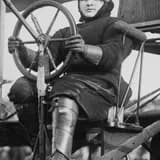
Scott and Gertrude Buffington Phillips depart New York on an Overland car drive to San Francisco.
On May 1, 1910, Blanche Stuart Scott, accompanied by journalist Gertrude Buffington Phillips, set out from New York in an Overland automobile to drive to San Francisco. Sponsored by the Willys‑Overland Company, the journey was partly a publicity stunt for the car and partly a personal challenge for Scott.
Over the following weeks she negotiated poor roads, scarce fuel supplies, and limited mechanical support, at a time when cross‑country infrastructure was rudimentary and maps were unreliable. Scott’s drive made her one of the earliest women to cross the United States by automobile, following Alice Huyler Ramsey’s pioneering 1909 trip, and helped normalize the idea of women as capable long‑distance drivers.
Press reports framed Scott as an adventurous "motor girl," challenging Victorian norms that saw women as passengers rather than drivers. Her overland journey demonstrated not only physical endurance but also mechanical competence, since she had to cope with breakdowns and maintenance far from urban garages.
Although not the first coast‑to‑coast female motorist, this May 1 departure is historically significant as a high‑profile, manufacturer‑backed expedition that showcased a woman at the wheel for weeks on end. It broadened public visibility of women’s mobility, served as a precursor to her aviation career, and showed that Scott was willing to test technological limits and societal expectations alike.