← All women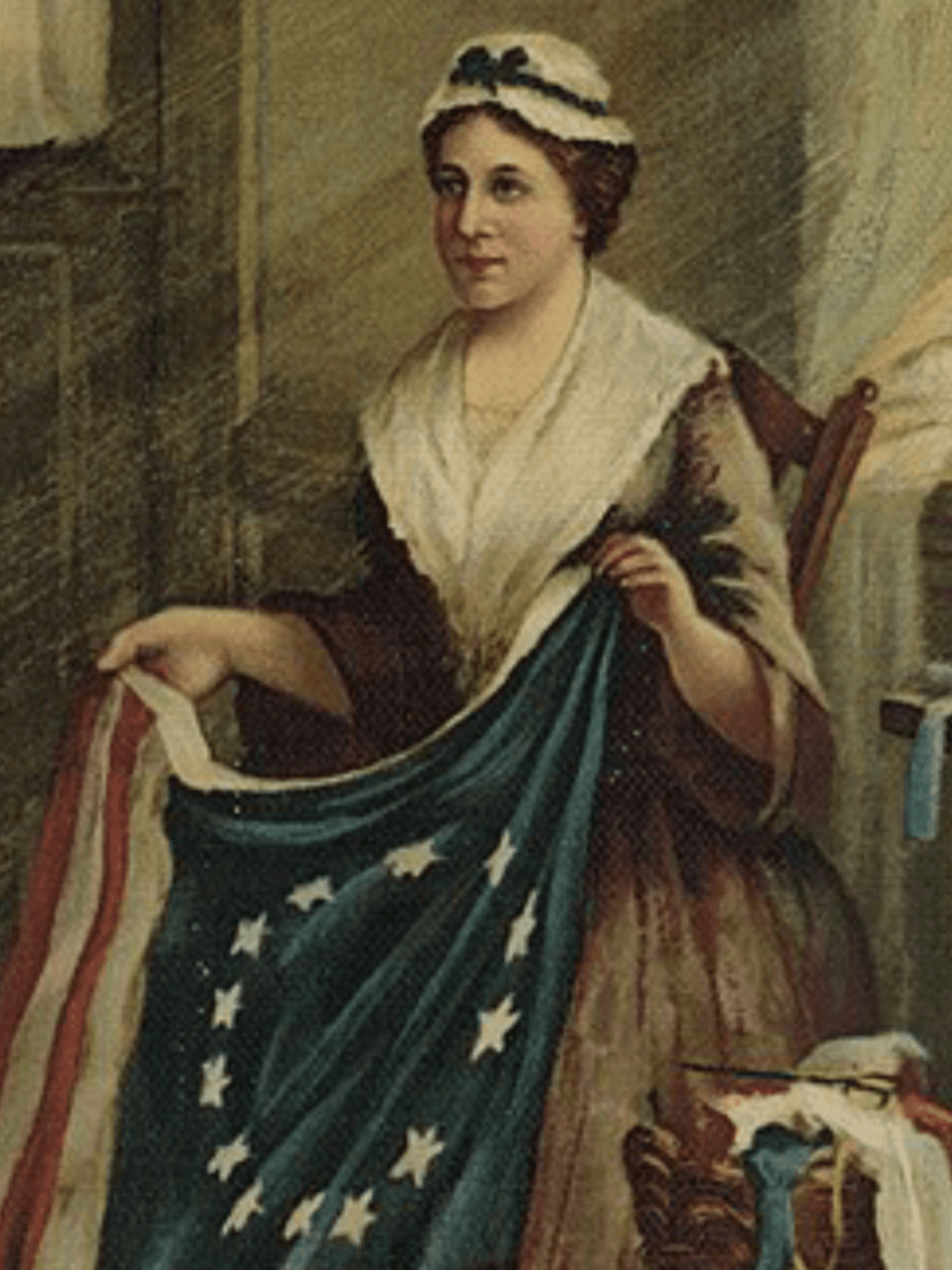
American · Arts · Activism
Betsy Ross
January 1, 1752 – January 30, 1836
Early life and background
Elizabeth "Betsy" Griscom was born on January 1, 1752, in the Philadelphia area to Samuel Griscom and Rebecca James, members of the Society of Friends, commonly known as Quakers.[3][16] She was one of seventeen children in a strict, working‑class Quaker family, a background that emphasized simplicity, hard work, and community responsibility.[1][3][15] Some sources identify nearby Gloucester City, New Jersey, as her birthplace, reflecting the mobility of artisan families in the mid‑Atlantic region.[9] Whatever the exact location, she grew up in and around colonial Philadelphia, one of the largest and most vibrant urban centers in British North America.
Quaker girls typically received basic literacy and religious instruction but were expected to contribute to the household economy through domestic work and craft skills. In this environment, Betsy demonstrated aptitude with sewing and textiles. As a teenager, she was apprenticed to an upholsterer, William Webster, in Philadelphia.[1][3] Upholstery in the eighteenth century encompassed furniture covering, curtains, bedding, and decorative trimming, and it required skill in cutting, stitching, and design as well as business acumen. This apprenticeship placed Ross squarely within the artisanal world that supplied material goods to both private households and public institutions.
Her Quaker upbringing also shaped her social and religious identity. The Society of Friends discouraged ostentation and closely regulated members’ conduct, including marriage. Betsy’s later decision to marry outside the faith would bring her into conflict with the Quaker community and alter her life trajectory, illustrating how religious discipline intersected with women’s personal choices in colonial America.[1][3]
Career beginnings and development
During her apprenticeship with William Webster, Betsy honed the technical skills and customer contacts that would be crucial to her later career as a self‑employed upholsterer. Upholstery shops in Philadelphia served a diverse clientele, from merchants and professionals to government bodies, and they could be contracted to produce tents, bed hangings, and flags as well as household furnishings. Betsy worked alongside other artisans, gaining experience in pattern cutting, hand sewing, and negotiating with customers.[1][3]
In 1773, Betsy married John Ross, a fellow upholsterer, in a ceremony conducted outside the oversight of the Quaker meeting.[1][3] John was the son of an Anglican rector, and because he did not belong to the Society of Friends, the marriage violated Quaker discipline. As a result, Betsy was disowned by her meeting, losing formal membership in her religious community.[1][3][15] The couple nonetheless established an upholstery shop together in Philadelphia, combining their skills to service local clients. Their shop produced a range of goods including chair covers, cushions, and possibly military supplies as the political situation in the colonies deteriorated.
With the outbreak of the American Revolutionary War in 1775, Philadelphia became a key center for provisioning Continental forces. Artisans who could supply uniforms, tents, and flags found new business opportunities. According to later accounts, Betsy and John Ross’s shop participated in this wartime economy. In 1776, John Ross died, likely as a result of an explosion while guarding munitions for the colonial forces, leaving Betsy a young widow.[1][3][4] Widowed women in the artisan class often continued to operate family businesses, and Ross appears to have kept the upholstery shop running, supporting herself through sewing and textile work.
The earliest firm documentary link between Ross and flag making comes from a 1777 receipt from the Pennsylvania State Navy Board, showing that she was paid for "making ship’s colours &c." for the state navy.[4][6][17][19] Although the exact day and month of the receipt are not consistently reported, the record demonstrates that Ross was one of several professional flag makers in Philadelphia serving military clients during the war. Over the following decades, she and her family continued to contract for flags and other supplies, establishing a long‑standing reputation in this specialized craft.[10][12]
Major works, claims, and documented accomplishments
Ross’s historical reputation rests on a combination of documented work as a flag maker and a later, highly influential legend that she designed and sewed the first American flag. The documented portion of her career is clear: she produced flags, uniforms, and other textiles for the Pennsylvania navy and, later, for federal authorities. By the early nineteenth century, on the eve of the War of 1812, she was regarded as one of Philadelphia’s principal suppliers of government flags.[10][12] Her work as a contractor illustrates how women’s artisanal labor underpinned the functioning of the early American state.
The contested claim concerns whether Ross was responsible for creating the first "stars and stripes" flag of the United States in 1776. According to a family story later recounted by her grandson William J. Canby, Ross was approached in 1776 by George Washington, accompanied by a congressional committee—often named as Robert Morris and George Ross—and asked to design and sew a new flag symbolizing the rebellion against British rule.[3][4][5][15][17][19] In this tale, Ross suggested changing the stars from six points to five because they were easier to cut and arranging them in a circle. She then supposedly produced the first flag in her upholstery shop.
No contemporaneous evidence has been found to corroborate this story. Extensive searches of the journals and correspondence of the Continental Congress and of Washington’s papers have uncovered no record of a flag committee or of Ross’s involvement in 1776.[2][5][6] The family narrative first entered the historical record nearly a century later. On May 8, 1870, Canby presented a paper to the Historical Society of Pennsylvania recounting the story based on conversations he said he had had with his grandmother in the 1850s.[3] This is the earliest known written account linking Ross to the first flag.
The legend gained wider currency when Canby’s narrative was published in Harper’s New Monthly Magazine in the issue dated July 1, 1873.[3][4] The magazine’s national reach helped spread the image of Betsy Ross as the humble seamstress who suggested a circle of stars and stitched the first "stars and stripes". In the decades leading up to the U.S. centennial in 1876, popular pamphlets and patriotic literature elaborated on Canby’s claims, sometimes attributing to Ross extravagant feats such as inventing the name "United States of America" or inspiring the French national anthem. These embellishments have no basis in evidence but contributed to the rapid growth of her legend.[3][4]
By the late nineteenth century, the Betsy Ross story had become deeply embedded in American culture. The "Betsy Ross flag"—an early U.S. flag design with thirteen stars arranged in a circle—was retrospectively named for her more than a century after such flags first appeared.[18] The flag conforms to the Flag Act of 1777, which specified thirteen stars and stripes but did not mandate their arrangement.[18] Artists and manufacturers adopted the circular star pattern as a visual shorthand for the Revolutionary era, and Ross’s name became attached to this design as her legend spread.
Modern historical research, however, has consistently failed to verify the claim that Ross created the first official U.S. flag. Scholars point instead to Francis Hopkinson, a New Jersey delegate to the Continental Congress and designer, as the most likely originator of the early stars‑and‑stripes motif, based on contemporary documents showing his requests for payment for designing national symbols.[2][5][6][15] As historian Marc Leepson summarized in his 2005 book Flag: An American Biography and in a 2008 interview, "every historical study has come to the same conclusion. There’s no good historical evidence that she did" make the first flag; most historians therefore believe the Ross story is apocryphal.[2]
Despite this, Ross’s concrete accomplishments remain significant. She was a successful upholsterer and flag maker whose business produced flags for government clients over more than fifty years.[10][12][16] Her surviving receipts and the testimony of later observers confirm that she and her family were central participants in the flag‑making trade in Philadelphia. In 2009, the Pennsylvania Historical and Museum Commission erected a state historic marker near the Betsy Ross House acknowledging that she has long been "credited with making the first stars and stripes flag" while emphasizing her documented role as a skilled artisan and symbol of women’s economic contributions.[12]
Awards, honors, and recognition
Betsy Ross did not receive formal awards in her lifetime for flag making or upholstery, as such recognition was rare for artisans and especially for women in eighteenth‑century America. Instead, her honors have largely been posthumous and symbolic, reflecting the evolution of her legend and the changing place of women in public memory.
In the late nineteenth and early twentieth centuries, Ross’s image was widely used in patriotic pageantry, schoolbooks, and consumer advertising.[3][15][18] She appeared on trade cards and commercial packaging, and women’s suffrage advocates sometimes invoked her as a "Founding Mother" to argue for the political rights of women.[15] These cultural references elevated Ross as one of the few widely recognized female figures associated with the Revolution.
The opening of the Betsy Ross House as a public museum in 1901 further institutionalized her fame. The site, a restored eighteenth‑century house in Philadelphia associated with Ross’s life, was promoted as the "birthplace of the American flag" and drew tourists eager to see where she supposedly stitched the first flag.[1][6][13] Interpretive materials at the museum long relied on the Canby narrative, but over time they have incorporated more critical perspectives on the legend.
On January 2, 1952, the U.S. Post Office Department issued a 3‑cent commemorative stamp depicting Ross sewing a flag, explicitly honoring her as the maker of the first American flag.[6] Although the stamp was immediately criticized by historians and collectors who pointed out the lack of authentic evidence for the claim, its release demonstrates her continued popularity in mid‑twentieth‑century patriotic culture.
In April 2009, the Pennsylvania Historical and Museum Commission placed a historic marker in front of the Betsy Ross House recognizing her "contributions" and noting that she produced flags for the government for over fifty years.[12] The marker frames her as a representative of "the many women who supported their families during the Revolution and early Republic," integrating her story into a broader narrative about women’s work.
More recently, academic and public‑history institutions have revisited Ross’s legacy in light of modern scholarship. The National Women’s History Museum, the Museum of the American Revolution, and other organizations now emphasize her role as a working artisan and flag maker while acknowledging that the first‑flag story cannot be substantiated.[1][10] Articles in venues such as The Conversation (2024) use her case to explore how women’s labor during the Revolutionary era has been remembered—or distorted—by later generations.[5][19]
Personal life
Betsy Ross’s personal life was marked by multiple marriages, religious conflict, and extensive family responsibilities, typical of many women in the Revolutionary generation. Her first marriage, to John Ross in 1773, involved considerable personal risk. Because John was not a Quaker, Betsy’s decision to marry him led the Society of Friends to disown her, effectively expelling her from the religious community of her birth.[1][3] The couple opened an upholstery business that supported them until John’s death during the early stages of the Revolutionary War.
Widowed at a young age, Betsy continued to operate the upholstery shop, taking on more responsibility for managing clients and production. In 1777, she married Joseph Ashburn, a sailor and merchant, and her surname became Ross Ashburn.[3] Ashburn’s maritime work brought him into the war at sea; he was captured by the British and died in prison in England in 1782.[3][1] During this period, Betsy bore at least one child and balanced domestic duties with running the upholstery and flag‑making operation.
Her third marriage, in 1783, was to John Claypoole, a former fellow prisoner of Ashburn who had returned from England.[3][1] With Claypoole, Betsy had additional children, and the couple continued the family upholstery and flag business well into the early nineteenth century. Ross is often referred to by all three married names—Ross, Ashburn, and Claypoole—reflecting both the succession of marriages and her persistence as a businesswoman across changing personal circumstances.[3]
Ross’s household combined family life with workshop production. Like many artisan families, the Ross–Ashburn–Claypoole home likely doubled as a workspace where apprentices, journeymen, and relatives participated in sewing and fabrication. Betsy’s daughters and other kin reportedly assisted in flag making, contributing to a multigenerational enterprise.[10][16] Her story thus highlights the blurred boundaries between domestic and economic spheres for women in the early United States.
Later life and death
In her later years, Betsy Ross remained active in the upholstery and flag‑making trade, gradually transferring responsibilities to her daughters and other family members as her health declined.[10][16] By the time of the War of 1812, she was recognized as a leading flag maker for the federal government in Philadelphia, reflecting decades of experience and a well‑developed network of clients.[10] Even as younger relatives took on more of the physical labor, Ross’s expertise and reputation underpinned the family business.
She lived through the transition from British colonial rule to the independent United States, the formation of the federal government, and the early expansion of the republic. Over this period, the demand for flags increased, and the symbolism attached to them deepened. As someone who had sewn flags since the Revolution, Ross witnessed firsthand how a practical military signal became a potent national emblem.
Betsy Ross died on January 30, 1836, in Philadelphia, at around 84 years of age.[3][9][16] She was initially buried in a Quaker burial ground, and later moved to Mount Moriah Cemetery as the city’s burial practices evolved.[16] In the twentieth century, remains believed to be hers were exhumed and reinterred at the courtyard of the Betsy Ross House, creating a physical link between the museum site and the woman whose legend it commemorates.[3][16] Debate persists over whether her remains were fully relocated, but both Mount Moriah Cemetery and the Betsy Ross House now honor her as a notable figure in American history.
Legacy, legend, and historical impact
Betsy Ross’s legacy is complex, balancing her documented work as an upholsterer and flag maker against a powerful but unsubstantiated legend that she created the first American flag. From the late nineteenth century onward, she became one of the most widely recognized non‑elite figures associated with the American Revolution, often celebrated as a symbol of women’s contributions to the founding of the nation.[1][3][15][18]
The construction of the Ross legend began in earnest with William J. Canby’s 1870 presentation to the Historical Society of Pennsylvania and its publication in Harper’s in 1873.[3][4] These accounts offered a compelling narrative of a practical, modest seamstress who helped George Washington refine the flag’s design. In an era seeking unifying national myths after the Civil War, Ross provided a female counterpart to male "Founding Fathers," and her story quickly entered school curricula and popular culture.
During the U.S. centennial in 1876, the Betsy Ross story gained widespread traction. Pageants, histories, and illustrations depicted her sewing the first flag, cementing her as a patriotic icon.[1][3][6][12][19] The later naming of the circular‑star "Betsy Ross flag" and the opening of the Betsy Ross House museum in 1901 further entrenched this association.[1][6][13][18] Her image appeared on postcards, textiles, and other memorabilia, and she was invoked by diverse groups, including suffrage advocates, as a symbol of female patriotism.[15]
Over the twentieth century, historians increasingly scrutinized the factual basis of the legend. Research in the records of the Continental Congress, Washington’s papers, and other primary sources found no corroboration for a 1776 flag commission involving Ross. Instead, they uncovered evidence for Francis Hopkinson’s role in designing early national flags and symbols.[2][5][6] Scholars also questioned the reliability of family oral history, noting that Canby wrote decades after Ross’s death and that memories can be shaped by later events.
By mid‑century, the tension between popular belief and historical evidence was visible. The 1952 Betsy Ross commemorative stamp prompted immediate protests from collectors and historians, who argued that the Post Office was endorsing an unproven story.[6] Subsequent scholarship, including Marc Leepson’s work and essays in institutions such as Colonial Williamsburg, the Museum of the American Revolution, and the National Women’s History Museum, has largely concluded that there is no good documentary evidence that Ross made the first official Stars and Stripes.[1][2][10]
Rather than diminishing her importance, this reassessment has reframed Ross’s legacy. She is now widely recognized as a representative figure for the many women whose skilled labor supplied the material needs of the Revolution and early republic.[1][5][10][16][19] Her upholstery and flag‑making business illustrates how women participated in wartime economies, navigated widowhood and remarriage, and managed family enterprises. As historian Laurel Thatcher Ulrich and others have noted, focusing on Ross as a working woman avoids privileging a single, unverifiable "first flag" and instead highlights the broader network of producers who made Revolutionary America function.[11][10]
Contemporary commentary, such as analyses published in The Conversation in 2024, uses Betsy Ross to interrogate how women’s work has been remembered and mythologized.[5][19] These studies emphasize that while the idea of a singular "first flag" is misleading—there were multiple early designs and uses—the story of Ross’s flag‑making business remains invaluable for understanding gender, labor, and memory in U.S. history.
Public‑history institutions have responded to this scholarship by updating their interpretations. On Flag Day 2016, the Betsy Ross House and associated initiatives highlighted that Ross "didn’t just make a flag, she made hundreds" and described her as a master upholsterer, shifting attention from the disputed first‑flag claim to her documented contribution as a prolific artisan.[10] This evolution in storytelling reflects a broader trend toward recognizing women’s economic agency and challenging simplistic patriotic myths.
Today, Betsy Ross occupies a dual place in American culture: as a beloved, if historically problematic, folk heroine and as a lens through which to examine the realities of women’s work in the founding era. Her name remains "sewn into the fabric" of American memory, both literally, through flags and textiles, and figuratively, as historians and the public continue to debate and reinterpret her story.[16][18]
Dated achievements
8 indexed.
- Jan011752Science
Birth of Betsy Ross in Philadelphia
Elizabeth 'Betsy' Griscom was born in Philadelphia to a Quaker family, the eighth of seventeen children.
View details Wikipedia: Betsy Ross - Jan301836Science
Death of Betsy Ross in Philadelphia
Betsy Ross died in Philadelphia at age 84, later reinterred at the Betsy Ross House as a site of public commemoration.