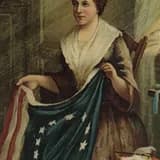
A 3-cent U.S. postage stamp honoring Betsy Ross as maker of the first American flag was issued, cementing her legend in mid-20th-century civic memory.
On January 2, 1952, the United States Post Office Department issued a 3-cent commemorative postage stamp honoring Betsy Ross, depicting her presenting the first American flag to a committee that reportedly included George Washington.
This stamp represented an official governmental endorsement of the popular legend nearly a century after William Canby first publicized it, reflecting how deeply the Betsy Ross story had become embedded in American civic identity by the mid-20th century, particularly amid Cold War-era patriotic sentiment.
The stamp's issuance is historically significant not only as a commemorative artifact but as a flashpoint for controversy: it prompted immediate objections from professional historians and philatelists who argued that no authentic documentation supported the claim that Ross designed or sewed the first U.S. flag. This tension—between popular memory and documented history—became a defining feature of the Betsy Ross legacy.
The stamp remains a notable artifact in U.S. postal history and a case study in how national mythology can be officially sanctioned through government institutions, even when historical evidence for the underlying story is thin or entirely absent. It also illustrates the enduring cultural power of the Betsy Ross narrative in shaping American ideas about women's contributions to founding the nation.