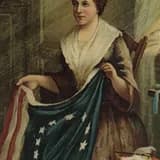
On Flag Day, the Betsy Ross House highlighted her documented career making hundreds of flags, shifting focus from the disputed 'first flag' legend to her real professional legacy.
On June 14, 2016—observed annually in the United States as Flag Day—the Betsy Ross House and allied public-history institutions issued statements and educational content reframing Betsy Ross's historical legacy. Rather than emphasizing the contested legend that she single-handedly designed and sewed the "first" American flag, these initiatives highlighted her well-documented career as a master upholsterer who ran a successful Philadelphia business producing hundreds of flags, ship colors, and other textile goods over roughly five decades.
This reframing reflected a broader trend in public history and museum interpretation during the 2010s: moving away from simplified, mythologized narratives toward richer, evidence-based portrayals of women's economic and craft labor during the Revolutionary era. Ross's real significance, in this light, lies not in an unverified singular event but in her sustained entrepreneurship as a woman running an independent business in a male-dominated trade, supporting her family through multiple widowhoods and wartime economic disruption.
The 2016 Flag Day materials are historically significant as part of a wider effort by historians and museum educators to present Betsy Ross as an example of women's real, undercelebrated contributions to the Revolutionary War economy—via skilled textile production essential to outfitting the Continental Army and Navy—rather than as a mythic single-handed originator of national symbols. This shift aligns with contemporary scholarship, including later work in outlets like The Conversation, emphasizing labor history over legend.