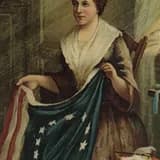
At the Historical Society of Pennsylvania, William J. Canby first publicly told the family story that Betsy Ross designed and sewed the first U.S. flag in 1776.
On May 8, 1870, nearly a century after the events it described, William J. Canby—Betsy Ross's grandson—delivered a paper to the Historical Society of Pennsylvania in which he recounted a family tradition: that in 1776, his grandmother had been visited by George Washington and members of a congressional committee who commissioned her to design and sew the first American flag featuring stars and stripes.
This was the first known public articulation of what would become one of the most enduring legends in American history. Canby based his account on oral family history, primarily recollections passed down from his aunt, Clarissa Sidney Wilson, who claimed to have heard the story directly from Betsy Ross.
The presentation launched decades of popular fascination, embraced eagerly amid the patriotic fervor of the approaching U.S. centennial in 1876. However, historians have long noted the absence of any contemporaneous documentary evidence—no congressional records, correspondence, or receipts—corroborating the 1776 commission story as Canby described it.
Despite the lack of primary-source verification, this 1870 presentation is historically significant as the origin point of the Betsy Ross legend, illustrating how oral family history and Victorian-era patriotism combined to elevate a relatively obscure Philadelphia craftswoman into a national symbol of Revolutionary womanhood.