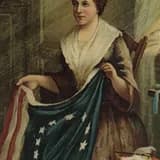
A day after the stamp's release, historians and philatelists flooded the Post Office with objections that no evidence proved Ross made the first flag.
Almost immediately after the Betsy Ross commemorative stamp was released on January 2, 1952, the U.S. Post Office Department began receiving a wave of letters—dated as early as January 3, 1952—from professional historians, archivists, and stamp collectors challenging the historical accuracy of the stamp's underlying claim.
These correspondents pointed out, correctly, that no contemporaneous 18th-century document—no congressional record, receipt, letter, or diary entry—had ever been found to substantiate the story that Betsy Ross met with George Washington in 1776 and was commissioned to design the first American flag. Their objections reflected a broader mid-20th-century movement within professional history toward rigorous documentary verification, pushing back against romanticized nationalist narratives.
This episode is historically significant because it represents one of the earliest organized, public pushbacks against the Betsy Ross legend by credentialed experts, foreshadowing the more systematic historical reassessments that would follow in later decades, including Marc Leepson's influential scholarship in the 2000s.
The controversy highlights the tension between government-sanctioned patriotic commemoration and evidentiary historical scholarship, a tension that continues to shape public understanding of Betsy Ross's actual, well-documented contributions as a Revolutionary-era flag maker and upholsterer, distinct from the unproven "first flag" myth.