← All women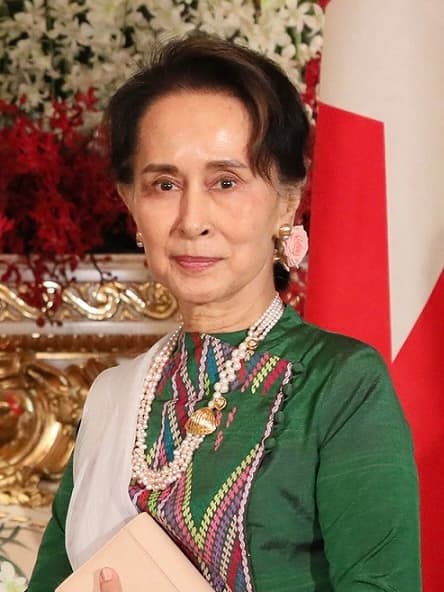
Myanmar · Politics · Activism
Aung San Suu Kyi
June 19, 1945 – present
Early Life and Family Background
Aung San Suu Kyi was born on 19 June 1945 in Rangoon (now Yangon), then part of British-ruled Burma. She is the youngest of three children of General Aung San, the foremost leader of Burma’s independence movement, and Khin Kyi, a nurse who became a prominent diplomat. Her father negotiated Burma’s independence from Britain but was assassinated on 19 July 1947, when Suu Kyi was two years old, an event that profoundly shaped her life and later political identity.
After Aung San’s death and Burma’s independence in 1948, Khin Kyi remained active in public service, heading social planning bodies and later entering the diplomatic corps. Suu Kyi grew up in a household deeply engaged with questions of nationalism, social policy and governance, absorbing narratives of sacrifice and responsibility that would influence her own choices.
In 1960, Khin Kyi was appointed Burma’s ambassador to India, and Aung San Suu Kyi accompanied her to New Delhi. There she attended school and encountered Indian political thought and the legacy of leaders such as Mahatma Gandhi, whose philosophy of nonviolent resistance would resonate with her later activism.
Education and Formative Influences
In the early 1960s, Aung San Suu Kyi returned to the United Kingdom for higher education. From 1964 she studied philosophy, politics and economics (PPE) at St Hugh’s College, Oxford, one of the university’s colleges for women. Oxford exposed her to comparative politics, political theory and Western democratic traditions, while also introducing her to international student networks and debates about decolonization and human rights.
At Oxford she met Michael Aris, a British scholar of Tibetan culture. After completing her studies, she lived in the UK and later spent time in the United States, where she worked for the United Nations in New York in the late 1960s and early 1970s, gaining experience in international institutions and diplomacy.
Aung San Suu Kyi married Michael Aris in 1972, and the couple eventually had two sons, Alexander and Kim, who were raised primarily in the United Kingdom. During these years she lived a relatively private life, focusing on her family and occasional academic and administrative work, including research and writing related to Burmese history and culture.
Despite her distance from Burma, she maintained strong ties to her homeland, following political developments and remaining aware of the increasingly authoritarian nature of the military regime, which had consolidated power after General Ne Win’s coup in 1962.
Return to Burma and Political Awakening
In 1988, Aung San Suu Kyi returned to Burma to care for her ailing mother. Her arrival coincided with one of the most turbulent periods in the country’s modern history, as widespread protests erupted against decades of authoritarian rule and economic mismanagement. Demonstrations, often led by students and monks, were met with brutal repression, and General Ne Win resigned as party leader in July 1988, deepening the political crisis.
Initially having no intention of entering politics, Suu Kyi was drawn into public life by requests for her to speak and by the moral authority attached to her father’s name. On 15 August 1988 she took her first explicit political step, issuing an open letter to the military government calling for an independent consultative committee to prepare multiparty elections. This act transformed her from a private citizen into a political actor advocating institutional democratic change.
Her profile rose dramatically on 26 August 1988, when she delivered a mass speech at Shwedagon Pagoda in Yangon to a crowd estimated at several hundred thousand people. Speaking at one of the country’s most sacred Buddhist sites, she called for an end to military rule and for the establishment of a democratic government grounded in nonviolence and human rights. The speech fused political and moral language and immediately positioned her as the central public figure in the pro-democracy movement.
On 24 September 1988, the National League for Democracy (NLD) was formed, and Aung San Suu Kyi was appointed its general secretary. The party sought to contest forthcoming elections and channel popular demands for democracy through peaceful, constitutional means. Suu Kyi’s leadership reflected both her own commitment to nonviolence and the symbolic legacy of Aung San; she advocated dialogue with the military and rejected calls for armed rebellion.
House Arrest and Emergence as an International Symbol
The military, reorganized as the State Law and Order Restoration Council (SLORC), moved quickly to restrict Suu Kyi’s activities. On 20 July 1989, she was detained under the State Protection Act and placed under house arrest at her mother’s home in Rangoon. This marked the beginning of her first long period of detention, which would last nearly six years.
In May 1990, despite her confinement, the NLD contested the general election. On 27 May 1990, the party won a landslide victory, securing about 82% of parliamentary seats. The military regime refused to recognize the results, blocked the convening of parliament, and continued to detain Suu Kyi and other leaders. The election became a symbol of thwarted democratic will and reinforced Suu Kyi’s status as the legitimate political choice of many Burmese citizens.
From detention, Aung San Suu Kyi began receiving international recognition. On 12 October 1990, she was awarded the Rafto Human Rights Prize. On 10 July 1991, the European Parliament granted her the Sakharov Prize for Freedom of Thought. Most notably, on 14 October 1991, the Norwegian Nobel Committee announced that she would receive the Nobel Peace Prize for 1991 for her "non-violent struggle for democracy and human rights". Because she remained under house arrest, her elder son Alexander Aris accepted the Nobel award on her behalf at the Oslo ceremony in 1991.
These honors transformed Suu Kyi into a major international symbol of nonviolent resistance. Human-rights organizations and foreign governments used her case to highlight political repression in Myanmar, and she became widely known as an "outstanding example of the power of the powerless," in the words later used by the Nobel Committee and the BBC.
On 10 July 1995, the SLORC government released Suu Kyi from house arrest. She quickly resumed contact with NLD members and supporters, although her political activities remained closely watched and constrained. On 10 October 1995, defying a ban on changes to party leadership, the NLD reappointed her as general secretary, reaffirming her role as its principal leader despite continuing pressure from the authorities.
Renewed Detentions and Political Engagement
Despite her release, Aung San Suu Kyi’s relationship with the military regime remained tense. In subsequent years she faced travel restrictions, intimidation of party members, and periods of renewed detention. On 6 May 2002, she was again released from house arrest and addressed large crowds outside her Yangon residence, signaling her determination to continue the democratic struggle. She resumed tours around the country to meet supporters and advocate nonviolent change.
However, the pattern of repression continued. In 2003 she was again detained following an attack on her convoy, leading to her third and longest continuous period of house arrest, which lasted until 2010. International pressure mounted, particularly after the 2007 "Saffron Revolution", when monks led mass protests that were violently suppressed. Suu Kyi remained a central reference point in discussions of Myanmar’s future, even though she was prevented from participating in public life.
On 13 November 2010, shortly after controversial national elections that the NLD boycotted, the authorities released Suu Kyi from house arrest. This liberation ended her third major detention and opened a new phase in Myanmar’s politics. She quickly reengaged with NLD members and citizens, and her house became a focal point for political dialogue and international visits.
Transition to Electoral Politics and Parliamentary Role
Myanmar’s political environment began to shift in the early 2010s. The military-backed government initiated limited reforms, including relaxing some media controls, releasing political prisoners, and allowing greater political participation. Aung San Suu Kyi and the NLD decided to contest parliamentary by-elections in 2012. Suu Kyi won a seat in the lower house of the national legislature, marking her formal entry into parliamentary politics.
This transition from dissident to legislator was historically significant. It demonstrated the possibility of former prisoners participating in state institutions and allowed Suu Kyi to influence legislation, particularly on issues of rule of law and governance. Internationally, it was interpreted as a sign of cautious liberalization, and many foreign governments expanded engagement with Myanmar.
Throughout this period, Suu Kyi continued to serve in senior roles within the NLD. She was regarded as the party’s central decision-maker, and her speeches and writings emphasized reconciliation, constitutional reform, and the need for a genuinely civilian government.
2015 Election Victory and Assumption of Power
The most dramatic step in Myanmar’s transition came with the general election of 8 November 2015. The NLD, led by Aung San Suu Kyi, contested the poll in what observers described as the country’s first openly contested national election in 25 years. Despite structural advantages for the military-backed Union Solidarity and Development Party, the NLD won about 80% of the elected seats, and the USDP conceded defeat.
Constitutional provisions barred Suu Kyi from the presidency because her sons are foreign citizens and her late husband was British, but the election was widely understood to be a mandate for her leadership. On 1 February 2016, Suu Kyi and hundreds of NLD legislators took their seats as a majority in parliament, while the military continued to hold a quarter of seats by constitutional guarantee.
On 22 March 2016, she was formally nominated to the new cabinet, expected to hold multiple portfolios including Foreign Affairs. Shortly thereafter, on 30 March 2016, her close ally Htin Kyaw was sworn in as president of Myanmar, becoming the country’s first elected civilian head of state in more than 50 years. Although Suu Kyi did not hold the presidential office, she was widely described as the country’s de facto leader, coordinating government policy and representing Myanmar internationally.
Later in 2016, a new position of state counsellor was created, effectively making Suu Kyi the country’s chief executive in civilian affairs. She also served as foreign minister, giving her a dual role in domestic governance and diplomacy. On 17 August 2016, she undertook her first major official foreign visit as national leader to China, meeting Chinese leaders to discuss bilateral relations, economic projects and peace processes with ethnic armed groups.
Rohingya Crisis and International Criticism
Suu Kyi’s tenure in government coincided with intensifying conflict in Rakhine State, where Myanmar’s Rohingya Muslim minority faced severe persecution. Military operations against Rohingya communities led to mass displacement, killings, and allegations of ethnic cleansing and genocide, particularly in 2016 and 2017.
International observers and human-rights organizations criticized the government’s handling of the crisis and Suu Kyi’s refusal to condemn the military’s actions in strong terms. Her administration denied that genocide was occurring and framed the situation as a counterinsurgency campaign against militants, while heavily restricting access to the region.
In 2019, Suu Kyi appeared before the International Court of Justice in The Hague to defend Myanmar against genocide allegations brought by The Gambia. She argued that the military operations were a response to terrorist attacks and that Myanmar’s own justice system would address any abuses, a stance that caused deep disappointment among many former supporters and human-rights advocates.
This period significantly altered her international reputation. Whereas she had previously been hailed as a global human-rights icon, many organizations revoked awards or criticized her silence and perceived complicity. The contrast between her earlier image and her role during the Rohingya crisis became a central theme in discussions of her legacy.
2021 Military Coup and Renewed Detention
Despite criticism abroad, Aung San Suu Kyi and the NLD remained popular among many Burmese citizens. In the November 2020 general election, the NLD won another decisive victory. The military, alleging electoral fraud without presenting convincing evidence, claimed the results were invalid.
On 1 February 2021, the military staged a coup d’état, detaining Aung San Suu Kyi and other senior NLD leaders and declaring a state of emergency. The coup ended her period in office as state counsellor and reversed many of the limited democratic gains of the 2010s. Suu Kyi was charged with a series of offenses by the junta, ranging from corruption to violations of COVID-19 regulations and state secrecy laws, in trials widely regarded as politically motivated.
Since the coup, information about her situation has been restricted. Reports indicate that she has spent time both in prison and under house arrest, with limited access to family, lawyers or independent observers. She remained a focal point for opposition to military rule, though the post-coup resistance has diversified, including armed groups and civil-disobedience movements that operate independently of the NLD.
Awards, Honors and Recognition
Aung San Suu Kyi’s activism has been recognized through numerous awards. Beyond the Nobel Peace Prize (1991), the Sakharov Prize for Freedom of Thought (1991) and the Rafto Human Rights Prize (1990), she has received honorary degrees, freedom-of-the-city awards, and other honors from universities, municipalities and organizations worldwide. Many of these honored her commitment to nonviolent democratic struggle and her willingness to endure long-term detention.
However, in the wake of the Rohingya crisis, several institutions reconsidered or revoked these honors. Some cities withdrew her freedom-of-the-city status, and organizations that had previously celebrated her leadership expressed deep disappointment with her government’s response to human-rights allegations.
Personal Life and Relationships
Throughout her political career, Aung San Suu Kyi’s personal life intersected with her public role in emotionally charged ways. Her marriage to Michael Aris and the upbringing of their sons in the UK meant that she faced agonizing choices when detained in Myanmar. At one point, the military offered to let her leave the country but indicated she might not be allowed to return; she refused, prioritizing her political responsibilities and her connection to the Burmese people.
Michael Aris died in 1999 of cancer in Britain, having been denied a visa to visit his wife in Myanmar. Suu Kyi was offered permission to travel to see him but feared that if she left the country she would not be allowed back, and she chose to remain in Myanmar. This decision underscored the extent of personal sacrifice involved in her political commitments and became part of the narrative of her moral authority.
Her sons, Alexander and Kim, have spoken publicly on occasion about their mother’s situation and have sometimes represented her at international events, particularly in the early 1990s. Their lives have largely been conducted outside Myanmar, illustrating the transnational dimensions of Suu Kyi’s family and public role.
Legacy and Historical Impact
Aung San Suu Kyi occupies a complex place in both Myanmar’s history and global narratives of democracy and human rights. For many years she was seen as a symbol of nonviolent resistance to authoritarian rule, embodying the power of moral authority and civil courage against a heavily armed military regime. Her long periods of house arrest, combined with her refusal to compromise on key democratic principles, inspired activists worldwide and contributed to the global discourse on peaceful political change.
Her role in leading the NLD to electoral victories and becoming Myanmar’s de facto civilian leader in the 2010s demonstrated the possibility of transitions from dissident politics to formal governance. It also highlighted the challenges of operating within a constitution that entrenched military influence and limited civilian authority.
At the same time, her government’s response to the Rohingya crisis and her defense of Myanmar at the ICJ significantly damaged her international reputation. Critics argue that her failure to protect minority rights or confront military abuses undermined the principles for which she had once been celebrated. Supporters inside Myanmar sometimes contend that her capacity to act was constrained by the military’s constitutional power and by domestic sensitivities, but the controversy remains central to assessments of her legacy.
In the broader history of women’s political leadership, Aung San Suu Kyi exemplifies both the possibilities and the limitations faced by female leaders in postcolonial states. She broke gender barriers by leading a major opposition party, winning national elections and serving as a country’s de facto head of government, yet she operated in a deeply patriarchal political culture and under the shadow of a powerful military establishment.
Her life story—spanning elite education abroad, marriage and motherhood, prolonged detention, international acclaim, controversial governance, and renewed repression—illustrates the entanglement of personal sacrifice, moral symbolism and political pragmatism that often characterizes high-profile women in politics.
Later Life and Continuing Detention
As of the mid-2020s, Aung San Suu Kyi remains detained under Myanmar’s military regime, facing multiple convictions and sentences in closed trials. Reports from state media and limited sources indicate shifts between prison and house arrest, but independent verification of her conditions is scarce. She is around eighty years old and continues to be a central, if largely unseen, figure in Myanmar’s political landscape.
Her future role in Myanmar’s politics is uncertain. Some opposition groups still view her as a unifying figure; others have moved toward different forms of resistance or new leadership structures. Regardless of these developments, her historical significance is secure: she has been one of the most influential and controversial women in contemporary politics, shaping Myanmar’s trajectory and global debates about democracy, human rights, and the responsibilities of leadership.
Dated achievements
18 indexed.
- Jun191945Politics
Birth of Aung San Suu Kyi
Aung San Suu Kyi is born in Rangoon, Burma, the third child of independence leader Aung San and diplomat Khin Kyi.
View details Aung San Suu Kyi – Biographical - Aug151988Politics
First political action: open letter calling for multiparty elections
Suu Kyi issues her first political act, an open letter urging an independent body to prepare multiparty elections in Myanmar.