← All women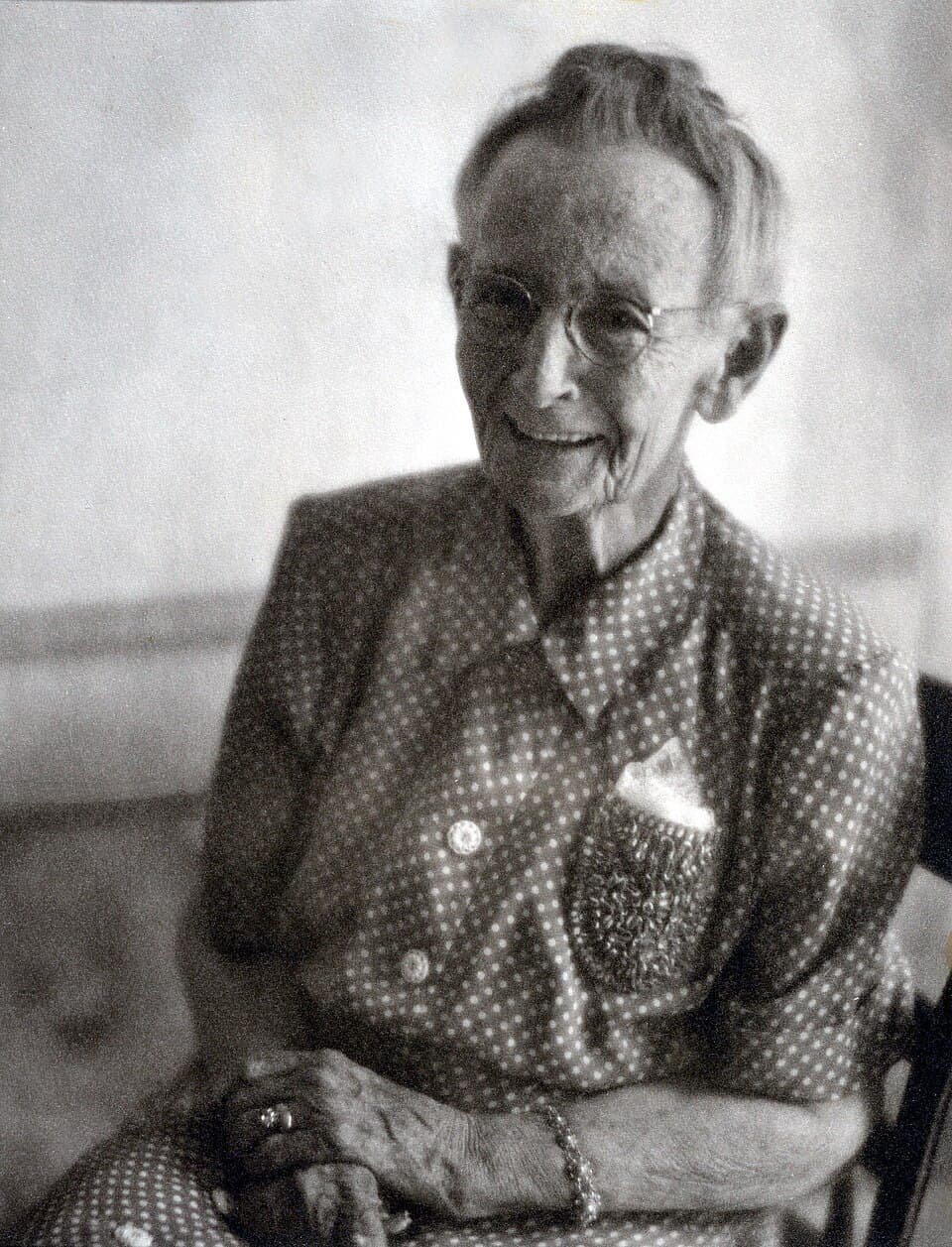
American · Arts
Anne Mary Robertson
September 7, 1860 – December 13, 1961
Early life and background
Anna Mary Robertson Moses was born on September 7, 1860, on a farm near Greenwich, New York, in Washington County. She was the third of ten children born to Russell King Robertson and Margaret Shanahan Robertson, and she grew up in a household shaped by the demands of rural labor and the rhythms of seasonal farm life. Her childhood was marked by limited formal schooling, with only intermittent attendance at local country schools, a circumstance that was common for children in rural nineteenth-century America. Yet the world around her—fields, animals, weather, domestic work, and the changing visual patterns of farm communities—would later become the primary subject matter of her paintings.
As a girl, Robertson was expected to contribute to household labor. She worked at home and later left the family farm at a young age to take employment as a hired girl on neighboring farms. That work exposed her to the practical skills and disciplined routines of rural households, including cooking, cleaning, sewing, and other domestic tasks. Sources associated with her biography also note that her father encouraged drawing on old newsprint and that she used berry and grape juices to brighten images, early signs of a visual imagination that would survive well beyond childhood. These experiences did not prepare her for a conventional artistic career, but they gave her an intimate knowledge of the everyday life she would later depict with such confidence.
Marriage, family, and farm life
On November 9, 1887, Anna Mary Robertson married Thomas Salmon Moses, a farmer. After marriage, she became known as Anna Mary Robertson Moses and lived the rest of her married life in rural farm settings. The couple had ten children, five of whom survived infancy. Like many women of her generation, Moses’s adult life was dominated by hard work: she managed household duties, helped on the farm, and contributed to the family economy through homemade food and other practical labor.
Her years as a farm wife were important not because they made her famous, but because they provided the material world that would later populate her art. She knew farm work not as spectacle but as routine. She knew the textures of barnyards, harvests, snow, spring planting, holiday gatherings, and communal labor from direct experience. In later life, those memories became the substance of her art. Her paintings are often admired for their sense of warmth and continuity, but that emotional power comes from decades of lived rural experience and from the endurance required of women who balanced childrearing, household management, and farm labor with little public recognition.
Early creative life and the road to painting
Before she became a painter, Moses expressed creativity through embroidery and needlework. She made decorative cloth pictures and quilts, and she used limited materials at hand to make domestic art. These early forms of making mattered because they trained her eye in composition, color, and pattern while remaining within the socially acceptable realm of women’s work. For many years, her creativity was private or local, not public.
The decisive shift came after the death of her husband in 1927. Widowhood eventually pushed her into retirement from farm work, and in 1936 she began painting seriously after giving up embroidery because of arthritis. This was the true beginning of the career that would make her famous as “Grandma Moses.” Her late start is one of the most important facts in her biography. At an age when many people are thought to have finished their productive lives, she embarked on a new artistic practice with no formal training. She painted from memory and observation, choosing scenes of rural life that reflected her own past rather than the fashionable subjects of the art market.
The fact that she began to paint after arthritis made needlework painful also highlights an important barrier she overcame. Her work emerged not from academic instruction but from adaptation. She used the skills, materials, and memories available to her, turning limitation into invention. That transformation from homemaker to artist is central to her enduring fame.
Public discovery and artistic breakthrough
In 1940, Moses’s paintings were included in a group exhibition at Otto Kallir’s Galerie St. Etienne in New York. Later that year, in October 1940, she made her public debut as a painter when Kallir mounted the first exhibition devoted entirely to her work. This event introduced her to the larger art world and helped establish the framework through which her art would be understood: as the work of a self-taught folk painter with a distinctive vision of American rural life.
The response to her work was important because it crossed the boundary between local amateur production and national cultural recognition. Moses was not trained in the academy, and her scenes did not fit the dominant modernist styles of the period. Yet collectors and critics were drawn to the clarity, sincerity, and detail of her work. Her paintings soon became associated with a nostalgic vision of America, especially the countryside and family life remembered from the nineteenth century and early twentieth century. As the public learned more about her biography, her age and self-taught status became part of the story of her appeal.
Her nickname, Grandma Moses, was popularized by the press and quickly became inseparable from her public identity. The name helped shape her image as an emblem of late-life creativity and rural authenticity, though it also simplified a more complex artist who worked steadily and with increasing ambition. Over time she became one of the best-known folk artists in the United States.
Major works and recognition
Moses painted scenes of sugaring, harvesting, holiday gatherings, sleigh rides, farm chores, and village life, often crowded with activity and organized in bright, legible compositions. Her paintings were rooted in memory rather than direct academic study, and they communicated a world in which labor, community, and the seasons were closely interwoven. She often worked with accessible materials, using house paint, board, and canvas scraps in her early period. Her method reflected the practical ingenuity of the life she had lived.
By the late 1940s and early 1950s, her reputation had expanded well beyond the folk-art field. On November 26, 1949, President Harry S. Truman presented her with the Women’s National Press Club Award at the White House, signaling the level of national attention she had received. On June 9, 1952, Russell Sage College awarded her an honorary LL.D., recognizing the cultural importance of her achievement. These honors were notable because they validated a woman who had come to art outside formal institutions and far later than the customary age for artistic debut.
In 1955, the Whitney Museum of American Art acquired her painting Sugaring Off, a significant museum purchase that marked her entry into a major American collection. Such acquisitions helped move folk art into broader institutional recognition and encouraged museums and collectors to treat self-taught artists as important contributors to the national visual record. Moses’s work had become both popular and respected, a rare combination that reflected the emotional accessibility of her imagery and the seriousness of her achievement.
Historical significance and legacy
Anna Mary Robertson Moses occupies a special place in American cultural history because she disrupted common assumptions about age, training, gender, and artistic legitimacy. She began her painting career in old age, after decades of farm labor and family responsibility, and achieved fame through work rooted in vernacular experience. In a period when women’s rural labor was often invisible and old age was associated with withdrawal, she became internationally known for creative productivity and public recognition.
Her paintings helped define a popular image of American folk art: cheerful, orderly, nostalgic, and deeply connected to rural traditions. At the same time, her career challenged the boundaries separating fine art from amateur and domestic making. Scholars and curators increasingly recognized that her work preserved historical memory and embodied a distinctive visual language shaped by lived experience rather than formal schooling. Her life also became an emblem of late bloomers in the arts, showing that a major public career could begin after seventy and still achieve extraordinary impact.
Her legacy continued after her death through museum exhibitions, reproductions, educational materials, and popular memory. In 1969, the United States Postal Service issued a commemorative stamp honoring her, an indication of the enduring reach of her fame. Her work remains closely identified with rural America, seasonal celebration, and the creative possibilities of self-taught artists. As a woman who transformed the textures of ordinary farm life into national art, she remains one of the most admired figures in American folk painting.
Later life and death
Moses continued painting into advanced old age and remained a public figure in her final years. Sources note that she painted until only a few months before her death, sustaining a creative life even as she approached the end of her century-long span. She died on December 13, 1961, in Hoosick Falls, New York, at the age of 101.
Her death closed a life that had begun before the telephone, the automobile, and modern museum culture had fully transformed the United States, and ended after she had become a national symbol of homespun American creativity. Few artists have had such a dramatic arc: from farm child and hired girl to matriarch, widow, self-taught painter, celebrity, and museum artist. Her story continues to resonate because it combines hardship, perseverance, and late accomplishment in a way that speaks to both historical context and enduring human aspiration.
Dated achievements
9 indexed.
- Sep071860Arts
Birth of Anna Mary Robertson (Grandma Moses)
Birth of Anna Mary Robertson, later known as Grandma Moses, on a farm near Greenwich, New York.
View details Smithsonian: Happy 150th Birthday, Grandma Moses! - Nov091887Arts
Marriage to Thomas Salmon Moses
Anna Mary Robertson married Thomas Salmon Moses, beginning the family and farm life that shaped her later art.