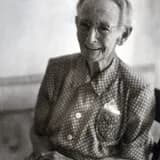
Her first public debut as a painter at Galerie St. Etienne brought Grandma Moses to wider art-world attention.
In October 1940, Anna Mary Robertson Moses made her public debut as a painter at the Galerie St. Etienne in New York, where Otto Kallir mounted the first exhibition devoted to her work. This moment introduced her art to a wider urban audience and marked the transition from local curiosity to recognized painter.
The exhibition was historically significant because it brought a self-taught rural woman into the orbit of the New York art world at a time when modern art institutions often privileged formal training and avant-garde styles. Moses’s paintings were rooted in memory and everyday rural scenes rather than academic composition, and that very difference became part of their appeal. The debut also demonstrates how serendipity, collectors, and gallery networks shaped the discovery of folk artists in the twentieth century. For Moses, whose life had unfolded largely outside elite cultural institutions, the 1940 exhibition created a public platform that validated decades of ordinary experience as a subject worthy of art. It helped establish her reputation and opened the path to the national fame that would follow in the years after World War II.