← All women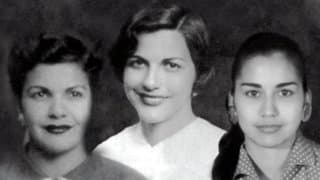
Dominican · Activism · Politics
The Mirabel Sisters
February 27, 1924 – November 25, 1960
Early life and family background
The Mirabal sisters—Patria, Minerva, María Teresa, and Dedé—were born into a prosperous Dominican family in Salcedo, in the northeastern Cibao region. Their parents, Enrique Mirabal and Mercedes Reyes, provided a household that valued education and social standing, though the family lived under the increasing pressure of the dictatorship of Rafael Trujillo, which dominated Dominican public life from 1930 until 1961. The sisters grew up in a country where political opposition was dangerous, censorship was pervasive, and women’s public roles remained constrained by conservative norms and state repression.
Patria Mercedes Mirabal Reyes was born on 27 February 1924, Minerva Argentina Mirabal Reyes on 12 March 1926, Dedé on 21 October 1925, and Antonia María Teresa Mirabal Reyes on 15 October 1935. The sisters were raised in what later sources described as a well-off family in Salcedo, and their upbringing combined privilege with the realities of living under a repressive authoritarian system. In later years, each would play a different role in the family’s political and memorial history, but it was Minerva, Patria, and María Teresa who became active in resistance to the regime and came to be known collectively as Las Mariposas—the Butterflies.
Education and political awakening
Minerva became the most politically prominent of the sisters. Her education and early intellectual independence helped set the tone for the family’s later opposition to Trujillo. Although exact dates for many of her formative steps are not consistently documented in accessible sources, she is remembered for challenging the regime’s authority directly and for helping transform family discontent into organized political action. María Teresa also pursued education and later worked as a surveyor, placing her among the small number of professional women in a society where women’s opportunities remained limited.
The sisters’ political awakening developed in the context of Trujillo’s increasingly violent dictatorship. Under his rule, civil liberties were severely restricted, critics were harassed or jailed, and the state relied on surveillance, intimidation, and public spectacle to maintain control. For women, dissent carried additional risks. To speak against the regime was to violate both political and gender expectations, and the Mirabal sisters faced the threat of arrest not only because they opposed Trujillo but because they did so openly enough to become symbols. Their courage challenged a system that depended on silence.
Resistance against Trujillo
In the late 1950s, Patria, Minerva, and María Teresa deepened their involvement in clandestine opposition to Trujillo, including support for the underground 14 de Junio movement. Their activism included organizing, distributing anti-regime materials, and sustaining networks of resistance in a climate of fear. Sources consistently describe them as repeatedly harassed and arrested in 1960, as state repression intensified around their activities. This pattern of surveillance and intimidation reflected the regime’s broader efforts to crush dissent before it could become politically decisive.
The Mirabal sisters’ activism was distinctive because it combined family loyalty, moral conviction, and political organizing. They were not isolated radicals but part of a broader network of Dominican dissidents who opposed dictatorship. Yet their visibility made them uniquely vulnerable. The state’s response to them also revealed how threatening women activists could be to authoritarian systems that relied on the assumption that women would remain socially subordinate. The sisters’ underground name, Las Mariposas, later became one of the most enduring symbols in Dominican memory.
Assassination and immediate aftermath
On 25 November 1960, Patria, Minerva, and María Teresa were murdered near La Cumbre while returning from visiting their imprisoned husbands. Trujillo’s agents attacked them and attempted to disguise the killings as an accident by placing their bodies in a jeep and sending it over a cliff. The official story collapsed under public scrutiny. Far from eliminating resistance, the murders intensified anger at the regime and made the Mirabal sisters national martyrs.
Their deaths are widely viewed as a turning point in Dominican political history. The outrage they provoked helped undermine Trujillo’s legitimacy and became one of the factors that contributed to his assassination roughly six months later in 1961 by dissidents and former allies. In this sense, the Mirabal sisters’ murder did not silence opposition; it amplified it. The brutality of the killings also resonated internationally as a stark example of how authoritarian regimes target women who refuse to accept their assigned place.
Dedé Mirabal and the preservation of memory
Dedé Mirabal survived the dictatorship and became the family’s principal custodian of memory. While less directly involved in the resistance than her sisters, she spent much of her later life ensuring that their story remained visible in Dominican public life. According to later accounts, she helped establish a foundation and museum in their name and guided the family legacy into the democratic era. Her role was indispensable: without her witness, the story of the Mirabal sisters might have remained a local tale rather than a global symbol.
The family’s memory work became especially important after the Dominican Republic’s transition to democracy in the late 1970s. At that time, the sisters were increasingly celebrated nationally as icons of resistance and democratic renewal. The growing public recognition of the Mirabal sisters was not merely commemorative; it also reflected the country’s effort to confront the violence of the Trujillo years and to honor those who had resisted it.
From national martyrs to global symbols
The Mirabal sisters’ legacy expanded far beyond the Dominican Republic in the late twentieth century. In 1981, feminist organizers at the first Latin American and Caribbean Feminist Encuentro in Bogotá selected 25 November, the anniversary of the sisters’ assassination, as a day of action against gender-based violence. This regional decision linked their memory to a wider movement for women’s rights and gave the date a political meaning that extended beyond Dominican history.
That process culminated on 17 December 1999, when the United Nations General Assembly established 25 November as the International Day for the Elimination of Violence against Women. The UN’s decision explicitly honored the Mirabal sisters and turned their martyrdom into an annual global observance. As a result, the sisters became enduring reference points in campaigns against gender-based violence, authoritarianism, and impunity. Their story is frequently invoked in human-rights education, feminist advocacy, and Latin American historical memory.
Popular cultural works also helped internationalize their legacy. Julia Alvarez’s 1994 novel In the Time of the Butterflies introduced many readers outside the Dominican Republic to the Mirabal sisters’ story, blending historical memory with literary reconstruction. Museums, memorials, educational programs, and public observances continued to reinforce the sisters’ place in both Dominican and global history. Dedé’s later death in 2014 marked the passing of the last surviving sister, but not the end of the legacy she helped preserve.
Historical significance
The Mirabal sisters are remembered as more than victims of a political murder. They are seen as women whose defiance helped expose the violence of a dictatorship, whose deaths accelerated resistance, and whose memory helped shape a major international observance against violence toward women. Their lives illustrate how women’s activism can be central to democratic struggle even when official histories initially minimize it.
Their significance also lies in the way memory transformed them. Over time, the sisters became national heroes, feminist icons, and symbols of courage under tyranny. Their story shows how martyrdom can be converted into organized remembrance, and how local resistance can become a global moral reference. In Dominican history and in women’s history more broadly, the Mirabal sisters remain among the most powerful examples of political sacrifice turned into lasting public memory.
Dated achievements
8 indexed.
- Feb271924Activism
Birth of Patria Mirabal
Birth of Patria Mercedes Mirabal Reyes in Salcedo, Dominican Republic.
View details Mirabal sisters - Wikipedia - Oct211925Activism
Birth of Dedé Mirabal
Birth of Bélgica Adela "Dedé" Mirabal Reyes in Salcedo, Dominican Republic.
View details