← All women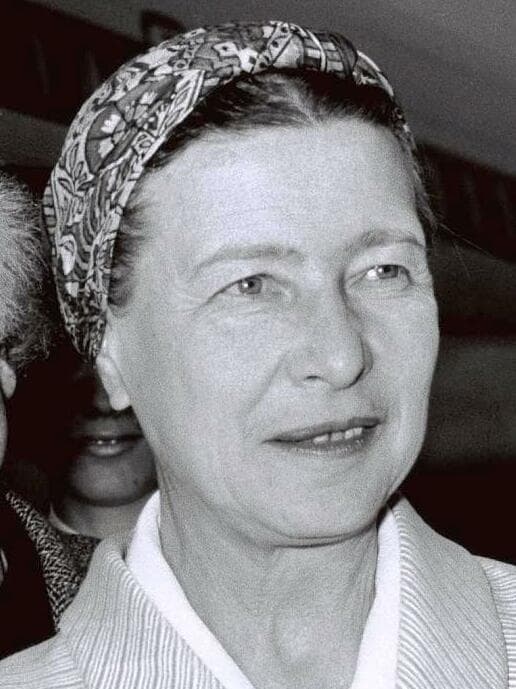
French · Literature · Arts · Activism · Politics
Simone de Beauvoir
January 9, 1908 – April 14, 1986
Early life and education
Simone Lucie Ernestine Marie Bertrand de Beauvoir was born on 9 January 1908 in Paris, France, into a bourgeois family that valued education, discipline, and cultural aspiration. She grew up in a milieu that gave her access to books and serious study, but also in a society that still expected women to prepare primarily for marriage and domestic life. From an early age, Beauvoir displayed unusual intellectual intensity, and literature became one of the central passions of her childhood. Later accounts of her life often emphasize the contrast between the conventional expectations placed on girls of her class and her own determination to pursue a life of ideas.
She studied in Catholic schools before moving on to advanced studies in philosophy in Paris. The intellectual climate of the French capital exposed her to major debates about religion, morality, free will, and modernity, and she soon emerged as a brilliant student. Her education culminated in the demanding philosophy agrégation, an examination that functioned as a key gateway to teaching and intellectual legitimacy in France. In 1929, she passed and became the youngest person ever to obtain the agrégation in philosophy, a feat that marked her entry into the elite world of French academic culture.
That early success mattered for more than professional reasons. It positioned Beauvoir inside the philosophical establishment at a time when women were still scarce in the field, and it sharpened her awareness of the structures that governed intellectual authority. Her studies also brought her into contact with Jean-Paul Sartre, whose relationship with her would become one of the most famous intellectual partnerships of the twentieth century.
Intellectual partnership and early career
Beauvoir met Jean-Paul Sartre while studying at the Sorbonne. Their relationship became lifelong in intellectual terms and enduring in personal terms, though it defied conventional norms of marriage and domesticity. Both thinkers committed themselves to a radical conception of freedom, and both explored the obligations that accompany choice, action, and responsibility. Their association helped define postwar French existentialism, but Beauvoir was never simply Sartre’s companion or disciple. She developed her own philosophical voice and literary method, and over time she became a major thinker in her own right.
After completing her studies, Beauvoir worked as a teacher, while also writing fiction and philosophical essays. Her early writing reflected the intellectual atmosphere of wartime and occupation France, where questions of freedom, authenticity, and moral responsibility carried immediate political weight. She published her first major novel, L’Invitée (She Came to Stay), in 1943. The novel established her as an existentialist novelist who could translate abstract philosophical issues into narrative form. It was followed by philosophical and fictional works that deepened her reputation as one of the most serious literary and intellectual figures of her generation.
During the 1940s, Beauvoir continued to publish at a rapid pace. In 1944 she released Pyrrhus et Cinéas, an early exploration of existential ethics. In 1945 came Le Sang des autres (The Blood of Others), a novel reflecting on resistance, responsibility, and complicity in wartime. In 1946, she published Tous les hommes sont mortels (All Men Are Mortal), extending her philosophical fiction into the problem of mortality and human projects. These works showed that Beauvoir was not only a novelist of psychological conflict but also a philosopher using fiction to test ideas about freedom and action.
The Second Sex and feminist theory
Beauvoir’s most influential work, Le Deuxième Sexe (The Second Sex), appeared in 1949 and changed the terms of feminist thought. Drawing on philosophy, history, anthropology, literature, and lived experience, the book examined how societies construct womanhood and how women are made into the “other” in relation to men. Its analysis of oppression, embodiment, sexuality, motherhood, labor, and myth gave feminist scholarship a conceptual vocabulary that would shape decades of debate.
The book became one of the foundational texts of modern feminism and is often associated with the emergence of second-wave feminist politics. Its most famous formulation—that one is not born, but rather becomes, a woman—captured the book’s central insight that gender is socially produced as well as biologically experienced. At the time of publication, Beauvoir’s arguments were controversial and often attacked, but the controversy itself helped establish the book’s importance. It was read widely in translation and became a touchstone for activists, philosophers, and scholars around the world.
Beauvoir’s feminist contribution was distinctive because it linked women’s oppression to the broader existential question of freedom. She argued that women’s situations were shaped by social structures, economic dependence, myth, and education, but also that consciousness and agency remained possible within those limits. This approach made her work foundational not only to political feminism but to feminist philosophy, women’s studies, and gender theory.
Literary maturity and public recognition
In the 1950s and 1960s, Beauvoir expanded her range as a novelist, memoirist, and essayist. Her novel Les Mandarins (The Mandarins) appeared in 1954 and won the Prix Goncourt, confirming her place among the leading writers of postwar France. The book presented a roman à clef portrait of the intellectual and political world in which she lived, and it remains one of the most important literary accounts of French postwar debate. The award signaled that Beauvoir’s fiction was being taken seriously not simply as adjunct to philosophy, but as major literature in its own right.
She also began a major autobiographical cycle that became one of the most distinguished in modern literature. Mémoires d’une jeune fille rangée (Memoirs of a Dutiful Daughter) appeared in 1958 and was followed by La Force de l’âge (The Prime of Life) in 1960 and La Force des choses (Force of Circumstance) in 1963. These books combined personal memory, literary reflection, and political commentary, offering an unusually candid account of the formation of an intellectual woman in twentieth-century Europe.
Later autobiographical and reflective works included Une mort très douce (A Very Easy Death, 1964), which addressed her mother’s illness and death, Les Belles Images (1966), a critique of consumer society and women’s roles, La Femme rompue (The Woman Destroyed, 1970), and La Cérémonie des adieux (1981), in which she recorded Jean-Paul Sartre’s final years. Across these works, Beauvoir continued to blend personal narrative with social analysis, making autobiography itself a serious philosophical form.
Political engagement and honors
Beauvoir was not only a writer of literature and philosophy; she was also an active participant in the political struggles of her time. She lent her voice to causes connected to women’s rights, anti-colonialism, and broader left-wing politics, and she remained publicly engaged throughout her career. Her work was especially important because it linked intellectual life to concrete social conditions rather than treating philosophy as detached from history.
Recognition came from both French and international institutions. The Prix Goncourt in 1954 was one of the major literary honors of her life, and the Jerusalem Prize in 1975 acknowledged the universal significance of her concern with human freedom. Such honors reflected her standing as a writer whose work crossed genres and audiences. By the later twentieth century, she was widely regarded as one of the most important women intellectuals of the century and as a central figure in the development of feminist thought.
Personal life
Beauvoir’s personal life has long attracted attention because it challenged conventional models of female respectability and domesticity. Her relationship with Sartre was intellectually central and personally enduring, though it did not conform to traditional marriage. She and Sartre maintained a famously unconventional partnership based on mutual commitment, independence, and intellectual exchange. Beauvoir also had other relationships over the course of her life, which she discussed more openly than many women writers of her generation would have done.
She did not have children of her own, but later in life she adopted Sylvie Le Bon, who became her literary heir and editor. Beauvoir’s refusal to accept a narrow domestic role was itself part of her historical significance. Her life demonstrated that a woman could claim authority through writing, intellectual work, and public engagement rather than through marriage or motherhood alone.
Legacy
Beauvoir’s influence is immense and enduring. The Second Sex helped lay the groundwork for modern feminism by showing that gender inequality was produced through social structures, not merely natural differences. Her philosophical work helped define existentialism in postwar France, while her fiction and memoirs demonstrated that literary form could illuminate the ethical dimensions of lived experience. Few twentieth-century writers combined theory, narrative, and political engagement as effectively as she did.
Her legacy also lies in the pathways she helped open for women in philosophy, criticism, and public intellectual life. Beauvoir showed that women could write canonical philosophy, produce major novels, and participate as authoritative voices in political debate. In later decades, scholars debated and revisited her work from multiple perspectives—feminist, existentialist, literary, poststructuralist, and historical—but the scale of her importance remained undisputed.
She died on 14 April 1986 in Paris. By then, she had become more than a famous author: she was an institutional presence in modern intellectual history, one whose writings continued to shape arguments about freedom, embodiment, gender, and the possibilities of a self-directed life. Her career remains a landmark in the history of women’s thought because it united philosophical originality with literary power and a sustained challenge to the social limits placed on women of her era.
Dated achievements
7 indexed.
- Jan091908Arts
Born in Paris
Birth of Simone de Beauvoir in Paris, France, one of the most influential philosophers and feminist writers of the 20th century.
View details Britannica biography of Simone de Beauvoir - Jan191929Literature
Youngest philosophy agrégation recipient
Beauvoir became the youngest person ever to pass the philosophy agrégation, a major academic first in France.