← All women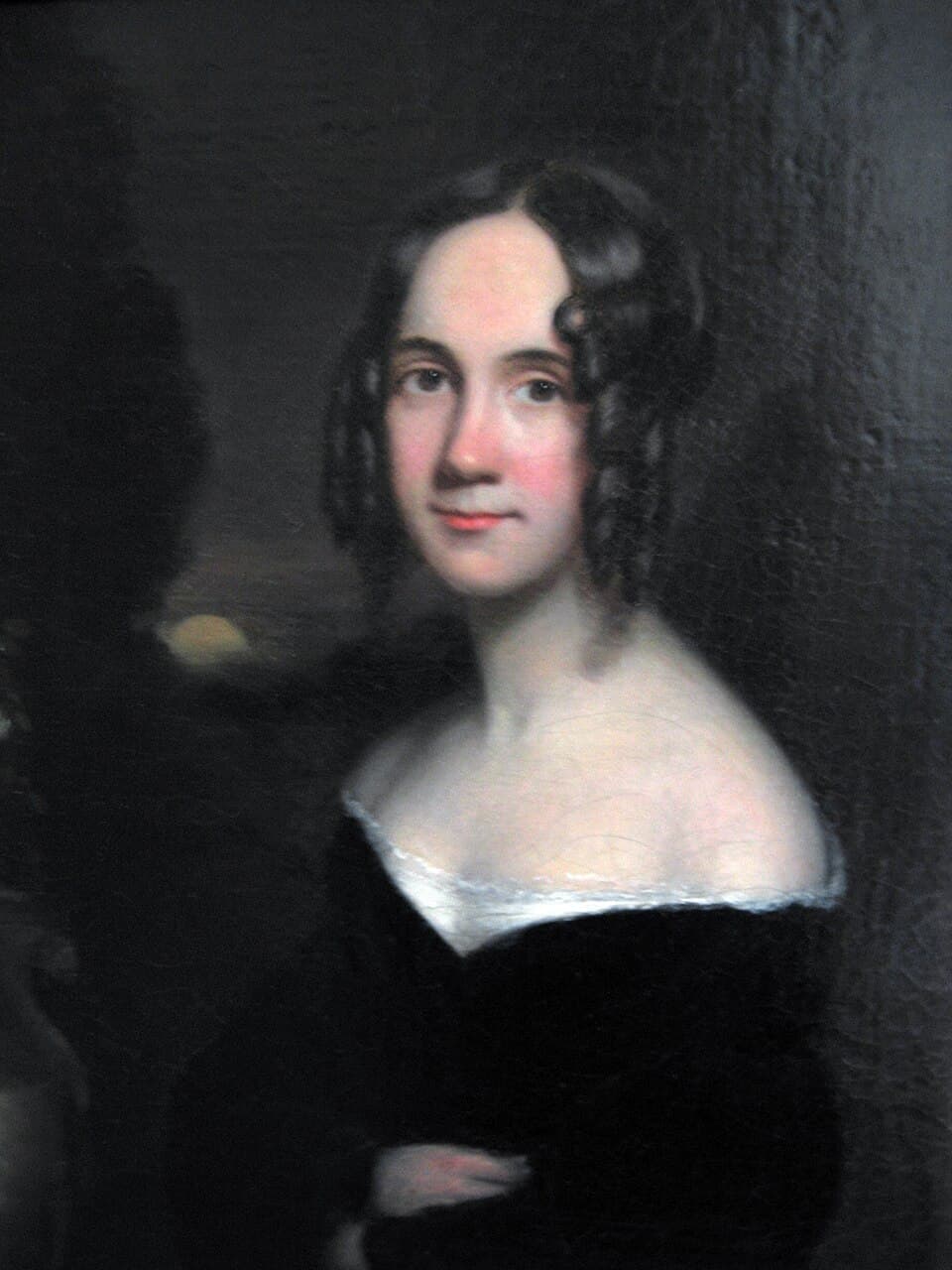
American · Literature · Activism · Arts
Sarah Josepha Hale
October 24, 1788 – April 30, 1879
Early Life and Background
Sarah Josepha Buell Hale was born on October 24, 1788, in Newport, New Hampshire, the second of four children of Gordon Buell and Martha (Whittlesey) Buell.[3][9][11] Her father, a veteran of the American Revolution, worked as a farmer and tavern keeper, while her mother oversaw the household and children.[9][10] The Buells believed their daughters should be educated as thoroughly as their sons, an attitude unusual in late 18th‑century New England.[1][12]
Hale did not attend college, which remained closed to women, but she received a strong education at home. Her mother taught her to read and encouraged literary study, and her older brother Horatio Buell, while attending Dartmouth College, shared his lessons with her so that she could follow a quasi‑college curriculum.[5][9] Through these informal means, she studied history, literature, philosophy, and religious texts, laying the intellectual foundation for her later work as writer and editor.
As a young woman, Hale worked as a schoolteacher in Newport from about 1806 to 1813, teaching local children and honing the pedagogical and organizational skills that would later serve her in editorial roles.[5][9] The combination of rural upbringing, domestic responsibility, and serious reading produced a worldview that valued education, moral discipline, and the domestic sphere as a site of cultural influence. These themes would recur throughout her writing and editorial work.
Marriage, Widowhood, and Turn to Writing
On October 23, 1813, Sarah married David Hale, a young lawyer from Newport.[9] Their marriage was intellectually formative: David encouraged her love of books and undertook to give her what contemporaries described as the "equivalent of a college education," reading history, philosophy, and poetry with her and treating her as an intellectual partner.[5][9] The couple had five children—David, Horatio, Frances, Sarah, and William.[9]
In 1822, David Hale died unexpectedly, leaving Sarah a widow with five young children and limited financial support.[5][9][12] Facing economic necessity, she turned to writing and teaching to support her family. Members of her late husband’s Masonic lodge recognized her talent and helped finance the publication of her first book, a volume of poetry titled The Genius of Oblivion, and Other Original Poems, which appeared in 1823.[4][9] This collection, exploring themes of grief, faith, and duty, marked her entry into the literary marketplace.
Hale’s early success as a poet encouraged her to attempt prose fiction. In 1827, she published the novel Northwood; Life North and South in Boston.[4][9] Later issued in London as A New England Tale, Northwood is one of the earliest American novels by a woman and among the first works of American fiction to offer an extended critique of slavery.[4][15] Through a detailed portrayal of New England domestic life contrasted with a Southern plantation, Hale argued that slavery violated Christian morality and undermined national unity.[4][15]
The success of Northwood brought Hale to the attention of Boston’s literary community and demonstrated that her writing could provide long‑term financial support. It also revealed her capacity to engage major social and political issues through the ostensibly "feminine" genre of domestic fiction.
Early Editorial Career: Ladies’ Magazine
On the strength of Northwood and her poetry, Hale was invited in 1828 to become editor of the Ladies’ Magazine, a new Boston periodical aimed at women.[3][9][13] Though the precise date of her appointment is unknown, the year marks a crucial turning point: she assumed a role generally regarded as the first substantial magazine editorship held by a woman in the United States.[3][9]
As editor, Hale oversaw a range of content including fiction, poetry, essays on moral and religious topics, and articles on education and household management.[5][13] She used the magazine to argue that women’s domestic responsibilities required serious education, insisting that literate, informed mothers were essential to the republic’s moral health.[3][9] She also encouraged American women writers by publishing their work and offering them visibility in a national forum.[5]
Hale’s editorial stance combined progressivism with conservatism. She supported expanded educational and professional opportunities for women—particularly in teaching, medicine, and missionary work—while affirming the importance of marriage, motherhood, and home as women’s primary sphere.[5][13] This blend would continue to characterize her thought: she embraced many reforms but opposed women’s suffrage and public speaking, believing that women could exert influence most effectively through home and benevolent activity.[5]
Godey’s Lady’s Book and Editorial Influence
In 1837, Louis A. Godey merged Hale’s Ladies’ Magazine into his Philadelphia‑based Godey’s Lady’s Book and appointed her editor.[3][5][14] She moved to Philadelphia around 1841 to work more closely with the journal.[13] For the next forty years, until her retirement in 1877, Hale shaped Godey’s Lady’s Book into the most influential women’s magazine in the United States.[5][6][11]
Under Hale’s editorship, Godey’s combined fashion plates and domestic advice with substantial literary and educational content. She published original work by American authors, including women poets and fiction writers, and promoted reading lists, moral essays, and discussions of public health and early childhood education.[5][6][13] The magazine deliberately avoided partisan politics, refusing to print news of political controversies or the Civil War, but it advanced reform indirectly by emphasizing education, charity, and women’s professional development.[5][13]
By the 1860s, Godey’s Lady’s Book reached a circulation of approximately 150,000, making Hale one of the most powerful cultural arbiters of middle‑class taste in the nation.[13][14] She became known as the "editress"—a term she herself favored—and her opinions on fashion, architecture, literature, and domestic conduct carried significant weight.[4][5]
Hale used this platform to support numerous causes. She advocated the founding of women’s colleges and was involved in the promotion of institutions such as Vassar College and other female academies.[16] She championed the Female Medical College of Pennsylvania, founded in 1850, and served as secretary of the Ladies’ Medical Missionary Society, urging that women be trained as physicians to care for female patients at home and in missionary settings.[13] She later headed the Philadelphia branch of the Woman’s Union Missionary Society after a merger of organizations in 1860.[13]
Hale also supported philanthropic efforts and preservation projects, including fundraising to complete the Bunker Hill Monument in Boston and campaigns to preserve George Washington’s Mount Vernon as a national shrine.[8][11] These activities reflected her belief that women had a special role in sustaining national memory and moral order.
Major Literary Works
Beyond her editorial career, Hale was a prolific author. She wrote or edited more than 50 books, including poetry collections, novels, cookbooks, etiquette manuals, and historical and biographical works.[5][16]
One of her best‑known contributions to children’s literature is the poem “Mary’s Lamb”, first published in the September 1830 issue of Lydia Maria Child’s Juvenile Miscellany and later included in Hale’s collection Poems for Our Children.[1][5] The poem, popularly remembered as “Mary Had a Little Lamb”, became a staple of early childhood reading and memorization in the English‑speaking world.[1][11]
Hale produced several significant poetry collections and devotional works, including Three Hours; or, The Vigil of Love: and Other Poems (1848) and the widely reprinted Flora’s Interpreter; or, The American Book of Flowers and Sentiments, which linked botanical lore with moral lessons.[5] She also edited the letters of notable European women such as Lady Mary Wortley Montagu and Madame de Sévigné, bringing their correspondence to American readers.[5]
Her most ambitious work is Woman’s Record; or, Sketches of All Distinguished Women, from the Beginning till A.D. 1850, first published in 1853 and revised in 1854.[5][15] This massive, roughly 900‑page biographical dictionary compiled thousands of entries on women from biblical times to the mid‑19th century, with particular emphasis on contemporary American women writers. Hale intended the book to demonstrate that women had always contributed significantly to civilization, thereby inspiring modern women to pursue education and moral improvement.[5]
Through these varied works, Hale reinforced a vision of womanhood that was intellectually capable, morally responsible, and central to the nation’s cultural life.
Thanksgiving Campaign and National Ritual
Hale’s most famous public campaign concerned the establishment of a national Thanksgiving holiday. Regional Thanksgiving observances had long existed, especially in New England, but dates varied by state and year.[14][15] Beginning around 1846, Hale used Godey’s Lady’s Book to promote the idea of a single national day of thanksgiving, arguing that it would strengthen family bonds, encourage gratitude to God, and promote unity across sectional divides.[9][14][15]
She wrote editorials describing ideal Thanksgiving celebrations—featuring family gatherings, shared meals, and charitable outreach—and she urged governors to synchronize state observances.[14][15] Hale also addressed successive U.S. presidents, including Zachary Taylor, Millard Fillmore, Franklin Pierce, James Buchanan, and ultimately Abraham Lincoln, requesting a federal proclamation.[14][15]
During the Civil War, Hale intensified her appeals, suggesting that a common Thanksgiving could help heal national wounds.[15] In September 1863, she wrote directly to President Abraham Lincoln, and on October 3, 1863, Lincoln issued a proclamation calling for a national day of Thanksgiving on the last Thursday of November.[14][15] While the proclamation did not name Hale, contemporaries and later historians have credited her decades‑long campaign as a significant influence.[3][14][15]
Thanks to Lincoln’s action and Hale’s sustained advocacy, Thanksgiving gradually became a fixed national tradition. For this reason, she has often been called the "Mother of Thanksgiving," reflecting her role in shaping the holiday’s cultural meaning as a domestic, religious, and civic celebration.[1][18] Her campaign is notable as an early example of a woman using media and correspondence to influence national policy without holding public office.
Views on Women, Education, and Reform
Hale’s thought on women’s roles combined support for education and professional work with opposition to formal political rights such as suffrage. She argued consistently that women should receive rigorous schooling and have access to professions compatible with their "feminine" nature, including teaching, medicine, and various forms of benevolent labor.[5][13][15] She supported the establishment of women’s colleges and professional training programs, emphasizing that women’s intellect was equal to men’s.
At the same time, Hale maintained that women’s primary sphere was the home and that their influence should be exercised indirectly, through moral example and charitable organizations rather than through voting or public oratory.[5] She feared that political agitation might undermine women’s moral authority and distract from domestic responsibilities. Consequently, she opposed women’s suffrage and female public speaking on partisan issues.[5]
Hale advocated for legal reforms such as improved property rights for married women and better support for single mothers and working women.[5][16] She wrote sympathetically about the challenges faced by widows and poor families, drawing on her own experiences. Her editorial work frequently highlighted charitable institutions and urged readers to support missions, schools, and hospitals.
Her positions reflect the complexity of 19th‑century women’s activism: she both reinforced and subtly expanded the ideology of separate spheres, leveraging domestic ideals to justify women’s engagement in education, health care, and philanthropy.
Awards, Honors, and Recognition
Hale lived before the era of modern literary awards, and she did not receive formal prizes comparable to contemporary honors. Recognition of her achievements came primarily through readership, institutional support, and posthumous commemoration.
During her lifetime, the prominence of Godey’s Lady’s Book and the breadth of her influence served as informal honors. She was widely acknowledged as one of the most influential American women of the mid‑19th century, often consulted as an arbiter of taste in dress, architecture, and literature.[4][5][6]
In the decades after her death, Hale’s legacy has been honored through historical scholarship and commemorative naming. Modern institutions have created awards and programs bearing her name, such as the Sarah Josepha Hale Award for New England writers, although the precise founding dates of these honors are not consistently documented in public sources. Her life and work are celebrated by organizations including the National Women’s History Museum and in educational resources produced by museums and historical societies.[1][14]
Personal Life and Character
Hale’s personal life was shaped by faith, family, and disciplined work habits. She remained a devout Christian throughout her life, and religious themes suffuse her writing and editorial commentary.[4][5] After her husband’s death, she did not remarry, devoting herself instead to her children, her literary career, and philanthropic causes.[9]
Contemporaries described her as industrious, orderly, and serious, with a strong sense of moral responsibility.[4][5] She maintained a demanding editorial schedule well into old age, editing Godey’s Lady’s Book until her late eighties.[5][6][11] Her correspondence reveals a woman keenly aware of the constraints placed on women yet determined to make full use of the opportunities available within those limits.
Hale’s relationships with other writers and reformers were significant. She corresponded with and published many American women authors, helping to build a literary network that sustained 19th‑century women’s writing.[5] She also engaged with male intellectuals and clergy, sometimes debating them over issues of education and morality.
Later Life and Death
Hale continued to edit Godey’s Lady’s Book until 1877, when she retired in her late eighties.[5][6][11] Even in retirement, she remained a respected figure in Philadelphia’s literary and philanthropic circles. She witnessed the Civil War, Reconstruction, and the beginnings of the women’s suffrage movement, though she did not embrace the latter.
On April 30, 1879, Sarah Josepha Hale died in Philadelphia, Pennsylvania, at age 90.[3][9][11] Her long life spanned from the early years of the new American republic to the post‑Civil War era, and her work both reflected and shaped shifting attitudes toward women, domesticity, and national identity.
Legacy and Historical Impact
Hale’s legacy is multifaceted. As a pioneering editor of Ladies’ Magazine and Godey’s Lady’s Book, she demonstrated that women could successfully manage major periodicals and exercise significant cultural authority.[3][5][6] Her promotion of women authors and her insistence on intellectual content in women’s magazines helped professionalize women’s writing and broaden the scope of acceptable female literary work.
Her novel Northwood and other writings contributed to early antislavery discourse and illustrated how domestic fiction could engage national issues.[4][15] Her biographical encyclopedia Woman’s Record preserved and interpreted the lives of thousands of women, offering one of the 19th century’s most ambitious efforts to construct a global women’s history.[5]
Most famously, Hale’s advocacy for a national Thanksgiving helped transform a patchwork of local observances into a central American ritual, earning her the informal title "Mother of Thanksgiving."[1][14][18] The holiday’s emphasis on family gatherings, home‑cooked meals, and gratitude reflects values she championed in her editorial work.
At the same time, Hale’s opposition to women’s suffrage and her adherence to separate‑sphere ideology complicate her legacy. She expanded women’s opportunities in education and benevolence while resisting formal political equality.[5] This tension makes her an important figure for understanding the gradual and uneven development of women’s rights in the United States.
Today, Hale is recognized as an influential 19th‑century writer, editor, and activist whose career illuminates the power of print culture in shaping gender roles, domestic ideals, and national traditions. Her work continues to be studied by historians of women’s history, literature, and American culture.[1][5][6][15]
Dated achievements
10 indexed.
- Oct241788Literature
Birth of Sarah Josepha Hale
Birth of Sarah Josepha Buell (later Hale) in Newport, New Hampshire, to Gordon and Martha Buell.
View details Encyclopedia.com – Hale, Sarah Josepha (1788–1879) - Oct231813Literature
Marriage to David Hale
Sarah Josepha Buell marries lawyer David Hale in Newport, New Hampshire, beginning a brief but formative intellectual partnership.