← All women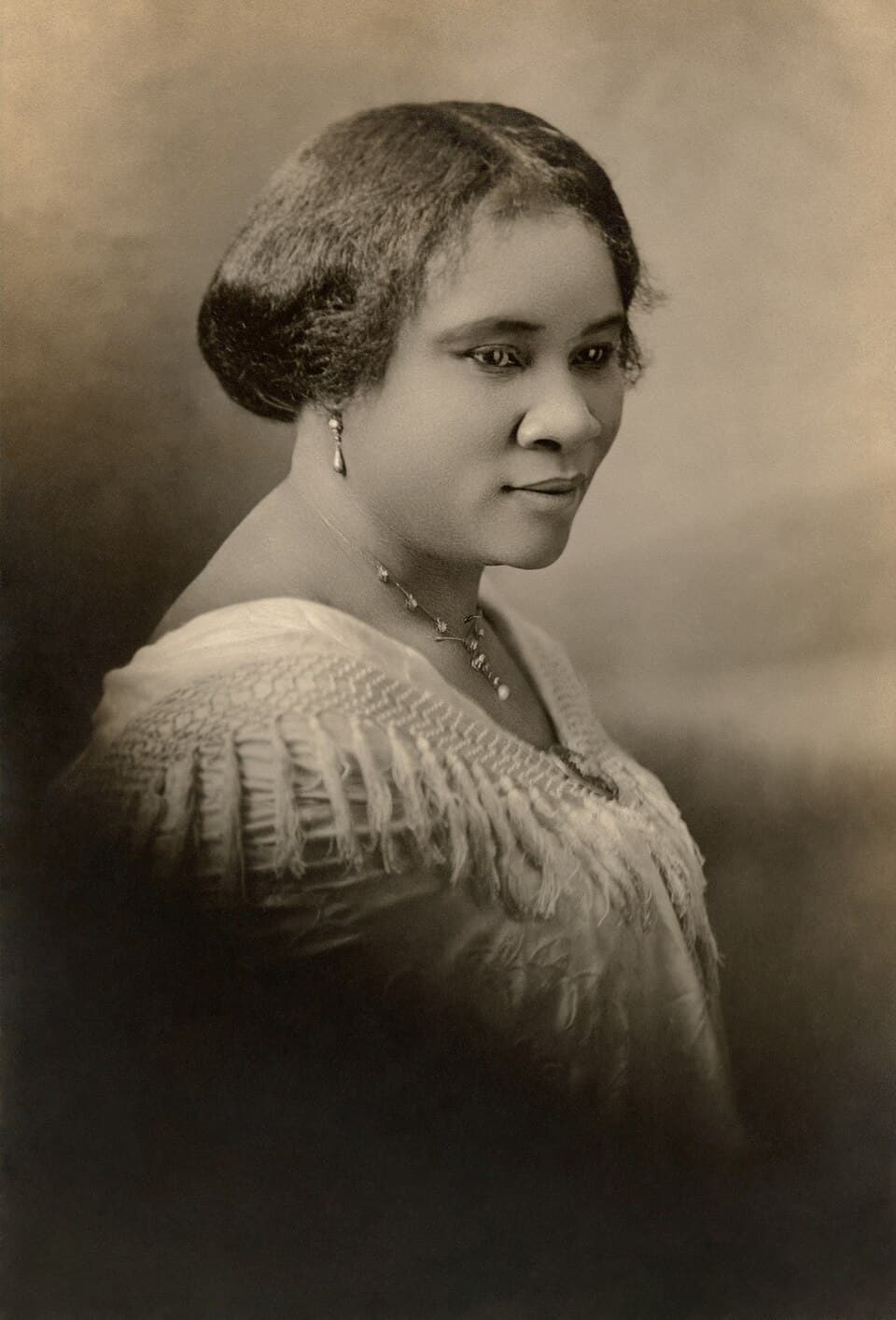
American · Activism · Science
Sarah Breedlove
December 23, 1867 – May 25, 1919
Early Life and Background
Madam C. J. Walker, born Sarah Breedlove on December 23, 1867, entered the world on a cotton plantation near Delta, Louisiana, in the years immediately following the American Civil War. She was the fifth of six children born to Owen and Minerva Anderson Breedlove, formerly enslaved parents who became sharecroppers after emancipation.[1][2][10][12] As the first of their children born into freedom, her life began at a moment when Black families were struggling to define what liberty could mean amid continuing poverty, discrimination, and violence.[1][6][12]
Her parents’ work as agricultural laborers reflected the broader conditions of Reconstruction and Jim Crow in the South, where newly freed African Americans often found themselves trapped in exploitative sharecropping arrangements.[1][14] Orphaned around age seven by the deaths of both Owen and Minerva, Sarah was raised by older siblings and worked from childhood in the fields, experiencing firsthand the severe economic and educational limitations placed on Black girls in the region.[1][4][6]
Seeking greater safety and opportunity, she moved to Vicksburg, Mississippi, in her early teens, where she labored as a domestic worker and laundress. Opportunities for formal schooling were scarce, and most accounts describe her as having only a few months of education.[1][10] Despite this, Breedlove developed practical business skills—budgeting, negotiating prices, and managing time—through the daily routines of washing and ironing.
On January 11, 1885, at around age fourteen, she married Moses McWilliams in Mississippi.[1][10] A daughter, A’Lelia McWilliams (later A’Lelia Walker), was born around 1888.[1][10] In the late 1880s and early 1890s, the family lived in Louisiana and then moved to St. Louis, Missouri, where Sarah continued to support herself through laundry work while participating in the life of local Black churches and mutual aid societies.[1][10]
Career Beginnings and Development
After Moses McWilliams’ death around 1903, Sarah was left a young widow responsible for her daughter and without financial security.[1][6][10] Working as a washerwoman for wages reportedly little more than a dollar a day, she experienced severe economic hardship and physical strain. At the same time, she suffered from a scalp condition that caused significant hair loss—a common problem among Black women of the era, exacerbated by harsh soaps, poor nutrition, and limited access to specialized hair-care products.[1][9][10]
In search of relief, she experimented with home remedies and commercial preparations, including those sold by Annie Turnbo Malone, a pioneering Black hair-care entrepreneur.[1][10] Around 1904–1905 she moved to Denver, Colorado, joining her sister’s household and seeking a fresh start.[4][5][10] In Denver she began developing her own scalp-conditioning formula, later marketed as Madam Walker’s Wonderful Hair Grower, and offered treatments and product demonstrations to local women.[1][4]
On January 11, 1906, she married Charles Joseph "C. J." Walker, a St. Louis salesman and newspaper advertising agent, who became her business partner.[1][10] Around this time she adopted the professional name Madam C. J. Walker, aligning her brand with the fashionable "Madam" title used by beauty specialists and signaling professionalism and authority to her clientele.[1][10]
Walker refined both her product line and her marketing strategies. She developed what became known as the "Walker System" of hair care: a regimen combining scalp preparation with special ointments, regular brushing, and the use of heated tools to style hair.[1][9][10] She trained women to serve as agents who performed demonstrations and sold products directly to customers, often in their homes, churches, and social clubs.[1][5][9]
By 1907 she was traveling extensively through the South and Midwest with her husband, organizing demonstrations and recruiting new agents.[1][10] Her approach combined personal charisma, meticulous presentation, and appeals to racial pride and self‑respect, encouraging Black women to see hair care as a route to dignity, professionalism, and financial independence.[1][9]
Formation and Growth of the Madam C. J. Walker Manufacturing Company
In 1908, Walker expanded her enterprise by opening a beauty school and manufacturing operation in Pittsburgh, Pennsylvania, training "hair culturists" in the Walker System and producing her products on a larger scale.[1][5][10] On August 5, 1908, she and her husband formally established the Madam C. J. Walker Manufacturing Company, giving her growing business a structured corporate identity.[10]
The company produced a range of items, including the signature "Wonderful Hair Grower," pressing oils, shampoos, and pomades, all marketed specifically to Black women.[1][10] Pittsburgh’s industrial infrastructure and transportation networks allowed Walker to ship products widely and support a growing sales force.
By 1910, she moved to Indianapolis, Indiana, then the nation’s largest inland manufacturing center.[4][5][10] On March 18, 1910, she relocated her firm’s headquarters there, building a factory, hair salon, and training school under one roof.[2][4][10] The company was incorporated soon afterward, formalizing its operations.[4][10]
From Indianapolis, Walker’s business grew dramatically. Her products were sold across the United States, and agents traveled to Canada, the Caribbean, and parts of Central America, introducing the Walker System to Black communities abroad.[1][5][10] The company’s training schools professionalized beauty work, turning it into a skilled occupation and creating new pathways for Black women who sought to escape domestic service and agricultural labor.[1][9]
Walker emphasized discipline, appearance, and customer service among her agents. They wore uniforms, carried sample kits, and presented themselves as representatives of a high‑quality brand. The company’s success depended as much on this network of trained women as on the products themselves, making Walker one of the earliest business leaders to build a national direct-sales organization of Black women.[1][5][9]
Major Accomplishments and Economic Achievements
By the early 1910s, the Madam C. J. Walker Manufacturing Company had become a major Black‑owned enterprise. Walker herself was increasingly recognized as one of the wealthiest African American women of her time.[1][10] Her fortune was built entirely through her own efforts, with no inheritance or marriage into wealth.
By 1912, the Black press and later commentators described Walker as a millionaire, emphasizing her status as a self‑made businesswoman.[1][10][12] She oversaw an operation that employed thousands of Black women as agents, factory workers, and salon staff, and her products were distributed across North America and into the Caribbean and Central America.[1][5][9]
In addition to direct sales, Walker’s schools produced a steady stream of trained "hair culturists" who opened their own salons under her brand or independently. This created a multiplier effect: as Walker’s products and techniques spread, so did the number of Black women with vocational skills and entrepreneurial experience.
Walker’s success in the beauty industry also intersected with broader debates about Black women’s appearance and identity. Her system often involved straightening or smoothing hair, a practice later criticized by some as conforming to Eurocentric standards.[1][9][10] Yet Walker’s own arguments emphasized cleanliness, scalp health, and styling as tools for self‑confidence and professional respectability in a society steeped in racist stereotypes.
By the time of her death in 1919, her company reportedly employed around 40,000 people, most of them Black women, and had generated a personal net worth estimated at hundreds of thousands of dollars.[5][10] Contemporary and later assessments placed her among the first women—of any race—to become a self‑made millionaire in the United States.[9][10][12]
Philanthropy, Activism, and Public Recognition
From early in her career, Walker linked her economic success to a philosophy of racial uplift. She contributed generously to Black churches, schools, and charitable institutions, funded scholarships, and supported organizations including the National Association for the Advancement of Colored People (NAACP), the Young Men’s Christian Association (YMCA), and various orphanages.[1][4][9][10]
Her activism became especially visible in the late 1910s. In 1917, after the East St. Louis race riot and other incidents of mass racial violence, Walker publicly condemned lynching and racial terror.[1][9] She attended meetings and rallies, spoke out on civil-rights issues, and used her wealth to support anti‑lynching campaigns.
From August 10–12, 1917, she convened the first national convention of her agents, the Madam C. J. Walker Hair Culturists Union of America, in Philadelphia.[1][10] The event is considered one of the earliest national business conventions organized by and for women entrepreneurs and sales agents in the United States.[1][10] Delegates discussed business practices, sales strategies, and community service, and Walker awarded prizes for both high sales and charitable giving.[1][10]
On the convention’s closing day, August 12, 1917, the delegates adopted resolutions condemning lynching and racial violence and urged collective action against racial injustice, while Walker pledged significant funds to support the NAACP’s anti‑lynching work.[1][9] This moment demonstrated her conviction that Black business organizations should serve as vehicles for political advocacy as well as economic advancement.
Walker’s prominence also brought her invitations to speak at public events and to join boards and advisory committees. She attended the National Negro Business League, founded by Booker T. Washington, and engaged with other Black leaders of the period.[1][9][10] Her philanthropic and civic efforts helped establish norms of corporate and community giving within the African American business community.[4][6]
Decades after her death, her achievements continued to attract recognition. In 1963, the Guinness Book of World Records listed her as the first woman to become a self‑made millionaire in America, confirming her place in popular business history and inspiring renewed biographical and scholarly interest.[5][10]
Personal Life
Walker’s personal life was marked by both hardship and close relationships. Her early marriage to Moses McWilliams brought the birth of her only child, A’Lelia, around 1888, but ended with his death, leaving her a young widow.[1][6][10] In St. Louis she found community through African American churches and voluntary associations, which provided spiritual support and informal networks that later helped her business.[1][4]
Her marriage to Charles Joseph Walker in 1906 merged personal and professional spheres. C. J. Walker assisted with advertising and helped her refine her promotional strategies, though the marriage eventually deteriorated, and the couple separated.[1][10] Nonetheless, she retained his surname for business purposes, and "Madam C. J. Walker" remained the brand associated with her products.
Walker’s relationship with her daughter, A’Lelia Walker, was central to both her personal and professional life. A’Lelia trained in the family business and later became an important cultural figure in Harlem, hosting salons and gatherings that drew artists, writers, and political activists of the Harlem Renaissance.[1][10] After Walker’s death, A’Lelia played a key role in sustaining the company and the family’s public profile.[1][10]
By the late 1910s, Walker’s wealth allowed her to commission a grand mansion, Villa Lewaro, in Irvington‑on‑Hudson, New York, designed by Black architect Vertner Tandy, one of the first licensed Black architects in the state.[1][10] The estate not only served as her residence but also as a symbol of Black achievement, hosting prominent African American leaders, intellectuals, and entertainers.
Later Life and Death
In her final years, Walker continued to oversee her business and travel to support its expansion, despite growing health problems. Her schedule of extensive touring, public speaking, and company management placed considerable stress on her body.[6][10]
In April 1919, she fell ill while traveling in St. Louis and returned to Villa Lewaro to recuperate.[6] On May 25, 1919, she died from complications of hypertension at age 51.[6][10] Reports at the time stated that she left an estate valued at more than $600,000, and some later estimates placed her net worth at or above $1 million, extraordinary figures for a self‑made Black woman in the early 20th century.[4][5][10]
At the time of her death, she was widely regarded as the wealthiest African American businesswoman and the wealthiest self‑made Black woman in the United States.[10] Her will included charitable bequests and instructions for the continuation of the company, ensuring that her philanthropic and economic impact would endure beyond her lifetime.[4][10]
Legacy and Historical Impact
Madam C. J. Walker’s legacy spans entrepreneurship, Black beauty culture, women’s economic empowerment, and civil-rights activism. As an entrepreneur, she demonstrated that a Black woman with minimal formal education could build a complex manufacturing and sales operation, train thousands of employees, and achieve national brand recognition in a segregated economy.[1][9][10]
Her business model—centered on vocational training, direct sales, and community-oriented conventions—provided one of the earliest large-scale examples of a Black female-led corporate network. The Walker System and her beauty schools professionalized cosmetic and hair-care work for Black women, laying groundwork for later generations of Black-owned beauty companies and salons.[1][9][10]
In the realm of philanthropy and activism, Walker set standards for Black business leaders. She insisted that her agents engage in charity and civic work, rewarded them for community contributions, and personally funded schools, missionaries, and civil-rights organizations.[1][4][9] Her anti‑lynching advocacy and support for the NAACP aligned her economic success with the broader struggle for racial justice.
Her story also challenged narratives about women’s roles in business. At a time when women were widely considered economically dependent on men, Walker’s rise as a self‑made millionaire offered a powerful counterexample. Her life has since inspired countless biographies, documentaries, and teaching materials, and her image has become a staple of women’s history and Black history curricula.[1][6][9][10]
Villa Lewaro and the Indianapolis factory have been recognized as sites of historical significance, and institution-based resources—from the National Women’s History Museum to the Library of Congress and state historical societies—highlight Walker as a central figure in American business and social history.[1][2][4]
In later decades, especially during the civil-rights era and the rise of Black feminist thought, Walker’s achievements were reinterpreted as evidence of Black women’s longstanding leadership in economic innovation and community-building. The 1963 Guinness Book of World Records listing confirming her as the first woman to become a self‑made millionaire in America solidified her international reputation and ensured her inclusion in global reference works.[5][10]
Today, Madam C. J. Walker is remembered not only for creating a successful hair-care empire but also for embodying a philosophy of self-help, racial pride, and collective uplift. Her oft-cited motto—"I got my start by giving myself a start"—captures a legacy that continues to resonate with entrepreneurs and activists seeking to build institutions that serve both individual aspiration and community progress.
Dated achievements
10 indexed.
- Dec231867Activism
Birth as first child in her family born free after slavery
Sarah Breedlove was born in Louisiana, becoming the first of her parents’ children born into freedom after emancipation.
View details TIME - Sarah Breedlove Walker - Jan111885Activism
Marriage to Moses McWilliams
Sarah Breedlove married Moses McWilliams, which marked the beginning of her family life.