← All women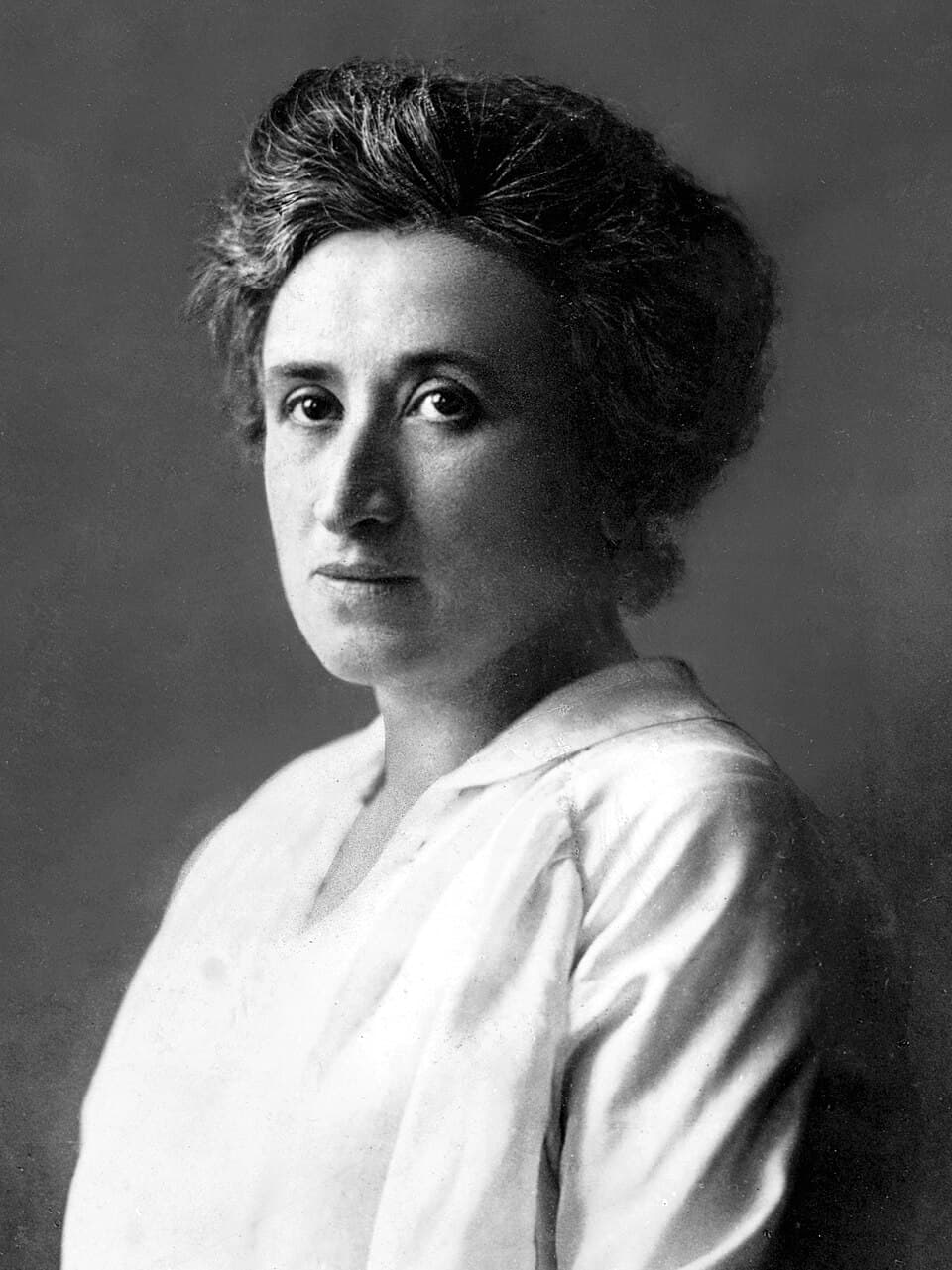
Polish, German · Politics · Activism
Rosa Luxemburg
March 5, 1871 – January 15, 1919
Early Life and Background
Rosa Luxemburg (born Rozalia Luksenburg) was born on 5 March 1871 in the town of Zamość in Congress Poland, then part of the Russian Empire. Her family belonged to the secular Jewish middle class; her father, Eliasz Luxemburg, was a timber merchant, and her mother, Line, managed the household. Growing up in a predominantly Jewish town under Tsarist rule, Luxemburg experienced both the repressive politics of imperial domination and the social marginalization of Jewish communities.
As a child, Luxemburg suffered from a hip disease that left her with a permanent limp. This disability, however, did not prevent her from excelling academically. She attended a girls’ gymnasium in Warsaw, where she distinguished herself in literature, languages, and history. Already as a teenager she was drawn to clandestine political circles. In Russian-controlled Poland, Polish nationalist sentiment was strong, but Luxemburg came to reject nationalist frameworks, arguing instead that the liberation of Poland depended on a broader international struggle of the working class.
Anti-Semitism and political repression were pervasive in the environment in which Luxemburg grew up, shaping her sensitivity to oppression and injustice. Her early encounters with underground socialist literature and activism led her to embrace Marxism, which she saw as offering a universal, class-based approach to emancipation that transcended ethnic divisions. This formative period in partitioned Poland laid the foundations for her later commitment to proletarian internationalism and her critical stance toward both bourgeois nationalism and liberal reformism.
Education and Exile in Switzerland
In 1889, facing the threat of arrest for her socialist activities and seeking educational opportunities unavailable to women in much of Europe, Luxemburg fled to Zurich, Switzerland. Zurich’s university was one of the few in Europe that admitted women, and it became a hub for exiled radicals from the Russian Empire and other countries. Luxemburg enrolled at the University of Zurich, studying philosophy, law, and political economy. She immersed herself in Marxist theory and joined the growing community of international socialist students and activists.
On 20 October 1898, Luxemburg defended her doctoral dissertation in political economy, later published as The Industrial Development of Poland. Her thesis examined how capitalist development in partitioned Poland under Russian rule undermined nationalist projects and integrated the region into broader imperial economic structures. By earning this degree, she became one of the first women to receive a doctorate in political economy and the first Polish woman to do so, breaking significant gender barriers in academia. Her analysis emphasized the primacy of class struggle and capitalist dynamics over national questions, themes that would recur throughout her later work.
While in Switzerland, Luxemburg also became deeply involved in socialist organizing. She co-founded, in 1893, the Social Democracy of the Kingdom of Poland (SDKP), a Marxist party that rejected Polish nationalism and called for international class struggle. The SDKP later expanded to include Lithuania and became the Social Democracy of the Kingdom of Poland and Lithuania (SDKPiL). Through these activities Luxemburg emerged as a leading figure in Polish Marxism, known for her intellectual rigor and unwavering commitment to revolutionary politics.
Move to Germany and Career Beginnings
After completing her studies, Luxemburg moved to Berlin in 1898, seeking to participate in the largest and most influential socialist party of the time, the Social Democratic Party of Germany (SPD). She quickly became involved in the party’s internal debates, particularly the controversy over Eduard Bernstein’s revisionist reinterpretation of Marxism. Bernstein argued that capitalism was stabilizing and that socialism could be achieved through gradual reforms within parliamentary democracy.
On 12 December 1898, Luxemburg delivered a major speech in Berlin that constituted her first prominent public intervention against Bernstein’s ideas. She insisted that capitalism’s contradictions and crises made revolutionary rupture necessary and that abandoning the goal of socialism in favor of reform would amount to a betrayal of the working class. This moment established her as one of the foremost theoretical opponents of revisionism within the SPD and positioned her as a rising intellectual force in international socialism.
In 1899, Luxemburg expanded these arguments in her pamphlet Reform or Revolution, which became a classic Marxist text. She argued that reforms, while often beneficial to workers in the short term, could not substitute for the abolition of capitalist property relations and that socialists must retain the strategic horizon of revolution. Her critique influenced debates across Europe, reinforcing the distinction between revolutionary and reformist socialism.
Major Works and Theoretical Contributions
Luxemburg’s major works spanned economic theory, political strategy, and critiques of nationalism and authoritarianism. Her engagement with the Russian Revolution of 1905 and mass strikes in Russian-occupied Poland served as a crucial empirical basis for her understanding of revolutionary dynamics.
On 1 May 1905, Social Democrats in Warsaw organized a mass strike and complete work stoppage to mark May Day. Luxemburg regarded this event as a decisive experience for the Polish proletariat and as a key illustration of the power of the mass strike. She argued that such strikes emerged spontaneously from workers’ struggles and could rapidly escalate from economic demands to overt political confrontation.
Her subsequent work, written during and after imprisonment, elaborated these ideas. Arrested in Warsaw on 19 March 1906 for agitation and organizing strikes, Luxemburg continued to write from prison. By 1 July 1906, she had completed major portions of her pamphlet The Mass Strike, the Political Party and the Trade Unions. In this text she argued that mass strikes were not tools to be mechanically deployed by party leadership but living processes arising from profound social contradictions. She emphasized the importance of workers’ spontaneous initiative and criticized both conservative union leaders and overly rigid party bureaucracies.
In economic theory, her most significant contribution was The Accumulation of Capital, published on 1 June 1913. In this book Luxemburg confronted the question of how capitalism, as described by Marx, could continue to expand despite limits internal to the system. She proposed that sustained accumulation depends on the continual incorporation and exploitation of non-capitalist social formations, often through imperialist and colonial expansion. Although her interpretation of Marx’s reproduction schemas was controversial and drew critique from other Marxist theorists, her emphasis on the links between imperialism, colonialism, and accumulation foreshadowed later theories of dependency and global capitalism.
Luxemburg also wrote extensively on democracy, revolution, and nationalism. She was skeptical of national self-determination when disconnected from class struggle, arguing that nationalist movements could serve bourgeois interests. At the same time, she insisted that socialist politics must be deeply democratic, with broad participation, freedom of expression, and open debate. Her critique of authoritarian tendencies within socialist movements, including those she perceived in Lenin’s Bolshevism, stressed the dangers of suppressing democracy in the name of efficiency or discipline.
Opposition to War and the Spartacus League
As tensions in Europe mounted in the years preceding World War I, Luxemburg became one of the most forceful voices against militarism and nationalism. She argued that imperialist competition among capitalist states made war inevitable and that workers had no interest in such conflicts. Her speeches and writings denounced the arms race and called for international solidarity against war.
On 20 February 1914, Luxemburg was sentenced in Frankfurt to one year in prison for inciting soldiers to disobedience through her anti-militarist speeches. Her prosecution highlighted the state’s determination to silence radical critics of war and underscored the personal risks she incurred by publicly urging conscripts to resist militarist policies. Despite imprisonment, she continued to write, offering sharp critiques of the SPD leadership when, in August 1914, the party voted to support war credits.
Luxemburg was central to the formation of the anti-war group that evolved into the Spartacus League. From prison, she helped draft statements and coordinate opposition within the socialist movement. On 31 March 1916, she co-founded and helped organize the Spartacus League, a revolutionary socialist grouping that opposed World War I and the SPD’s collaboration with the state. The League later began publishing the newspaper Die Rote Fahne, with Luxemburg as a leading contributor. Her writings in this period, including the Junius Pamphlet, offered a scathing indictment of war and laid out a vision of internationalist socialism.
Role in the German Revolution
By 1918, the cumulative impact of war, economic hardship, and political discontent produced revolutionary ferment in Germany. Workers’ and soldiers’ councils formed, and the Kaiser’s regime collapsed. Luxemburg was released from prison in November 1918 and immediately became a central figure in the unfolding German Revolution.
On 10 November 1918, she spoke at a mass rally in Berlin, advocating for a socialist republic based on the power of workers’ councils rather than a mere parliamentary system. She criticized the SPD leadership, which sought to stabilize the situation through alliances with conservative military and administrative elites, arguing that such compromises would preserve the underlying structures of capitalist and militarist domination.
Luxemburg’s programmatic vision for the revolution was articulated most clearly in her article "What Does the Spartacus League Want?", published on 14 December 1918 in Die Rote Fahne. In this text she called for the abolition of the monarchy, expropriation of the ruling classes, workers’ control of production, and the establishment of a council-based republic. She also demanded extensive democratic rights, including freedom of speech and association, reflecting her belief that socialism must be inseparable from political democracy.
At the turn of the year, Luxemburg helped lead the transformation of the Spartacus League into a new revolutionary party. On 1 January 1919, at the founding congress in Berlin, the Communist Party of Germany (KPD) was established. Luxemburg, together with Karl Liebknecht and other comrades, played a major role in shaping the party’s initial orientation. She argued for participation in elections, for close ties with workers’ councils, and against purely insurrectionary tactics that might isolate the party.
Personal Life and Relationships
Luxemburg’s personal life was closely intertwined with her political commitments. She never married, but she maintained deep and complex relationships, many of them within the socialist movement. A significant partnership was with Leo Jogiches, a fellow Polish Marxist and co-founder of the SDKP, with whom she shared both political work and an intimate relationship for many years. Their correspondence reveals intellectual collaboration, emotional intensity, and occasional conflicts rooted in differing temperaments and strategic views.
Luxemburg also formed close friendships with figures such as Clara Zetkin, a leading socialist feminist, and Karl Liebknecht, her comrade in the Spartacus League. Her letters, many of which have survived, show a woman who combined fierce political determination with an appreciation for literature, nature, and everyday beauty. She was known to enjoy collecting plants and to find solace in observing the natural world, even during times of imprisonment.
Despite her intense public life, Luxemburg’s personal choices reflected her refusal to conform to traditional gender norms. She pursued an intellectual and political career in a male-dominated environment, lived independently, and rejected expectations of domesticity and marriage, viewing such norms as entangled with bourgeois social relations she sought to transform.
Later Life, Assassination, and Martyrdom
The revolutionary hopes of late 1918 quickly met with violent resistance from conservative and nationalist forces. In early January 1919, radical workers in Berlin engaged in an uprising, and the government responded by deploying paramilitary Freikorps units to suppress the movement. Luxemburg, as a leading figure in the KPD and a public proponent of deepening the revolution, was a primary target.
On 15 January 1919, she was captured in Berlin alongside Karl Liebknecht. Transported to the Eden Hotel, she was interrogated, beaten with rifle butts, and ultimately shot in the head. Her body was then thrown into the Landwehr Canal, where it remained for several months before being recovered. Her murder was carried out by members of the Freikorps, operating with at least tacit approval from elements of the government, illustrating the lethal fusion of state power and right-wing paramilitary violence.
News of her death began circulating quickly. On 16 January 1919, German and international newspapers reported her assassination, sparking outrage among socialists and sympathizers. These reports, even before her body was found, framed her killing as an act of counterrevolutionary terror and helped cement her status as a martyr of the workers’ movement. Her funeral, held months later after the discovery of her body, became a major political event.
Legacy and Historical Impact
Rosa Luxemburg’s legacy spans political theory, revolutionary practice, and cultural memory. She is widely regarded as one of the most original and influential Marxist theorists of the twentieth century. Her contributions to debates on capitalist accumulation, imperialism, democracy, and the mass strike have shaped subsequent generations of socialist thought. The Stanford Encyclopedia of Philosophy describes her as among the most brilliant intellectual heirs of Marx and Engels.
Within the workers’ movement, Luxemburg stands out for her insistence that socialism must be deeply democratic and rooted in the self-emancipation of the working class. She championed mass participation, free criticism, and the autonomy of workers’ councils. Her critiques of revisionism within the SPD and of authoritarian tendencies within revolutionary movements, including aspects of Bolshevik practice, underscored her belief that means and ends must align: a socialist society could not be built through undemocratic methods without betraying its emancipatory goals.
Luxemburg also left a lasting mark on analyses of imperialism and colonialism. Her argument that capitalism’s drive to accumulate pushes it to penetrate non-capitalist environments, often through brutal forms of domination, anticipated later theories of global capitalism and dependency. Her attention to the destruction wrought by imperial expansion has informed contemporary understandings of how economic systems intertwine with racism, colonialism, and ecological harm.
In women’s history, Luxemburg holds a distinctive place as a woman who reached the highest levels of theoretical and organizational leadership in a major international movement. She obtained a doctorate at a time when few women could attend university, intervened decisively in central ideological debates, and helped found the Communist Party of Germany. Her life illustrates both the possibilities and the perils faced by women who challenged gender norms and patriarchal institutions, and her assassination underscores the violence that could be directed at female leaders.
Luxemburg’s memory is preserved in numerous ways. Institutions bearing her name, most prominently the Rosa-Luxemburg-Stiftung, a foundation associated with contemporary left politics in Germany, promote research, education, and activism inspired by her work. Her writings are widely published, and her letters offer insight into the personality behind the theory. Annual commemorations, scholarly conferences, and political discussions continue to revisit her ideas, debating their relevance for current struggles over democracy, capitalism, and internationalism.
Beyond formal institutions, Luxemburg’s image as "Red Rosa" has become a symbol of uncompromising resistance to oppression and commitment to a humane, democratic socialism. Her insistence that "freedom is always and exclusively freedom for the one who thinks differently"—a line from her critique of Bolshevik policies—resonates as a warning against dogmatism within all movements for change. More than a century after her death, Rosa Luxemburg remains a central figure in the intellectual and political history of the left and an enduring icon in the global history of women who fought to reshape the world.
Dated achievements
14 indexed.
- Mar051871Politics
Birth in Zamość, Poland
Rosa Luxemburg was born in Zamość, Poland, on March 5, 1871.
View details Wikipedia: Rosa Luxemburg - Oct201898Politics
First Polish woman to earn a doctorate in political economy
Luxemburg became the first Polish woman to earn a doctorate in political economy on October 20, 1898.