← All women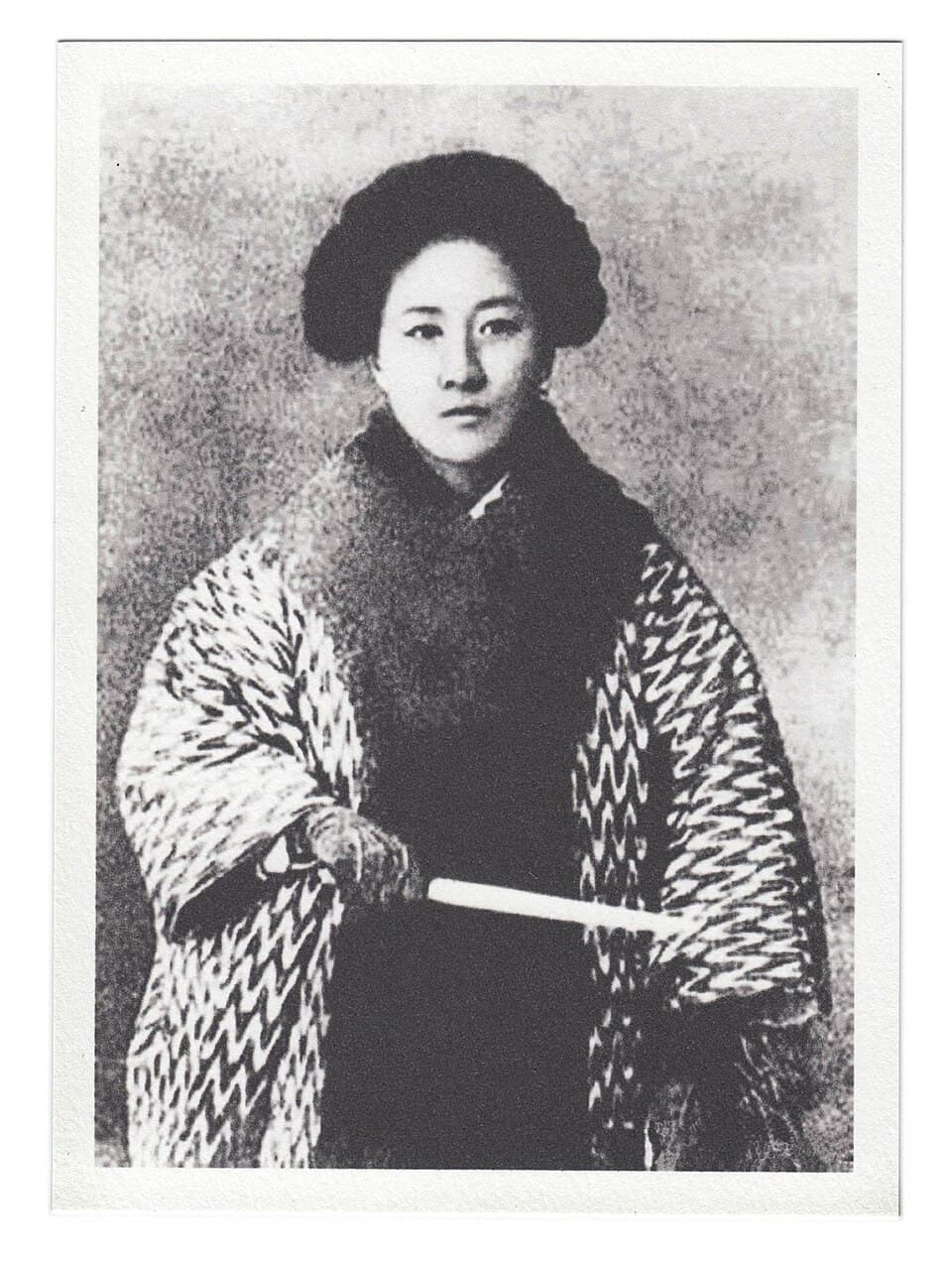
Chinese · Activism · Literature
Qui Jin
November 8, 1875 – July 15, 1907
Early life and background
Qiu Jin (Chinese: 秋瑾; 8 November 1875 – 15 July 1907) was a Chinese revolutionary, feminist, poet, journalist, and writer whose brief life made her one of the most enduring figures in modern Chinese women’s history. She was born in Xiamen, Fujian, into a relatively well-off family connected to the local gentry. Later biographical traditions sometimes gave differing accounts of her birthplace, but the most widely used scholarly and reference sources identify Xiamen as her birthplace. Her family background gave her access to literacy and classical learning, both of which became central to her later work as a writer and political thinker.
Qiu Jin grew up in the late Qing dynasty, a period marked by internal crisis, foreign pressure, and sharp debates about reform and national survival. As a girl, she was raised according to the gender norms of her time. She learned the skills expected of elite women, including domestic arts, and as a teenager her feet were bound, an experience she later condemned as a symbol of women’s oppression. That bodily discipline, which was then still widely accepted in elite Chinese society, became one of the most important personal experiences shaping her feminism. In her later writing, she repeatedly criticized customs that restricted women’s movement, education, and autonomy.
Her family arranged her marriage to Wang Tingjun, the son of an official. Like many marriages of the period, the union was formed within social and family expectations rather than personal choice. Qiu Jin later lived with her husband and children in Beijing for a time, but she increasingly found the marriage constraining. The tension between her personal dissatisfaction and the public role expected of a married woman became a recurring theme in her life and writing. Later accounts emphasize that she had two children, and that her family life became one of the pressures that pushed her toward self-reinvention and political action.
Education, travel, and awakening to reform
By the early twentieth century, Qiu Jin had begun to develop a sharper political consciousness. Like many educated reform-minded Chinese women of her generation, she came to see women’s subordination as inseparable from China’s broader weakness. The late Qing crisis encouraged new arguments that national survival required stronger citizens, new schools, and new public roles for women. Qiu Jin absorbed these ideas and gave them force through her own writing and example.
In 1903, she left her husband and children and traveled to Japan to study. That decision was radical in the context of her era. A married Chinese woman leaving home to pursue education abroad challenged not only gender expectations but also family authority and conventional morality. In Japan, she encountered Chinese student circles and revolutionary organizations, and she was exposed to anti-Qing and feminist ideas circulating among reformers and exiles. Her time there became formative: she adopted more forceful political language, cultivated a public revolutionary identity, and learned skills associated with self-defense and militancy.
Japan was also a crucial site for the transnational exchange of reform ideas in early twentieth-century East Asia. Chinese students in Tokyo debated nationalism, constitutionalism, women’s emancipation, and revolution. Qiu Jin moved within this world and emerged from it with a stronger conviction that women must be educated not merely to improve the family, but to transform the nation. Her experience abroad reinforced her belief that women’s liberation and political revolution were inseparable goals.
Writing, feminism, and revolutionary politics
Qiu Jin became widely known for her writing. Her poetry and prose fused classical literary forms with modern political urgency. She is especially remembered for combining personal complaint, patriotic sentiment, and feminist critique. Her works attacked arranged marriage, footbinding, the confinement of women to domestic life, and the exclusion of women from education and public affairs. At the same time, she linked these injustices to national weakness under the Qing dynasty, arguing that a strong nation could not be built on the subordination of half its population.
In 1904, she published her best-known manifesto, A Respectful Appeal to China’s 200 Million Female Comrades. In that text, she urged women to pursue education, physical strength, and collective solidarity. The manifesto remains one of the most important early documents of Chinese feminism because it turned women’s grievances into a public political program. Rather than appealing only for moral reform, Qiu Jin called for women to develop the power to resist oppression. The work is often cited as a landmark in modern Chinese women’s political thought.
After returning to China in 1905, Qiu Jin deepened her involvement in revolutionary networks and women’s groups. She aligned herself with anti-Qing activists associated with the broader republican movement, including circles connected to Sun Yat-sen. She used journalism, teaching, and organizational work to advance revolutionary goals. Her activism was not limited to abstract argument; she attempted to build institutions and train supporters. In 1906, she became principal of Datong (Great Unity) Girls’ School in Shaoxing. Although it functioned as a school for girls, it also served as a covert center for revolutionary organizing and training. This made the school a striking example of how educational reform and political conspiracy overlapped in the late Qing period.
Personal life and conflict with gender expectations
Qiu Jin’s personal life cannot be separated from her public identity. She was born into a social world that expected women to marry, bear children, remain loyal to their husband’s household, and avoid political visibility. She rejected those expectations repeatedly and at great cost. Her departure from home and her willingness to live independently in Japan placed her outside the moral norms applied to most women of her time. To supporters, this made her a model of courage. To authorities and conservative critics, it made her dangerous.
Her marriage and motherhood remained important parts of her biography, but they did not define her in the way social convention prescribed. Instead, they sharpened her awareness of women’s constraints. Her poetry and essays often reflect the emotional conflict between domestic obligation and public purpose. This tension gave her writing a distinctive force, because it came from lived experience rather than abstract theory. Later feminist memory embraced her precisely because she embodied a refusal to accept the life that had been assigned to her.
Some biographies also note her martial arts training and interest in swordsmanship, which contributed to her later image as a “modern Mulan” or “Chinese Joan of Arc.” Whether as literal practice or as part of her symbolic afterlife, these associations reinforced the idea that she challenged gender norms in both body and mind. Her image as a woman willing to act, fight, and die for her convictions became central to her mythos.
Arrest, trial, and execution
In July 1907, Qiu Jin became caught up in revolutionary plotting involving her cousin Xu Xilin. After Xu’s failed uprising, Qing authorities moved quickly against suspected conspirators. Qiu Jin was arrested and detained. According to later accounts, she was tortured and refused to recant. Her capture marked the collapse of the immediate revolutionary network in which she had been working, but it also sealed her reputation as a martyr.
She was executed by beheading on 15 July 1907 at Xuantingkou in Shaoxing. She was only thirty-one. The Qing state intended the execution to serve as a warning, but the public brutality of the act had the opposite effect in historical memory. Qiu Jin’s death became a rallying point for revolutionaries and a powerful symbol of the violence of the old order. Her execution transformed her from a controversial activist into a national martyr.
The timing of her death also mattered. Only a few years later, the revolutionary tide that she had helped energize would culminate in the fall of the Qing dynasty. After the Xinhai Revolution of 1911 and the establishment of the Republic of China, Qiu Jin was posthumously honored as a revolutionary heroine. Her image was incorporated into the broader story of republican struggle, where she stood for both anti-imperial resistance and women’s emancipation.
Posthumous honors and historical legacy
By the early Republic, Qiu Jin was already being described as “China’s first feminist.” That designation, while not the product of a single official proclamation, captures the way her memory was mobilized by women’s rights advocates in the first generation after the Qing collapse. Her status as a female martyr mattered because it supplied a heroic genealogy for the women’s movement in China. She became proof that women could be agents of national transformation, not merely its beneficiaries.
Her legacy rests on several overlapping achievements. She wrote some of the most politically charged poetry of her era. She authored a major feminist manifesto. She helped connect women’s emancipation to nationalist revolution. She also turned her own life into a challenge to social convention, using dress, education, travel, and political speech to defy expectations placed on elite women. For later generations, these acts made her a founder-like figure in Chinese feminism, even though her life ended before the fall of the dynasty she opposed.
Qiu Jin’s memory has endured in schools, museums, literature, film, and public history. She has been celebrated as a heroine of both feminism and revolution, and she remains one of the best-known women of the late Qing period. Her life illustrates how a woman in a deeply patriarchal society could use writing, education, and political organizing to create a new public role for women. The power of her legacy lies not only in what she accomplished during her lifetime, but in how her death helped future generations imagine women’s equality as part of China’s modern national story.
Qiu Jin stands as one of the defining figures of early Chinese feminism: a poet who turned grievance into manifesto, a teacher who turned a girls’ school into a revolutionary node, and a martyr whose execution became inseparable from the history of women’s emancipation in modern China.
Dated achievements
3 indexed.
- Nov081875Activism
Birth of Qiu Jin
Birth of Qiu Jin in Xiamen, Fujian Province, China.
View details Fembio - Biography of Qiu Jin - Jul151907Activism
Execution of Qiu Jin
Execution by beheading of Qiu Jin for her revolutionary activities.
View details