← All women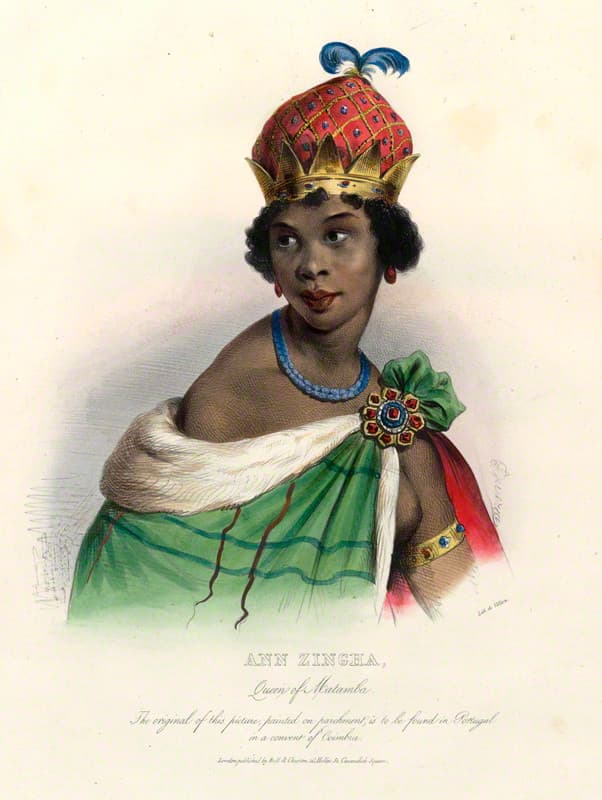
Angolan · Politics · Activism
Queen Anna Nzinga
1582 – December 17, 1663
Early Life and Background
Nzinga Mbandi (also spelled Njinga, and later known as Ana de Sousa Nzinga Mbande) was born around 1582–1583 in the kingdom of Ndongo, in the interior of what is now northern Angola.[2][3][10] Her people were the Mbundu (Ambundu), and Ndongo was ruled by a line of kings who bore the title ngola, from which the modern name "Angola" derives.[2][13] Most scholarly accounts identify her father as Ngola Kiluanji Kia Samba (often rendered Mbandi a Ngola Kiluanji), a king of Ndongo who faced growing pressure from Portuguese expansion and the Atlantic slave trade.[2][3]
Nzinga was born into an era of intense turmoil. The Portuguese had established a colony around Luanda in the late sixteenth century and were pushing inland to secure captives for the transatlantic slave trade and to control key trade routes.[2][10] Ndongo suffered repeated military incursions, fort-building, and alliance-making by Portuguese officials and their African allies, including the mercenary Imbangala bands.[2][3] As a royal daughter in this climate, Nzinga grew up in a court where war, diplomacy, and survival were constant concerns.
Sources emphasize that Nzinga received unusually extensive training for a woman of her time. She is described as her father’s favored child and as an inquisitive, politically astute girl who learned languages, military tactics, and diplomatic etiquette.[3][4][9] She reportedly gained familiarity with Portuguese through interpreters and early encounters and participated in court affairs from a young age.[3] Although detailed records of formal education are lacking, her later mastery of negotiation and battlefield strategy suggests that she absorbed both Mbundu political culture and the emerging European diplomatic norms.
Family, Succession Context, and Formative Influences
Nzinga’s family relations were complex and framed by succession disputes. She had at least one brother who became king, commonly known as Ngola Mbande, and sisters, including Barbara Kambu (also called Kambu or Kumba), who would later succeed her in Matamba.[2][3][9] Internal Ndongo politics were shaped by competition among royal lineages, struggles over relations with Portugal, and the presence of Imbangala war bands, whose militarized culture and practices influenced regional warfare.[2][3]
Her formative experiences included seeing Ndongo subjected to Portuguese attacks and witnessing large-scale enslavement of her people.[3][10] Portuguese campaigns in the late sixteenth and early seventeenth centuries devastated villages, seized captives, and established forts on Ndongo soil.[2][10] These events instilled in Nzinga a deep awareness of the existential threat posed by colonial expansion and the slave trade. They also taught her the importance of diplomacy, alliance politics, and military innovation, themes that would define her later rule.
Career Beginnings and Diplomatic Emergence
By the early 1620s, Nzinga had become a principal advisor and diplomat for her brother King Ngola Mbande.[2][3] While he struggled with Portuguese offensives and internal opposition, she was tasked with high-stakes negotiations. In 1617 and subsequent years, thousands of Ndongo people were captured and enslaved following Portuguese incursions, prompting the king to seek talks with Luanda’s colonial government.[4]
Nzinga’s most famous early diplomatic mission occurred on 21 December 1622, when she traveled to Luanda as her brother’s envoy to meet Portuguese governor João Correia de Sousa.[2][10] During this audience, she argued forcefully for the cessation of Portuguese raids, the removal of forts built on Ndongo territory, and the release of captives. Contemporary and later accounts emphasize her composure, intelligence, and command of the meeting.[2][10] The negotiations produced a treaty that temporarily halted some slave seizures and allowed a number of captives to return to Ndongo.[2]
The episode also generated one of the most enduring stories about Nzinga. According to several accounts, the Portuguese refused to offer her a chair, expecting her to sit on the floor as a sign of inferiority. Nzinga instead ordered one of her attendants to kneel, using the woman’s back as a human seat, thereby symbolically asserting equality with the governor.[2] Whether embellished or not, this anecdote has become emblematic of her insistence on sovereign dignity in dealings with European powers.
Conversion, Accession, and Early Rule in Ndongo
In 1624, events in Ndongo took a decisive turn. Ngola Mbande died, leaving a fraught succession landscape in which Portuguese influence and internal factions posed serious threats.[2][10] Around this time, Nzinga was baptized as Ana de Sousa by Catholic missionaries in Luanda, with the Portuguese governor acting as her godfather.[2] She adopted the Christian name "Ana" and the surname "de Sousa," signaling both religious conversion and a political relationship with Portuguese authorities.
In the same year, Nzinga assumed power as queen of Ndongo, taking the royal title and governing as paramount ruler of the Mbundu kingdom.[2][10] The exact mechanics of her accession are difficult to reconstruct, but sources agree that she asserted her right to rule despite patriarchal norms that typically favored male succession.[3][10] As queen, she inherited a state battered by war, depopulation, and rival claimants.
During the early phase of her reign, Nzinga attempted to use her Christian conversion and diplomatic overtures to secure Portuguese recognition and peace.[2] She initially pursued negotiations and alliances that aimed to stabilize Ndongo and curtail slave raids. However, Portuguese policy remained largely geared toward territorial expansion and the capture of labor, and relations soon deteriorated.[2][3] By the mid-1620s, renewed fighting forced Nzinga to abandon Ndongo’s traditional capital and seek new strategies for survival.
Flight, Alliance with Imbangala, and Creation of a New Power Base
Under increasing Portuguese pressure and facing internal opposition, Nzinga left Ndongo territory and sought refuge among the Imbangala, a group of militarized warriors who operated as mercenary bands in the region.[2][3] These groups practiced distinctive initiation rituals and were deeply involved in warfare and the slave trade. Nzinga forged alliances with them, integrating some of their military practices into her own forces.
In the 1630s, she developed a system of militarized camps known as kilombos (sing. kilombo). These camps functioned simultaneously as youth military training institutions and as sanctuaries for refugees and escaped slaves.[3][4] The kilombo structure allowed Nzinga to consolidate power among displaced populations, create disciplined armies, and offer protection to those fleeing Portuguese control. This innovation contributed significantly to the resilience of her realm and to the continuation of resistance against colonial incursions.
Conquest and Rule of Matamba
Around 1631, Nzinga seized control of the neighboring kingdom of Matamba.[2][3] Matamba lay to the east of Ndongo and already had its own political traditions and ruling elite. Through a combination of alliance, warfare, and strategic maneuvering—often involving Imbangala support—Nzinga displaced the existing rulers and installed herself as queen.
Once in power, Nzinga transformed Matamba into her principal kingdom. She relocated her court there, integrated Ndongo refugees and Imbangala forces into the state, and asserted control over important inland trade routes.[2][3] Matamba’s position allowed direct engagement with interior African markets and gave Nzinga leverage over the flow of captives and goods toward the coast.
Under her rule, Matamba became a refuge for escaped slaves and communities fleeing Portuguese domination.[2] The kingdom’s kilombo network and flexible social policies enabled former captives to resettle and, in some cases, join military units defending the realm. Matamba, under Nzinga, thus served as a counterweight to Portuguese Angola: a sovereign African state that offered alternatives to plantation bondage and colonial rule.
Military Campaigns and Shifting Alliances
Throughout the 1630s and 1640s, Nzinga led prolonged military campaigns against Portuguese positions and their African allies.[2][3] She used Imbangala fighters, reorganized Mbundu forces, and shifted between guerrilla tactics and open warfare depending on circumstances. Her armies attacked forts, cut off supply lines, and seized captives, while her diplomats negotiated temporary truces, alliances, and trade agreements.
Nzinga’s strategy relied heavily on shifting alliances. At different points she allied with Imbangala chiefs, neighboring African rulers, and European powers, notably the Dutch West India Company.[2][14] These alliances were often transactional and temporary, but they enabled her to counterbalance Portuguese military superiority and to exploit divisions among her enemies.
Alliance with the Dutch and the Capture of Luanda
A major turning point occurred on 26 August 1641, when the Dutch West India Company captured Luanda, dislodging the Portuguese from their main coastal stronghold.[2][14] Nzinga quickly aligned herself with the Dutch, seeing in them potential allies against her long-standing adversaries. She negotiated cooperation agreements and received arms and support for campaigns aimed at reclaiming territories and captives.
Under this alliance, Nzinga’s forces, in coordination with Dutch troops and ships, attacked Portuguese positions and disrupted slave-trading networks centered on Luanda.[2][14] For several years, Portuguese power in Angola was severely weakened, and the balance of regional forces shifted toward Nzinga and her allies. The alliance demonstrated her ability to exploit European rivalries and confirmed Matamba’s status as an important player in Atlantic geopolitics.
Portuguese Reconquest, Capital Relocation, and Continued Resistance
In August 1648, Portuguese forces under Salvador Correia de Sá e Benevides launched a successful expedition that recaptured Luanda from the Dutch.[2][14] This reconquest restored Portuguese control over the coastal colony and undermined Nzinga’s position. Dutch support faded, leaving her once more confronting Portugal largely on her own.
Nzinga responded by relocating her capital from Kavanga deeper into the interior of Matamba, creating a more defensible base of operations.[2][15] Rather than signaling defeat, this move allowed her to continue guerrilla warfare and raids against colonial forces while making it harder for Portuguese armies to penetrate her core territory. Matamba expanded its role as a refuge for escaped slaves and opponents of Portuguese rule, reinforcing its identity as a sanctuary kingdom.
Even after the Portuguese reconquest of Luanda, Nzinga maintained active resistance. She continued to attack Portuguese and allied positions, negotiate short-term truces, and manage trade and diplomacy to keep her kingdom viable. Her campaigns in this period helped prevent Portugal from exercising full control over inland regions and preserved the independence of Matamba.[2][3]
Diplomacy, Religious Policy, and Peace Negotiations in the 1650s
By the 1650s, Nzinga began exploring the possibility of more durable peace arrangements with the Portuguese. After decades of warfare, depopulation, and instability, establishing a modus vivendi offered potential benefits for both sides. Portuguese officials sought secure trade routes and captives; Nzinga sought recognition of her sovereignty and guarantees for her people’s safety.[2][15]
In 1656, Nzinga is reported to have renewed her Catholic faith and invited missionaries back into Matamba.[2][10] This religious realignment was part of a broader diplomatic strategy aimed at reassuring Portuguese authorities and securing favorable treaty terms. She embraced certain Christian rituals and permitted church establishments, while retaining control over internal governance and continuing to protect runaway slaves.
Subsequent agreements in the 1650s recognized her authority in Matamba and allowed her kingdom to remain a place of refuge, even as it engaged in regulated trade—including participation in aspects of the Atlantic slave trade under terms she negotiated.[2][15] Nzinga’s approach to peace was pragmatic: she accepted some compromises to secure her state’s autonomy and strengthen its commercial position, while resisting direct colonial rule.
Major Accomplishments and Political Innovations
Over the course of her reign, Nzinga achieved a series of major political and military accomplishments:
- Transforming Ndongo and Matamba into resilient, sovereign African states that maintained independence from Portuguese Angola for most of the seventeenth century.[2][5]
- Developing the kilombo system in the 1630s, which combined military training camps with refuge communities for escaped slaves and displaced people, strengthening resistance and social cohesion.[3][4]
- Forging and managing complex alliances with Imbangala war bands, neighboring African rulers, and European powers, especially the Dutch West India Company in the 1640s.[2][14]
- Using religious conversion and reconversion strategically, first in 1624 and again in the 1650s, to secure diplomatic recognition and negotiate peace from a position of relative strength.[2][10][15]
- Maintaining Matamba as a major commercial state that dealt with Portuguese Angola on nearly equal terms by the time of her death.[5]
These accomplishments required navigating the brutal realities of the slave trade. Scholars note that while Nzinga fiercely resisted Portuguese incursions and sheltered runaways, she also engaged in the trade of captives as part of her diplomatic and economic strategies, a complexity characteristic of the era’s African polities.[3]
Awards, Honors, and Historical Recognition
Nzinga ruled in a period before modern formal awards; there is no record of contemporary decorations akin to modern orders or medals. However, her legacy has been honored extensively in subsequent centuries. She is frequently described as one of the "most formidable rulers" of seventeenth-century Africa and a "trailblazing African female leader" in historical and public-history literature.[3][14]
In modern Angola, Nzinga has been commemorated as a national heroine and symbol of resistance to colonialism. Statues, public artworks, school curricula, and feminist writings celebrate her as a pioneer of African anti-colonial struggle and women’s leadership.[5][13] Contemporary organizations, including women’s movements and heritage groups, invoke her name and story as inspiration, and her life is regularly highlighted during observances such as Black History Month and in world history educational programs.[11][12]
Personal Life
Detailed information about Nzinga’s personal life is limited and often filtered through European observers or later traditions. Some sources state that she entered into a politically motivated marriage with an Imbangala chief during her efforts to secure alliances and military support.[9] Others emphasize her practice of maintaining a retinue of young male companions whom she used as consorts and, according to some accounts, executed after sexual relations to prevent them from becoming rivals; however, these stories are difficult to verify and may reflect hostile or sensationalist depictions by European chroniclers.
Nzinga did not leave any known biological heirs who succeeded her, but she maintained close ties with her sisters, particularly Kambu (Barbara), who would later inherit the throne of Matamba.[2][9] Her kinship network, including female relatives, played important roles in court politics and in the continuation of her dynastic line after her death.
Later Life and Rule into the 1660s
During the 1650s and early 1660s, Nzinga continued to rule Matamba, balancing diplomacy and military preparedness. The kingdom participated in regional trade, including exchanges with Portuguese Angola, while preserving its autonomy and sanctuary functions.[2][5] The relative stabilization achieved through negotiated arrangements allowed her to focus on internal governance, religious policy, and economic development.
By the time of her death, Matamba was recognized as a formidable commercial state that engaged the Portuguese colony on near-equal terms.[5] Nzinga’s long reign gave her the opportunity to institutionalize many of her innovations, including the integration of diverse populations, the use of refuges for displaced people, and the strategic use of Christianity in royal politics.
Death
Queen Nzinga died on 17 December 1663 in Matamba.[2][10] She was probably in her early eighties, having been born circa 1582–1583.[2][3] Accounts describe her death as peaceful, despite numerous earlier Portuguese attempts to capture or kill her.[1][11] Her sister Kambu (Barbara) is reported to have succeeded her as queen, continuing female rule in Matamba.[2][9]
Nzinga’s death marked the end of a singularly influential reign in central African history. Yet the structures she created—the strengthened Matamba state, the refuge networks for escaped slaves, and the diplomatic precedents for negotiating with European powers—outlasted her, shaping regional politics into the eighteenth century.[5]
Legacy and Historical Impact
Nzinga’s legacy is multifaceted. She is widely regarded as a central figure of Angolan resistance to Portuguese colonialism and the Atlantic slave trade.[2][3][10] Over four decades, she used diplomacy, warfare, religious maneuvering, and alliance-building to preserve the sovereignty of Ndongo and Matamba in the face of intense external pressure.
Her reign had several lasting impacts:
- Political impact: She demonstrated that African rulers could successfully negotiate with, fight against, and manipulate European colonial powers, influencing the trajectory of Portuguese expansion in Angola and limiting inland control.[2][5]
- Social and humanitarian impact: By offering refuge to escaped slaves and displaced communities, she mitigated some of the harms of the slave trade and created spaces of autonomy amidst widespread violence.[2][3]
- Gender impact: Nzinga’s rule challenged patriarchal norms by placing a woman at the head of major African kingdoms, inspiring later narratives of African queens and contributing to modern feminist and Afrocentric histories.[3][13]
- Cultural memory: Her life has become a powerful symbol in literature, art, and education, representing courage, strategic intelligence, and resistance to oppression.[5][12]
Contemporary scholarship also underscores the complexity of her position. Nzinga operated within a world where participation in slave trading could be a tool of state survival, and where alliances with European powers were sometimes necessary to protect local sovereignty.[3] Her legacy, therefore, involves not only heroic resistance but also difficult moral compromises characteristic of the early modern Atlantic world.
In modern times, Nzinga has been reclaimed as a heroine of African and diasporic history, particularly in Angolan national narratives, Pan-African movements, and feminist historiography.[5][13] Museums, educational institutions, and public-history projects continue to highlight her life as an example of African agency in the age of empire, ensuring that her story remains central to global understandings of women’s history and colonial encounters.
Dated achievements
8 indexed.
- Dec211622Politics
Envoy to Luanda, peace negotiations with Portuguese
On 21 December 1622, Nzinga negotiated a peace treaty with the Portuguese in Luanda.
View details Wikipedia: Nzinga of Ndongo and Matamba - Jan011624Politics
Accession as queen of Ndongo
In early 1624, Nzinga became queen of Ndongo following her brother's death.