← All women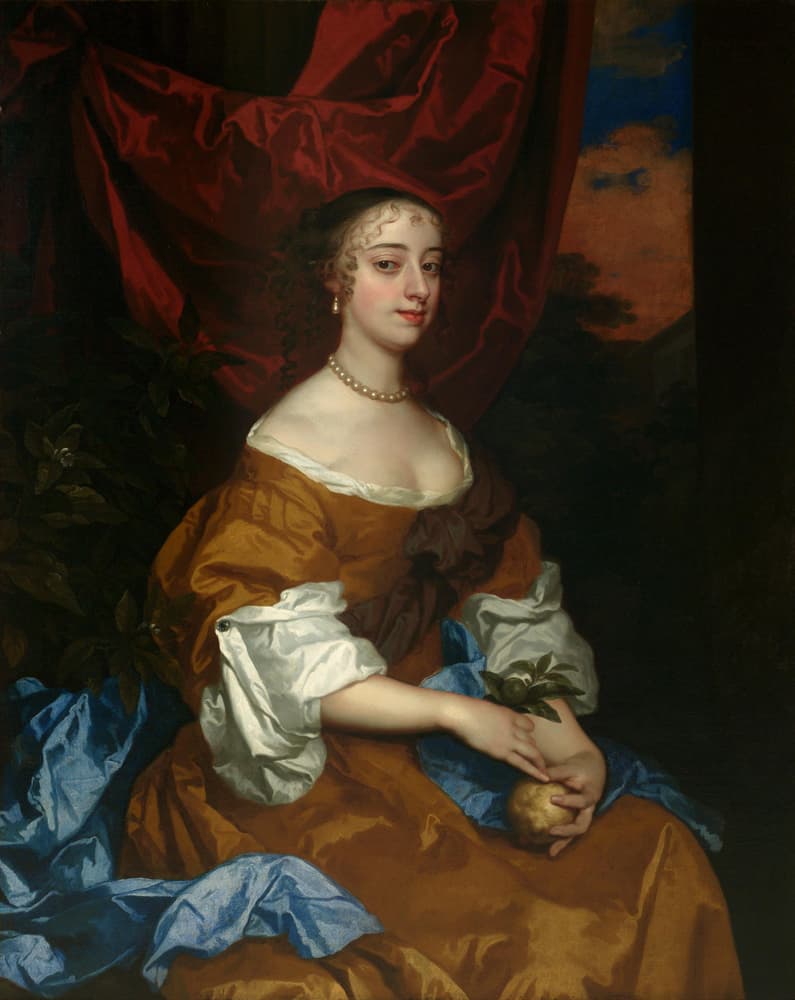
English · Arts
Margaret Hughes
May 29, 1630 – October 1, 1719
Early life and background
Margaret Hughes (also known as Peg Hughes or Margaret Hewes) was born on 29 May 1630, in England.[1][7][15] Primary documentation of her childhood is scarce, and surviving sources agree that little is known about her parents, precise birthplace, or early education.[1][11][15] Later popular accounts describe her as being born into a “theatre family,” but academic reference works such as the Dictionary of National Biography (DNB) and modern encyclopedic entries do not corroborate specific details of family background.[6][9] As a result, historians treat her early life as largely undocumented.
Hughes grew up during a turbulent period in British history. Her childhood and youth coincided with the final years of Charles I’s reign, the English Civil War, and the subsequent Interregnum under Oliver Cromwell. During this era, public playhouses were officially closed and theatre activity suppressed or driven underground, severely limiting opportunities for formal training or legitimate stage work.[1][20] For women, the constraints were especially severe: pre‑Restoration English theatre forbade women from performing on the public stage, and all female roles in plays by Shakespeare and his contemporaries were played by boys or young men.[15][20]
Against this backdrop, Hughes’s emergence as an actress after the Restoration represents a sharp break with earlier norms. Whatever informal exposure she may have had to performance or courtly entertainment, the historical record only begins to document her life meaningfully when theatres reopen and women begin—tentatively—to appear in professional productions.[1][20]
Historical context and the Restoration stage
The turning point for both English theatre and Hughes’s career came in 1660 with the Restoration of Charles II. The new king authorized two patent theatre companies—the King’s Company under Thomas Killigrew, and the Duke’s Company under William Davenant—and granted them royal licenses to stage plays in London.[1][20] Charles II had spent years in exile in France, where actresses already performed on public stages, and he expressed a clear preference for women playing female roles.[20]
In this climate, the prohibition against women on the public stage began to weaken. Scholars note that a small number of women were involved with the patent companies as they prepared to reopen the theatres in late 1660.[20] It is within this moment of institutional change that Margaret Hughes first appears in the historical record as a performer, poised to take on a role that would redefine expectations about gender and the stage.
Breakthrough performance: Desdemona and the first English actress
Hughes’s reputation in theatre history rests principally on her performance as Desdemona in Shakespeare’s Othello. On 8 December 1660, she appeared in this role at the Vere Street Theatre (formerly Gibbon’s Tennis Court) in London, in a production mounted by Thomas Killigrew’s King’s Company.[1][11][15][6] Multiple narrative sources—including encyclopedic entries, educational articles, and theatre histories—state that on this date she became the first woman known to perform on the English public stage, thereby earning her a place in history as the first professional English stage actress.[1][7][11][15]
At the time, both male and female characters in English drama had traditionally been played by men or boys, a practice that had persisted from the Elizabethan and Jacobean periods through the pre‑Civil War era.[15][20] Hughes’s appearance as Desdemona broke with this longstanding convention. By embodying one of Shakespeare’s most prominent tragic heroines, she introduced a new kind of theatrical realism and shifted audience expectations about the relationship between gender and performance.
The role of Desdemona is central to Othello, depicting a woman whose loyalty and innocence stand in stark contrast to the jealousy and manipulation that ultimately lead to her death. Casting a woman in this part intensified the emotional force of the play and made scenes of tenderness and violence more immediate for Restoration audiences.[8][20] In addition, the decision to put a woman on stage in such a high‑profile role signaled the King’s Company’s willingness to capitalize on novelty and royal favor to attract spectators in a newly reopened theatre market.
It should be noted that the attribution of "first actress" status has been debated among scholars. Some historians argue that fellow performer Anne Marshall may have appeared prior to or very close to Hughes’s debut, and the DNB observes that the title of earliest actress "belongs to neither" Hughes nor Marshall with certainty.[9][12][20] Nonetheless, the convergence of narrative sources around Hughes’s 8 December 1660 performance, and Downes’s later documentation of her as Desdemona, have led most modern popular histories and reference works to continue crediting Margaret Hughes as the first professional actress on the English stage.[1][7][8][11]
Documented Desdemona and early recognition
While the 1660 performance is foundational, Hughes’s place in theatre historiography is further anchored by documentary evidence from the early 1660s. As a member of the King’s Company playing at the Theatre Royal, she appears in early records summarized by prompter and theatre historian John Downes. In his book Roscius Anglicanus, Downes identifies Hughes as the "first recorded representative of Desdemona" in a production of Othello around 1663.[9][13]
This notation is important because it constitutes an internal theatrical record naming a woman in a specific role, rather than a retrospective anecdote. It confirms that within a few years of the Restoration, Hughes was firmly established as a principal actress capable of carrying major parts in the King’s Company repertoire. Downes’s account reinforces the association between Hughes and Desdemona and provides a crucial piece of evidence for modern scholars studying the transition from all‑male casts to mixed‑gender companies in English theatre.[9][13][20]
Career development and major roles
After her breakthrough as Desdemona, Hughes continued to build a substantial career on the Restoration stage. Contemporary and later accounts describe her as a leading actress in the King’s Company and, later, in the Duke of York’s Company.[1][13][17] She was noted for her beauty and her capacity to attract audience attention, qualities that contributed to her casting in prominent roles and to her emergence as an early theatrical celebrity.[1][6][19]
One of the best‑documented highlights of her career is her work in new drama by John Dryden, the era’s foremost tragic and comic playwright. According to Downes and the DNB, Hughes was the original Theodosia in Dryden’s comedy Evening’s Love, or the Mock Astrologer, which premiered on 22 June 1668.[9][13] Originating the role meant that Dryden’s characterization of Theodosia was shaped by Hughes’s particular stage presence and interpretive choices. This premiere demonstrates that Hughes did not merely inherit roles from earlier male performers but helped define new female characters written expressly for actresses in the post‑Restoration world.
Sources also mention Hughes in connection with other plays of the 1660s and 1670s. She is said to have performed in works by playwrights such as Thomas Shadwell, Thomas D’Urfey, and Sir Charles Sedley, particularly during her later association with the Duke of York’s Company at the Dorset Garden Theatre in the mid‑1670s.[13][6][17] Although specific casting lists for these productions are incomplete, the pattern of references suggests that Hughes was a versatile performer, capable of appearing in tragedy, comedy, and tragicomedy.
Visual evidence of Hughes’s celebrity survives in the form of portraits. She was painted by court artist Sir Peter Lely, whose portraits of leading actresses and court beauties helped create a new image culture around women performers.[6][19] Such paintings reinforced the association between actresses, aristocratic circles, and fashion, further elevating Hughes’s profile beyond the theatre audience to broader society.
Royal relationships, status, and wealth
Hughes’s personal life was closely intertwined with high politics and royal patronage. She became the long‑term mistress of Prince Rupert of the Rhine, a prominent Royalist general during the English Civil War, later a naval commander and cousin to Charles II.[1][9][13] Their relationship is well attested in biographical and historical sources, which describe Hughes living with Rupert and being deeply involved in his domestic life during the 1660s and 1670s.[1][9][12]
The connection to Prince Rupert appears to have brought Hughes considerable material benefits. Accounts note that she lived a relatively wealthy and lavish lifestyle, benefiting from fine clothes, jewels, and high social visibility.[6][19] She reportedly had access to influential patrons and social circles by virtue of both her own theatrical fame and Rupert’s rank. Some popular narratives even speculate about possible flirtations or brief affairs with Charles II, though such claims are less firmly documented and tend to belong to the realm of anecdote.[6][19]
Hughes and Rupert had at least one child together, a daughter named Ruperta.[1][9][12] Ruperta later married Brigadier‑General Emanuel Scrope Howe, an army officer and court figure, and their descendants entered the landed and military elite.[6][12][19] This marriage illustrates the way Hughes’s family line intersected with the gentry and aristocracy, further entangling the history of the early English stage with that of the ruling classes.
Rupert’s death in 1682 marked a significant change in Hughes’s circumstances. Sources suggest that she gradually withdrew from acting and devoted herself to managing family and property interests.[6][19] Her relationship with Rupert, however, remained central to how contemporaries and later writers remembered her: as both a pioneering actress and the last great love of one of the Restoration’s most famous princes.[9][19]
Later career, retirement, and life in Kent
By the mid‑1670s, Hughes’s stage career appears to have been winding down. DNB references and later summaries note that she played with the Duke of York’s Company at the Dorset Garden Theatre in seasons around 1676–1677, appearing in plays by Thomas D’Urfey, Sir Charles Sedley, and other dramatists.[13][6] Some modern theatre histories and commemorative posts state that she retired from regular performance after the 1676 season, in part to devote more time to her relationship with Prince Rupert and to domestic life.[17][6]
After Rupert’s death in 1682, Hughes is said to have moved to Eltham in Kent, where she lived on property acquired or consolidated during her time with the prince.[6][19] The surviving accounts describe her life there as relatively quiet compared to the public celebrity of her earlier years, focused on family matters and the upbringing of her daughter and grandchildren. As with her early life, however, detailed records of her day‑to‑day activities in later life are limited.
Hughes’s daughter Ruperta died in the same year as her mother, 1719, after having borne several children with Emanuel Scrope Howe.[6][12] The parallel timing of their deaths has been noted in genealogical and biographical literature, which traces the lineages of the Howe family and their connections back to Margaret Hughes and Prince Rupert.[12][19]
Death
Margaret Hughes died on 1 October 1719.[1][7][9] Her death is recorded in biographical dictionaries and modern encyclopedic entries, which consistently give this date and place her age at approximately eighty‑nine.[1][7] She likely died in or near Eltham, Kent, where she is believed to have spent her later years, though specific burial records are not widely cited in accessible secondary sources.[6][9]
By the time of her death, the theatrical world she had helped to transform had changed dramatically. Actresses were now a fixture of the London stage, and a growing repertoire of roles written for women had become standard in both tragedy and comedy. Hughes’s lifetime thus encompassed the full transition from an exclusively male public theatre to one in which women performers were indispensable.
Legacy and historical impact
Although documentation of her life is fragmentary, Margaret Hughes occupies a central place in the history of women and theatre. She is widely cited as the first professional actress on the English stage, due to her role as Desdemona in Othello at the Vere Street Theatre on 8 December 1660.[1][7][11][15] Her appearance is frequently invoked as the symbolic end of the all‑male stage tradition and the beginning of a new era in which women claimed space as public performers.
Modern historians emphasize that Hughes’s pioneering status should be understood in context. The degree to which she was literally the first woman ever to act publicly in England remains debated, and the DNB cautions that the title of earliest actress is contested.[9][12][20] Nevertheless, the cultural power of Hughes’s story lies in her association with a clear, documented moment when a woman took on one of Shakespeare’s great roles in a royal‑patent theatre, under the gaze of Restoration audiences.
Hughes’s legacy is reinforced by her role in Dryden’s Evening’s Love, where she originated Theodosia, and by her frequent citation in theatre histories as the first recorded Desdemona in company records.[9][13] These facts anchor her not only as a symbol but as a working professional whose talent shaped new character types and influenced subsequent portrayals.
Her life and legend have inspired later artistic works. She appears as a character or reference point in studies of Restoration theatre and in creative retellings, including discussion connected with the 2004 film Stage Beauty, which explores the transition from male to female performers in seventeenth‑century London.[3] Educational articles, blogs, and podcasts continue to celebrate her as a women’s‑history figure who “broke boundaries and made the way for many future actresses to come.”[3][11][15][21]
In the twenty‑first century, her story has gained renewed visibility through outlets such as Guinness World Records, which profiles Hughes as the "original Desdemona" and names her as the first stage actress in its discussion of theatre records.[8] These modern recognitions underscore her enduring significance in both popular and scholarly narratives about gender, art, and public life.
Assessment and place in women’s history
For historians of women’s history, Margaret Hughes’s career illuminates the intersection of gender, power, and cultural production in Restoration England. She navigated a world in which actresses were both celebrated and stigmatized, associated with glamour and influence but also with moral suspicion. Her professional success, high‑ranking romantic partnership, and visual representation in art reveal the complex ways in which women could gain agency—albeit within constrained social frameworks—through performance.[1][6][19]
Hughes’s life also shows how women’s contributions can be simultaneously central and poorly documented. Despite her fame, the archival record of her personal background and many of her roles is thin, reflecting broader patterns in which women’s experiences were less often formally recorded than men’s. The work of piecing together her biography from cast lists, portraits, genealogies, and anecdotal reports has therefore become an important exercise in reconstructing women’s presence in early modern cultural history.[9][13][20]
In sum, Margaret Hughes stands as a pioneering actress whose documented performances—especially as Desdemona and as Theodosia—helped to inaugurate the age of the English actress and to expand possibilities for women on the public stage. Her story continues to serve as a touchstone in discussions of theatre, gender, and the long struggle for women’s visibility and professional recognition.
Dated achievements
6 indexed.
- May291630Science
Birth of Margaret Hughes
Margaret Hughes, later celebrated as the first professional actress on the English stage, is born in England.
View details Margaret Hughes - Wikipedia - Dec081660Arts
First woman known to perform on the English stage
Hughes appears as Desdemona in Othello at the Vere Street Theatre, becoming the first woman known to perform on the English public stage.