← All women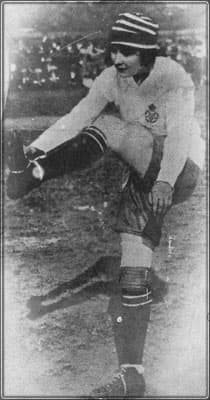
British · Sports · Activism
Lily Parr
April 26, 1905 – May 24, 1978
Early Life and Background
Lilian "Lily" Parr was born on 26 April 1905 in St Helens, a mining and industrial town in Lancashire, England.[1][4][15] She was the fourth of seven children in a working-class family, growing up in a community shaped by coal mining, glass manufacturing, and wartime factory labour.[2][4] Playing in the streets and fields with her brothers, Parr learned both football and rugby from an early age, developing a fearless physical style and a notably powerful left-footed shot.[2]
St Helens at the turn of the twentieth century offered few formal sporting opportunities to girls. Social expectations emphasised domestic roles, and organised football was widely considered a male preserve.[5][6] World War I changed that landscape: as men went to the front, women entered factories and, in many places, formed works football teams that raised money for war relief and hospitals.[4][7] This wartime opening would prove decisive in Parr’s life, providing a route from informal street play to organised competition.
Career Beginnings and Development
Parr’s organised football career began in 1919, when, aged about 14, she joined St Helens Ladies, a local women’s side that played charity matches.[2][8][14] Her prolific scoring quickly attracted attention. Contemporary accounts credited her with 43 goals in her debut season, an extraordinary figure in any context, and especially notable for a teenager in a fledgling women’s league.[12]
During World War I and its immediate aftermath, large factories such as Dick, Kerr & Co., a munitions manufacturer in Preston, sponsored women’s teams to boost morale and raise money for charities. Around 1919, Parr was spotted playing for St Helens Ladies and recruited to the Dick, Kerr Ladies, which had been founded in 1917 and soon became the most famous women’s club in Britain.[1][4][7][14] She moved into the role of winger, soon specialising as a left-sided attacker known for her pace, strength, and hard shot.
By the age of 15, Parr was already recognised as a special talent with Dick, Kerr Ladies.[4][8] The team’s fixtures drew significant crowds, often raising funds for wounded soldiers and local hospitals, and Parr emerged as one of their most celebrated players. She combined athletic ability with a striking presence: sources describe her as close to six feet tall, a chain-smoker with jet-black hair and an uncompromising on-field demeanour.[8]
Rise to Prominence and Major Sporting Achievements
Parr’s rise coincided with what historians call the first golden age of women’s football in Britain. Dick, Kerr Ladies and similar teams regularly attracted thousands of spectators and toured domestically and internationally.[5][7][17] Parr, playing primarily as a winger, became a central figure in this boom.
First Recognised Women’s International Match (1920)
On 7 May 1920, Parr took part in a landmark fixture at Deepdale, the home of Preston North End. Dick, Kerr Ladies represented England in what is widely regarded as the first recognised women’s international football match, facing a French team.[4][12][17] England won 4–0, with Parr playing on the flank. Although women’s matches had been played previously, this game is cited as the first organised international representative match between women’s sides in Europe, symbolising the growing ambition and visibility of the women’s game.[4][12]
The match formed part of a wider pattern of cross-channel tours between English and French women’s teams in 1920 and 1921. These tours showcased women’s football as an entertaining and charitable spectacle, challenging contemporary stereotypes that women lacked the stamina or skill for sustained competitive play.[12][17]
Record Boxing Day Crowd at Goodison Park (1920)
Later that year, on 26 December 1920, Parr featured in a Boxing Day match between Dick, Kerr Ladies and St Helens Ladies at Goodison Park, home of Everton FC.[4][11][17] The game drew a crowd of around 53,000 spectators, with thousands more reportedly locked out when the gates were closed, setting a then-record attendance for a women’s club match in Britain.[4][11] The scale of the crowd rivalled major men’s fixtures and demonstrated conclusively that women’s football could attract mass audiences.
This record-breaking event highlighted both the popular appeal of women’s matches and the threat they posed to established male authorities. The success of Dick, Kerr Ladies, with Parr as one of their stars, undermined the notion that women’s football was a novelty. Instead, it appeared as a viable and commercially significant branch of the sport.[4][5]
The 1921 FA Ban and Defiance
Alarmed by the success of women’s teams and critical of their charitable finances, the Football Association’s council moved against the women’s game. On 5 December 1921, the FA passed a resolution banning women’s football from pitches under its control, declaring the sport “quite unsuitable for females.”[2][6][17] This decision effectively pushed women’s teams off the main professional grounds and relegated them to parks and non-affiliated venues.
By 1921, Parr was already a leading figure in women’s football. Rather than retire, she and Dick, Kerr Ladies defied the ban. The team continued to play extensively, staging matches on non-FA grounds and undertaking tours abroad, including to the United States.[4][7][17] The women’s game survived for decades in this semi-official, often precarious environment, thanks in large part to players like Parr who refused to stop playing.
Parr’s career under the ban demonstrated resilience and quiet activism. The very act of continuing to play football in defiance of institutional condemnation challenged contemporary gender norms and forced the existence of women’s football onto the public stage, even when the mainstream football establishment tried to disown it.[4][6]
Playing Style and Goal-Scoring Record
Parr was famed for her left-footed shot, frequently described as having a "kick like a mule."[6] Contemporary reports and later statistical reconstructions credit her with around 986 to 1,000 goals over a career spanning roughly thirty to thirty-two years.[4][7][12][17] She played primarily as a winger, but her scoring tally rivals the great centre-forwards of men’s football.
Her debut season at age 14 alone produced an estimated 43 goals, an output later compared to contemporary male stars to illustrate her prolific nature.[12] Over hundreds of matches, she scored against both women’s and men’s teams; in some charity fixtures, women’s sides faced male opposition, with Parr’s power and accuracy challenging assumptions about female physical weakness.[7][14]
Notable sources describe Dick, Kerr Ladies as winning 758 of 828 matches, losing only 24 and drawing 46, with Parr contributing heavily to their offensive success.[7] Although precise match-by-match records are incomplete, the weight of evidence positions her among the most productive goal-scorers in early twentieth-century football, regardless of gender.
Later Playing Career and Final Representative Match
Parr continued playing for Dick, Kerr Ladies and later Preston Ladies throughout the 1920s, 1930s, and into the post-war era.[1][4] Her career encompassed domestic fixtures, charity matches, and international tours. Despite the FA ban, she and her teammates maintained high standards of play and public appeal, often raising money for causes such as unemployed miners or local hospitals.[7][14]
On 7 October 1950, Parr played her final documented representative match for Preston Ladies, an 11–1 victory over Scotland in which she scored.[14] This match is widely treated as marking the end of her elite-level football career after roughly 32 years on the field. She formally retired from playing around 1951, closing a career that had spanned from the immediate post-war boom through the long years of the ban.[1][4][7][13][17]
Awards, Honours, and Posthumous Recognition
During her lifetime, Parr’s achievements were celebrated mainly in local and popular press rather than through formal institutional honours, given the FA’s hostility to the women’s game. Her major official recognition came posthumously.
In 2002, she was named the first woman inducted into the National Football Museum’s English Football Hall of Fame, based then in Preston.[1][4][10][12][17] Parr was the only woman among the inaugural class of honourees, which otherwise consisted of male players and managers. This induction signalled a significant reassessment of football history, acknowledging that the story of the sport in England must include women’s contributions.
In 2019, the National Football Museum unveiled a life-size bronze statue of Parr outside its Manchester building, widely reported as the first statue of a woman footballer in the United Kingdom.[3][10][12][17] The statue, created ahead of the 2019 FIFA Women’s World Cup, depicts her in playing kit and has become a focal point for public education about women’s football history.
Media outlets, including the BBC and international publications, have since produced features on Parr as a "trailblazer" and "football’s female superstar".[6][12] In 2023, The New York Times included her in its "Overlooked" obituary series, further consolidating her international recognition as a pioneering athlete and LGBTQ+ figure.[17]
Personal Life and Relationships
Outside football, Parr built a career in nursing. She trained and worked at Whittingham Hospital, a large psychiatric institution near Preston, and continued in nursing after her retirement from football.[7][12] Her dual identity as nurse and footballer reflected the limited professional options available to women, even those with exceptional sporting talent.
Parr’s personal life has gained increased attention from LGBTQ+ historians. Multiple sources describe her as a lesbian, living openly with her partner Mary for many years.[7][8][14] They met while Parr was working at Whittingham Hospital and ultimately shared a home in Goosnargh, near Preston.[7] In a period when same-sex relationships were subject to intense social stigma and, for men, legal penalties, Parr’s long-term partnership with Mary stands as a significant example of queer domestic life.
Accounts also highlight Parr’s strong personality and independence. She smoked, spoke her mind, and refused to conform to conventional expectations of femininity in dress or behaviour.[5][8][14] Her visibility as a successful athlete, coupled with her non-conforming gender presentation, made her a quiet but powerful challenge to stereotypes about women’s roles.
Legacy and Historical Impact
Parr’s legacy operates on several levels: sporting, social, and cultural. As a footballer, she is widely regarded as one of the greatest players of her generation and perhaps the greatest early female footballer in Britain.[4][5][15] Her goal-scoring record, longevity, and participation in landmark matches give her a central place in the history of the women’s game.
Her participation in the first recognised women’s international match in May 1920 and the record-setting Goodison Park fixture later that year marked her as a foundational figure in women’s football’s global emergence.[4][11][12][17] Playing through the FA’s 1921 ban and into the mid-twentieth century, she represents the continuity of women’s football culture despite institutional suppression.
Socially, Parr has become a symbol of resistance to gender norms. Her success challenged contemporary beliefs about women’s physical capacities, while her defiance of the ban showed that official disapproval could not extinguish women’s enthusiasm for the sport.[6][14] Her life story intersects with broader movements for women’s rights and the long campaign to secure recognition and resources for women’s teams.
Culturally, Parr is now recognised as an LGBTQ+ icon. Historians and activists have highlighted her open same-sex relationship and non-conforming presentation as early examples of queer visibility in sport.[2][8][14] In modern narratives, she functions as a predecessor to out athletes who challenge homophobia and heteronormativity in football.
The lifting of the FA ban in 1971, which occurred during Parr’s lifetime, and the subsequent formation of the Women’s Football Association in 1969 and growth of organised women’s competitions are frequently linked back to the groundwork laid by her generation.[4][6] The Football Association’s formal apology in 2008 for its treatment of women’s footballers further underscores the long-delayed institutional recognition of the harm done to players like Parr.[2]
Later Life and Death
After retiring from football around 1951, Parr focused on her nursing career at Whittingham Hospital and on her life with Mary in Goosnargh.[1][4][7][13] She lived relatively quietly compared to her earlier fame, as the women’s game remained marginalised and records of its history were fragmented.
In 1971, the FA officially lifted its ban on women’s football, allowing women’s teams to play on FA-affiliated grounds once more.[2][6] Parr, then in her sixties, did not return to play but lived to see this partial vindication of the sport for which she had sacrificed so much. The broader growth of organised women’s football structures, however, would come largely after her death.
On 24 May 1978, Parr died of cancer, widely described as breast cancer, at the age of 73 at her home near Preston.[1][2][5][6][7][9] Her remains were buried in St Helens, returning her story to the town where it began.[2][9] At the time of her death, her achievements were better remembered locally than in national histories of football.
In the decades since, extensive research by football historians, museums, journalists, and activists has brought Parr’s story back into the spotlight. Her inclusion in the Hall of Fame, the erection of her statue, and international media coverage have collectively transformed her from a largely forgotten pioneer into a central figure in the canon of women’s football and queer sporting history.[4][10][12][17]
Continuing Influence
Parr’s name now appears in educational materials, museum exhibits, and campaigns promoting women’s and LGBTQ+ inclusion in sport. Organisations such as the National Football Museum and FIFA have profiled her as a "pioneering star," emphasising her role in shaping the early women’s game.[4][8][10] Radical history projects and local councils produce profiles of her for history months and school resources, ensuring that new generations encounter her story.[7][14][15]
Her life demonstrates how individual athletes can become catalysts for broader change, even when they do not hold formal leadership positions. By excelling on the pitch, refusing to stop playing under a ban, and living authentically in her personal life, Parr forced society to confront the disconnect between its prejudices and the realities of women’s capabilities and desires.
As women’s football continues to expand globally—with professional leagues, major tournaments, and increasing media coverage—Parr’s record crowds, international matches, and long fight for recognition serve as a historical foundation and a reminder that today’s successes rest on the persistence of pioneers who played against the odds.
Dated achievements
9 indexed.
- Apr261905Sports
Birth of Lily Parr
Lilian 'Lily' Parr was born in St Helens, Lancashire, England, later becoming one of the greatest and most influential footballers of the 20th century.
View details Lily Parr - Wikipedia - May071920Sports
Plays in first recognised women's international football match
Parr played for Dick, Kerr Ladies as England beat France 4–0 at Deepdale, Preston, in what is widely regarded as the first recognised women's international football match.