← All women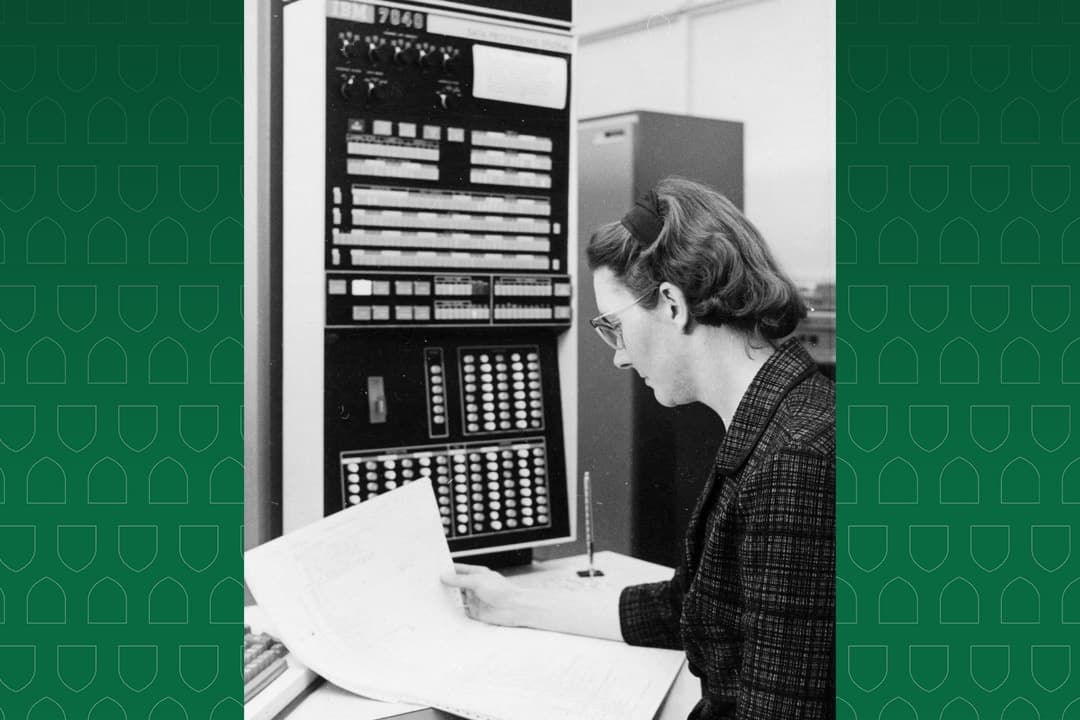
British · Science
Kathleen Booth
July 9, 1922 – September 29, 2022
Early Life and Background
Kathleen Hylda Valerie Booth (née Britten) was born on 9 July 1922 in Stourbridge, Worcestershire, EnglandKing Edward VI Grammar School for Girls in Birmingham, a selective school known for strong academic standards.[6] This environment nurtured her mathematical ability at a time when advanced scientific education for girls in Britain remained rare.
Britten progressed to higher education during the Second World War, enrolling at Royal Holloway CollegeBSc in Mathematics in 1944, completing her degree while the war reshaped both British universities and the scientific professions.[3][6][7][10][11] Her success reflected broader wartime efforts to mobilize women with technical skills, but she remained part of a small minority of women receiving full degrees in mathematics.
After her bachelor’s studies, Britten pursued advanced work in applied mathematics at King’s College London while simultaneously working in scientific positions. She completed a PhD in Applied Mathematics in 1950, again through the University of London.[3][6][10] This combination of rigorous mathematical training and early exposure to practical research would become crucial as she entered the emerging field of electronic computing.
Career Beginnings and Development
Following her BSc, Kathleen Britten’s first professional role was as a junior scientific officer at the Royal Aircraft Establishment (RAE) at Farnborough between about 1944 and 1946.[11] The RAE was a key British research center for aviation technology, and her work there allowed her to apply mathematical methods to engineering problems in wartime Britain. According to later accounts, she used statistical and analytical skills to contribute to research on aircraft performance, gaining practical experience with numerical computation in an institutional setting.[11] This period exposed her to the kinds of calculation problems that would soon be tackled by electronic machines.
In 1946, Britten was recruited as a research assistant at Birkbeck College, University of London, joining a tiny but ambitious group centered on physicist and engineer Andrew Donald Booth.[3][13] Booth was constructing the Automatic Relay Calculator (ARC), a simple relay‑based machine intended for scientific computation. The team at Birkbeck was one of the smallest in Britain working on computers, with severely limited resources compared to larger national laboratories.[3][13] Within this context, Kathleen Britten rapidly became a central figure, assisting in both hardware design and the emerging conceptualization of programming.
During the late 1940s and early 1950s, she helped design and build three early computers at Birkbeck: the ARC (Automatic Relay Calculator), the SEC (Simple Electronic Computer), and the APE(X)C (All Purpose Electronic X‑Ray Computer).[2][3][4][6][12] These machines were among the world’s earliest operational stored‑program computers. Booth’s work on them ranged from circuitry to the logical structure of programs, and she wrote much of the software needed to operate them.[3][7] Her dual role—as both mathematician and developer—reflected the fluid boundaries of hardware and software in the era’s computer projects.
Major Works, Discoveries, and Accomplishments
Invention of Assembly Language and Rotating Storage
Kathleen Booth’s most widely cited achievement is her creation of what is regarded as the first assembly language for a computer system. Around 1947, while working on the ARC at Birkbeck, she devised a symbolic programming notation called Contracted Notation to simplify the process of programming the machine.[2][3][7][9] Instead of writing raw numeric codes corresponding directly to machine instructions, programmers could use mnemonic symbols and structured syntax, which her assembler program translated into machine code. University of Saskatchewan and computing‑history sources describe this system as the world’s first assembly language and credit Booth as its originator.[1][3][9]
In conjunction with the development of these early machines, Booth also helped create what is described as the first magnetic rotating storage device attached to a computer, a metal drum memory built in 1947.[1][6][10] Drum memories stored data magnetically on a rotating cylinder, allowing rapid access compared to earlier technologies and anticipating concepts later used in disk and hard‑drive systems. Sources from the St Andrews history of mathematics project and other retrospectives note that Kathleen and Andrew Booth’s drum device has been recognized as a precursor to modern rotating storage technologies.[1][6]
These achievements mark Booth as a pioneer at both the software and hardware levels. Her assembly language allowed higher‑level symbolic representation of instructions, while the drum memory enabled more efficient storage. Both innovations formed part of a small but influential Birkbeck contribution to global computing development, despite limited funding and equipment.[1][3]
Design of Early Computers and the Booth Multiplier
During the late 1940s and early 1950s, Booth co‑designed the ARC, SEC, and APE(X)C systems at Birkbeck.[2][3][4][12] Contemporary and later accounts describe these machines as being among the first three operational computers built by their group and important steps in the evolution of British computing.[3][14] The APE(X)C, in particular, featured a 32‑bit architecture and rotating drum storage, and its design was sufficiently robust that it served as a model for other machines abroad.
In the early 1950s, Kathleen and Andrew Booth co‑developed the Booth multiplier algorithm, an efficient method for performing binary multiplication on digital computers.[1][2][6][9] This algorithm reduces the number of addition and shift operations needed to multiply signed binary numbers and has been implemented in many processor designs. University of Saskatchewan’s tribute notes that the algorithm became fundamental to billions of computer processors.[9] The Booth multiplier is still taught in computer architecture courses as a classic example of algorithmic optimization at the hardware‑software interface.
Booth also co‑authored the technical book "Automatic Digital Calculators" with Andrew Booth, published in the early 1950s.[3][6][14] This work is among the earliest books on computer design, discussing components, instruction sets, and the architecture of digital calculators at a time when very few comprehensive texts existed. It complemented her later programming book and reflected her dual expertise in both circuitry and programming.
Machine Translation and Early Software Applications
In the mid‑1950s, Kathleen Booth turned to novel applications of computers in language processing. She wrote a natural‑language translation program for the APE(X)C that converted text from French to English.[3][9][10] On 11 November 1955, she publicly demonstrated this program at Birkbeck by typing a French sentence into the computer and displaying its English translation, in what historians describe as likely the first public demonstration of computer‑based text translation.[9][13] This experiment placed her at the forefront of machine translation, predating large government‑funded projects in the United States and Europe.
Her work with Andrew Booth on machine translation highlighted the versatility of stored‑program computers. Rather than restricting them to numerical calculation, she showed that they could manipulate symbolic representations of words, grammar, and meaning. This early exploration anticipated later developments in computational linguistics, natural‑language processing, and the broader field now known as artificial intelligence.[3][9]
Booth’s translation demonstration also had a strong gendered dimension: as a woman mathematician leading a cutting‑edge experiment in a public academic setting, she challenged prevailing stereotypes about women’s roles in science and engineering. Later accounts emphasize that she wrote much of the software for the ARC2 and SEC machines, as well as the translation program, effectively making her one of the earliest professional computer programmers.[7][3]
Academic Leadership and Founding of Computer Science
One of Kathleen Booth’s most historically significant contributions lies in academic institution building. In 1957, she and Andrew Booth established the Department of Numerical Automation at Birkbeck College.[3][9] Retrospective sources—including the Centre for Computing History and University of Saskatchewan—describe this department as the world’s first university computer science department.[3][9][1] It later evolved into Birkbeck’s School of Computer Science and Information Systems.
Within this department, Booth taught some of the earliest university courses in computer science, covering programming, machine architecture, and applications.[3][6][9] She helped define curricula, supervised students, and integrated her research into teaching. Her position as a woman co‑founder and principal teacher in a technical department during the 1950s was unusual in British academia and underscored her status as a trailblazer.
In 1958, Booth published "Programming for an Automatic Digital Calculator", a book focused on programming the APE(X)C.[3][6][9] Institutional histories note that this work was one of the first books ever written on computer programming, and that its authorship by a woman was highly unusual for the era.[3] It systematized programming knowledge—explaining instruction formats, program structure, and practical examples—and became a key resource for students and practitioners learning to program digital computers.
International Influence and the NUSSE Computer
Booth’s design work at Birkbeck had international consequences. In 1954, the Norwegian computer NUSSE (Norsk Universell Siffermaskin Selvstyrt Elektronisk), Norway’s first electronic digital computer, was built based on the 32‑bit APE(N)C architecture originally designed by Kathleen and Andrew Booth.[3] This adoption of their architecture abroad demonstrates the broader impact of their work beyond the United Kingdom, especially given the small scale of the Birkbeck team.
NUSSE’s construction shows how Booth’s computer designs offered a practical and adaptable template for early national computer projects. Through this transfer, her ideas contributed indirectly to the establishment of computing infrastructure and expertise in Norway, illustrating how pioneering work in a modest London laboratory helped seed international technological development.[3]
Research in Neural Networks and Later Scientific Work
After leaving Birkbeck, Kathleen Booth’s career continued in North America. She moved to Canada, where she held positions as Research Fellow, Lecturer, and Associate Professor at the University of Saskatchewan and later served as a Professor of Mathematics at Lakehead University.[3][9] Her research interests shifted toward neural networks and pattern recognition, reflecting the early convergence between computing and models of biological intelligence.
University of Saskatchewan’s memorial article notes that her research led to successful simulations of how animals recognize patterns, using neural‑network techniques implemented on computers.[3][9] These studies formed part of the broader mid‑ to late‑20th‑century exploration of artificial neural networks, long before the modern resurgence of deep learning. Her continued engagement with cutting‑edge topics underscores that she did not treat computing as a completed field after her pioneering work in assembly language but remained active as the discipline evolved.
Remarkably, accounts from colleagues suggest that in the 1990s, when she was around 70 years old, Booth co‑authored a research paper on neural networks with her son, demonstrating her ongoing participation in scientific publication late in life.[9] This collaboration illustrates both her intellectual longevity and the familial dimensions of her scientific work.
Awards, Honors, and Recognition
Despite her substantial contributions, Kathleen Booth did not receive the same level of formal honors as some contemporaries in computing. There is no evidence in the available sources of major national awards such as fellowships in the Royal Society or formal government decorations. Instead, recognition of her achievements has come largely through retrospective historical work and institutional tributes.
The St Andrews MacTutor History of Mathematics project includes a detailed biography highlighting her pioneering role in assembly language and rotating storage.[1] The Centre for Computing History features her in its "Women in Computing" materials and emphasizes her creation of ARC assembly language and her early programming textbook.[3] Articles and posts from the University of Saskatchewan describe her as a "pioneer" and credit her with inventing assembly language and co‑developing the Booth multiplier algorithm.[9]
Technology journalism has also contributed to her recognition. In 2022, following her death, The Register published a piece titled "RIP: Kathleen Booth, the inventor of assembly language", bringing wider public attention to her work and underlining the historical significance of her contributions to early software.[7][18] Popular and educational blogs, such as Mission Encodeable and various Medium essays, have further helped reintroduce her story to younger audiences and programming communities.[10][14]
Personal Life
Kathleen Britten’s professional and personal lives were closely intertwined. At Birkbeck she worked with Andrew Donald Booth, who led the computer group that built the ARC, SEC, and APE(X)C.[3][13] The two shared interests in computation and novel applications such as machine translation, and they collaborated extensively on both hardware and software. In 1950, Kathleen Britten married Andrew Booth, becoming Kathleen Hylda Valerie Booth.[1][2][6]
The couple’s partnership extended beyond marriage into a long‑term professional collaboration. Together they co‑authored technical books, co‑founded the Department of Numerical Automation, and co‑designed computers and the Booth multiplier algorithm.[2][3][6][9] Their joint work exemplifies the collaborative nature of early computing research, but many retrospective accounts highlight that Kathleen’s contributions were often underrepresented relative to Andrew’s in contemporaneous records—a pattern familiar in the history of science.
Kathleen and Andrew Booth raised a family; later sources mention at least one son, with whom she co‑authored a neural‑network paper in the 1990s.[9] In her later years, she lived in Canada, particularly in British Columbia, where she continued to engage with computing topics and local academic communities until advanced age.[1][11]
Legacy and Historical Impact
Kathleen Booth’s legacy spans multiple foundational aspects of computer science. Her invention of Contracted Notation and associated assembler established the paradigm of assembly language—a symbolic interface between human programmers and machine code that remains central to computer architecture and systems programming.[2][3][7][9] Modern assembly languages for x86, ARM, and other architectures descend conceptually from the approach she pioneered, even as specific syntaxes have evolved.
Her contributions to rotating magnetic storage through the 1947 drum device anticipated the design principles of later disk drives and hard disks, technologies that became essential for data processing and storage in the second half of the 20th century.[1][6] As such, her work is part of the lineage that led from early drum memories to contemporary solid‑state storage and cloud‑scale systems.
The Booth multiplier algorithm, co‑developed with Andrew Booth, is still taught and implemented, illustrating how her work affected both theoretical and practical computing.[1][2][6][9] Meanwhile, her APE(X)C architecture provided a model for Norway’s NUSSE computer, demonstrating international influence.[3]
Institutionally, Booth’s role in co‑founding the Department of Numerical Automation helped establish computer science as a university discipline. This department’s transformation into Birkbeck’s School of Computer Science and Information Systems reflects how her early academic efforts laid the groundwork for the field’s institutionalization.[3][9] Her 1958 programming book contributed to the development of formal curricula and textbooks, moving programming knowledge into the classroom and away from informal lab apprenticeships.[3][6]
From a women’s‑history perspective, Booth is significant as a woman mathematician and engineer who occupied leading roles in design, programming, teaching, and authorship at a time when women were rarely visible in such positions. Later feminist and historical scholarship has used her story to highlight the often‑hidden contributions of women to early computing and to challenge narratives that center only male figures.[1][3][6][9]
Later Life and Death
In later decades, Kathleen Booth continued her academic and research activities in Canada. At the University of Saskatchewan, she worked as a Research Fellow, Lecturer, and Associate Professor, contributing to teaching and research in mathematics and computing.[3][9] Subsequently, she became a Professor of Mathematics at Lakehead University, where she pursued research on neural networks and pattern recognition.[3] Her Canadian period underscores the transnational character of her career, bridging British and Canadian scientific communities.
Booth’s interest in neural networks, pattern recognition, and animal behavior remained strong well into her senior years. The University of Saskatchewan notes that her neural‑network research produced simulations of how animals recognize patterns, and that she co‑authored work with her son in the 1990s.[9] Even in retirement, she maintained intellectual engagement with new computing developments.
Kathleen Booth died on 29 September 2022 in Sooke, Vancouver Island, Canada, at the age of 100.[1][2][16] Obituaries from academic institutions and technology media reflected on a century‑long life intertwined with computer science’s evolution—from relay computers and drum memories to modern microprocessors and artificial intelligence. Articles in venues such as The Register described her as the "inventor of assembly language" and called for broader recognition of her role.[7][18] Her passing prompted renewed archival work and public interest in her contributions, helping to secure her place in the historical record.
Today, Kathleen Booth is remembered as a pioneer of both software and hardware, a co‑designer of early computers, an inventor of assembly language, a co‑founder of the first computer science department, an early machine‑translation researcher, and a neural‑network scientist. Her career illustrates how one woman’s work helped shape the conceptual and practical foundations of computing as it moved from experimental laboratories to the center of modern life.
Dated achievements
6 indexed.
- Jul091922Science
Birth of Kathleen Hylda Valerie Britten (Booth)
Kathleen Hylda Valerie Britten was born in Stourbridge, England, later becoming a pioneering computer scientist.
View details Kathleen Booth - Wikipedia - Jan011947Science
Creation of Contracted Notation — the first assembly language
Kathleen Booth devised Contracted Notation for the ARC computer, now recognized as the world's first assembly language.