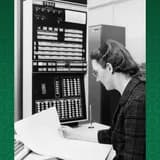
Kathleen Booth published one of the earliest books on computer programming, notable for having a woman author in that era.
In 1958, Kathleen Booth published her book Programming for an Automatic Digital Calculator, a work now recognized by historians of computing as one of the very first books ever written on the subject of computer programming.
The book distilled Booth's practical experience designing and programming the early Birkbeck computers, along with her invention of assembly-language concepts, into an instructional text intended to teach the fundamentals of programming to a new generation of students and practitioners. At a time when there was almost no established pedagogical literature on how to write computer programs, Booth's book helped fill a critical gap.
The publication was especially notable because it was written by a woman at a time when the nascent computing field, despite significant early contributions from women like Booth, Ada Lovelace, and the ENIAC programmers, was rapidly becoming professionally dominated by men. Booth's authorship of a foundational programming textbook stood as a quiet but significant assertion of women's central role in the birth of computer science.
Alongside her earlier co-authored volume Automatic Digital Calculators, this book cemented Kathleen Booth's reputation as both a practical computer designer and an important early educator and communicator of computing concepts, whose written legacy helped shape how programming was taught in Britain and beyond during computing's formative decade.