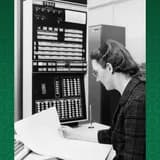
At Birkbeck College, Kathleen Booth typed a French sentence into a computer and produced its English translation, an early machine translation milestone.
On November 11, 1955, at Birkbeck College, University of London, Kathleen Booth conducted what contemporary and later historical accounts describe as likely the first public demonstration of automatic text translation by computer. She typed a sentence in French into the APE(X)C computer and the machine produced its English translation.
This event was the culmination of research Booth had conducted throughout the mid-1950s into using computers for linguistic processing, one of the earliest applications of computing to what would later be called natural language processing and machine translation. At a time when computers were primarily seen as tools for numerical and scientific calculation, Booth's demonstration showed their potential for symbolic and linguistic tasks.
The demonstration was a landmark moment not only for machine translation research, which would grow into a major field of computer science and linguistics over subsequent decades, but also for illustrating the versatility of the small computers being built at Birkbeck. It foreshadowed the enormous modern industry of automated translation software and multilingual computing.
Booth's pioneering work in this area, done with limited computing resources compared to later machine translation projects, exemplifies the ingenuity required in the earliest years of computer science, when foundational techniques were being invented from first principles by a small number of researchers, among whom women like Booth played a crucial but often under-credited role.