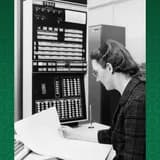
Kathleen Booth devised Contracted Notation for the ARC computer, now recognized as the world's first assembly language.
Working with Andrew Booth on the Automatic Relay Calculator (ARC) at Birkbeck College, Kathleen Booth developed a symbolic programming system she called Contracted Notation. Rather than requiring programmers to write in raw binary or numeric machine code, her notation allowed instructions and operations to be represented with mnemonic-like symbols, which were then translated into machine-executable code by an assembler she also designed.
This innovation is now widely credited by computing historians as the world's first assembly language, predating many other early symbolic coding systems developed in the United States and elsewhere. It represented a critical conceptual leap: separating the human-readable representation of a program from its machine-executable form, a distinction that underlies virtually all subsequent programming language design.
The exact day of this invention within 1947 is not documented in surviving records, but the achievement is consistently dated to that year across multiple historical accounts. It emerged from the pressing practical need to make programming the ARC's relay-based logic more tractable for human operators.
Booth's work here laid essential groundwork for later developments in software engineering, and her role as the originator of assembly language is increasingly recognized in modern retrospectives correcting the historical record of early computing, a field long dominated by narratives centered on male engineers.