← All women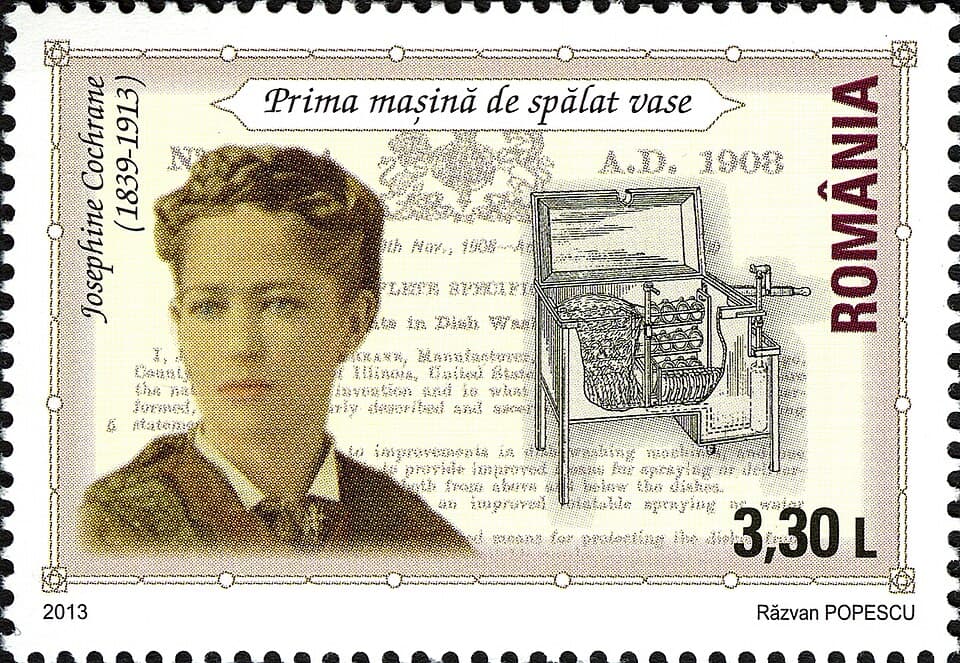
American · Science
Josephine Cochrane
March 8, 1839 – August 3, 1913
Early Life and Background
Josephine Garis Cochrane (often spelled Cochran in early records) was born on March 8, 1839, in Ashtabula County, Ohio, in the rural American Midwest.[1][10][3][8] She was the daughter of John Garis, a civil engineer, and reportedly the granddaughter of an inventor.[10] This family background in engineering and invention exposed her early to the idea that technical ingenuity could solve everyday problems, an unusual environment for a nineteenth‑century girl.
Josephine spent much of her childhood in Valparaiso, Indiana, where she was raised after her mother’s death.[1][8] Sources stress that she was intelligent, strong‑willed, and interested in mechanical ideas, though like most women of her era she lacked formal technical training. She attended school for a time but did not have access to higher education, reflecting broader constraints on women’s educational opportunities before the Civil War.
Her youth coincided with rapid industrialization: railroads were expanding, new machinery was transforming agriculture and manufacturing, and the U.S. patent system was gaining prominence. These developments formed the backdrop for her later decision to turn a domestic irritation—chipped dishes—into a patented machine and a business.
Marriage, Social Position, and Formative Influences
In 1858, at around age nineteen, Josephine married William Cochran(e), a successful dry goods merchant and political figure.[14][11] The genealogical record places the wedding in Illinois and notes that William was older and already established in commerce.[15] Through this marriage Josephine entered a more affluent social circle, eventually living in Shelbyville, Illinois, where the couple occupied a mansion and entertained frequently.[3][8][15]
Her social position was central to the genesis of her later invention. Josephine hosted elaborate dinner parties using delicate heirloom china said to date back several generations.[11][7][15] The china was hand‑washed by household staff, but pieces were often chipped or broken. This damage caused Josephine both financial loss and emotional frustration, and it sharpened her awareness that existing methods of dishwashing were inadequate—especially for valuable, fragile tableware.
In addition to social obligations, Josephine faced personal challenges. Her husband’s business ventures were not always successful, and he struggled with debt and ill health. Several accounts report that he died leaving Josephine financially insecure.[7][10] Widowed and responsible for maintaining her household, she needed income and turned seriously to the idea of a machine that could wash dishes safely and efficiently. The combination of genteel expectations, economic pressure, and exposure to broken china shaped her resolve to seek a technical solution.
Origins of the Dishwasher Idea
By the early 1880s, various forms of dishwashing machines had been attempted, including devices demonstrated at earlier world’s fairs. However, they were generally inefficient, relied on brushes or rotating scrubbers, and did not significantly reduce labor or protect delicate dishes.[10] Josephine studied these existing devices and found them unsatisfactory.[7] Her experience as a hostess, dealing with the practical realities of large‑scale dishwashing in a domestic yet semi‑professional environment, gave her a distinct perspective on what was needed.
She is widely quoted as saying, "If nobody else is going to invent a dishwashing machine, I’ll do it myself," capturing both her frustration and her determination.[8][7] Rather than accepting the limits of available technology, she began sketching her own concept: a machine that would rely on pressurized water rather than abrasion, and that would hold each piece of tableware securely in specially shaped racks.
Josephine set up a workshop behind her home in Shelbyville and hired local machinists to help build prototypes.[10][6][7] These collaborations were not easy. She later remarked, “I couldn’t get men to do things I wanted in my way until they tried and failed in their own. And that was costly for me,” highlighting both the technical and gendered barriers she faced.[7] Nonetheless, she persisted, iterating her designs until she achieved a reliable working model.
Design and Technical Features of Her Dishwashing Machine
Cochrane’s machine organized dishes in wire racks or compartments, each designed to fit a specific type of item—plates, cups, saucers—so that they would be held securely.[7][15] These racks were mounted inside a frame or wheel placed within a copper boiler. When the machine operated, a mechanism pumped hot, soapy water from the bottom of the boiler and directed it forcefully against the surfaces of the dishes.
This design was innovative for several reasons:
- Water pressure: Unlike earlier machines relying on scrubbers, her design used jets of water as the primary cleaning action, which reduced physical contact and risk of breakage.[10][6]
- Rational arrangement of dishes: By fitting dishes into custom racks, the machine could be loaded efficiently and exposed evenly to water, improving cleaning consistency.[7]
- Suitability for large‑scale use: The size and operation of the machine made it particularly useful for hotels, restaurants, and institutional kitchens, where large numbers of dishes needed to be washed repeatedly.[2][6]
Technically, her solution reflected an understanding of fluid dynamics at a practical level. She did not invent the concept of a dishwasher, but she created the first commercially successful and truly practical dishwashing machine that relied on water pressure rather than scrubbing—a distinction emphasized by the U.S. Patent and Trademark Office.[10]
Patent Activity and Formal Recognition as an Inventor
On December 31, 1885, Josephine filed her first patent application for a dishwashing machine with the U.S. Patent Office, signing the document under the name “J.G. Cochran.”[10] This New Year’s Eve filing marked her official entry into the patent system and was a rare moment in which a woman claimed technical authorship over a domestic appliance.
On December 28, 1886, the U.S. Patent Office granted Patent No. 355,139 for her “Dish Washing Machine.”[7][2][10] The patent document described the configuration of racks, the arrangement within the boiler, and the mechanism for circulating water. With this grant, Josephine became formally recognized as the inventor of what is often described as the first practical, hand‑powered dishwasher for commercial use.[1][2]
The patent was not simply a technical milestone; it was a social and legal one. Women in the late nineteenth century rarely appeared as patentees, particularly for mechanical inventions. Josephine had to navigate legal paperwork, capital constraints, and skepticism from male colleagues and investors. Nonetheless, the patent secured her intellectual property and gave her leverage to develop a manufacturing business.
Founding and Growth of Her Dishwashing Business
Following the patent grant, Cochrane moved from inventor to entrepreneur. She founded a company variously referred to as the Garis‑Cochran Dish‑Washing Company or Crescent Dish Washing Machine Company, to manufacture and market her machines.[2][7][12] Working initially from relatively modest facilities, she targeted hotels, restaurants, and large institutions rather than individual households, recognizing that these customers had the scale and financial resources to invest in industrial equipment.
Early sales required significant personal effort. Josephine traveled to meet hotel and restaurant managers, demonstrating the machine’s ability to clean large quantities of dishes quickly without damaging fine china.[6][7] Her gender made this prospecting work unusual; she negotiated directly in commercial spaces dominated by men.
Over time, her machines gained a reputation for reliability and effectiveness. Her business expanded to supply dishwashers across the United States, establishing her as an industrialist as well as an inventor. The company’s growth occurred despite the broader social convention that married women and widows were expected to focus on home life rather than commercial enterprise.
Chicago World’s Fair and Wider Recognition
In 1893, Josephine Cochrane exhibited her dishwashing machine at the World’s Columbian Exposition in Chicago, commonly known as the Chicago World’s Fair.[7][6] Her machine won top honors for "best mechanical construction, durability and adaptation to its line of work," an important endorsement from an international exhibition that showcased cutting‑edge industrial technology.
Although the precise day of the award is not documented in the available sources, its impact is clear. The exposition brought her invention to the attention of a broader set of commercial clients and validated her design in a highly competitive environment. For a woman inventor, receiving a mechanical prize at a major world’s fair was extraordinary and helped to cement her reputation.
This recognition further boosted sales to hotels and restaurants and demonstrated that a woman’s invention in the realm of domestic labor could be judged on equal terms with machinery associated with male engineering domains.
Later Patent Developments and Corporate Evolution
Josephine continued to refine her designs through the late nineteenth and early twentieth centuries.[7][6] The company she founded remained active after her death and pursued further patent protection.
On April 29, 1914, an improved dishwashing machine patent application associated with the Garis‑Cochrane Manufacturing Co. was filed, and on April 24, 1917, the U.S. Patent Office granted Patent No. 1,223,380 for this improved design.[3][7] The patent lists Josephine Garis‑Cochrane among its inventors, underscoring how her original concept continued to shape technical developments even after her death.
Her company was eventually acquired by the Hobart Manufacturing Company in 1916, three years after her death.[7][12] Hobart later introduced dishwashers for home use under the KitchenAid brand, bringing Cochrane’s conceptual innovations into domestic kitchens on a mass scale.[2][7][12] KitchenAid itself became part of the Whirlpool Corporation in the late twentieth century, further embedding her legacy within global appliance manufacturing.
Personal Life and Character
Josephine’s personal life combined the expectations of a nineteenth‑century socialite with the responsibilities of a working inventor and business owner. She and William Cochran are reported to have had children, though detailed records vary and are less central to the historical narrative.[15] After her husband’s death, she faced substantial debt and social pressure, yet she chose to enter the workshop and the marketplace rather than retreat into dependency.[7][10]
Contemporary and retrospective accounts portray her as determined, practical, and outspoken. Her complaints about machinists who doubted her instructions and her insistence on doing things "her way" suggest a personality accustomed to negotiating both gendered and technical authority.[7] Her willingness to travel, demonstrate her machines, and manage manufacturing operations points to a high level of resilience and self‑confidence.
She also embodied contradictions of her class and time: a woman whose invention reduced the labor of dishwashing but whose initial customers were institutions rather than the domestic servants whose work she knew so well, and a socialite whose solution to a household problem ultimately became a symbol of modern domestic convenience.
Later Life and Death
Josephine remained active in promoting and improving her dishwashing machines into her seventies.[12][6] Accounts indicate that she was still personally involved in sales as late as 1912.[12] Her continued labor reflected both the demands of running a growing business and her commitment to ensuring that her machines met the needs of clients.
On August 3, 1913, Josephine Cochrane died at home in Chicago, Illinois, at age 74.[1][10][3][8] Obituaries and later historical summaries attribute her death to a stroke or "nervous exhaustion," language that captures both the medical framing of the time and hints at the intense effort she had invested over decades.[10][8] She was buried in Glenwood Cemetery in Shelbyville, Illinois, linking her final resting place to the town where she built her business.[8][15]
Her death came just before the acquisition of her company by Hobart Manufacturing in 1916 and the subsequent transformation of her design into the KitchenAid brand. She did not witness the broad adoption of dishwashers in private homes after the mid‑twentieth century, but the infrastructure for that transformation had already been laid by her patents and business model.
Awards, Honors, and Posthumous Recognition
During her lifetime, Josephine’s most prominent recognition came from the 1893 Chicago World’s Fair, where her machine won top honors for mechanical construction, durability, and fitness for purpose.[7][6] This award, granted in a highly competitive environment, demonstrated that her invention met industrial standards as well as domestic needs.
In 2006, she was posthumously inducted into the National Inventors Hall of Fame for U.S. Patent No. 355,139, her 1886 dishwashing machine patent.[8][7][11] The induction recognized her as the inventor of the first practical dishwasher and highlighted the enduring influence of her innovation. Although the exact date of the ceremony is not specified in the sources, the honor situates her among a select group of inventors whose work significantly shaped technology and society.
Educational and museum organizations, including the Lemelson‑MIT Program and the National Inventors Hall of Fame, now feature her story to illustrate both technological creativity and the challenges faced by women inventors in history.[2][4][6] Her life is also recounted in children’s educational materials and popular history articles, bringing her achievements to new generations.[17][11]
Legacy and Historical Impact
Josephine Cochrane’s primary legacy lies in her role as the inventor and early manufacturer of the first commercially successful, water‑pressure‑powered dishwasher. Her design and business were foundational in transforming dishwashing from a labor‑intensive manual task to a mechanized process.[1][2][10] This transformation had significant implications for labor in hotels and institutions and, ultimately, for domestic work in homes.
Her contribution is historically significant in several dimensions:
- Technological innovation: She advanced mechanical dishwashing by shifting the focus from scrubbing to hydraulic action and rational rack design, making large‑scale dish cleaning both feasible and gentle on fragile items.[10][6]
- Gender and invention: As a woman inventor and entrepreneur in the late nineteenth century, she challenged contemporary assumptions that women were unsuited to mechanical work or business leadership. Her patents and company provide a counterexample to the male‑dominated narrative of industrial innovation.[7][10]
- Industrial and corporate lineage: Her company’s evolution into KitchenAid and its later incorporation into Whirlpool connect a single domestic frustration to a major global brand and the modern appliance industry.[2][7][12]
- Domestic labor history: Her machine is now widely recognized as a landmark in the mechanization of housework, a development that shaped twentieth‑century debates about domestic labor, convenience, and gender roles.
In recent years, historians, technology educators, and advocates for women in STEM have highlighted Josephine Cochrane as an example of how overlooked domestic problems can inspire significant engineering innovations, and how women’s contributions to technology have often been under‑acknowledged.[6][14][7]
Historical Debates and Clarifications
Some popular accounts loosely describe Josephine Cochrane as the "inventor of the dishwasher," but historians and the U.S. Patent and Trademark Office emphasize that she was not the first person to invent a dishwashing machine.[10] Earlier patents and prototypes existed, but they were impractical or ineffective. Cochrane’s distinction lies in creating the first practical, commercially successful dishwasher that used pressurized water and rational rack design.
There is also some inconsistency in sources regarding her birth and death years and dates. Most modern scholarly and institutional references—including the USPTO narrative and English, German, and Catalan‑language Wikipedia articles—give her birth date as March 8, 1839 and her death date as August 3, 1913.[1][3][8][10] A few sources, including some commemorative materials, list 1841 as her birth year or August 14 as her death date, but these are now generally regarded as less accurate.[4][5][15] Editorial consensus favors the 1839–1913 timeline.
Despite such minor discrepancies, the broad contours of her life and work are well documented and increasingly highlighted in historical and educational contexts. Josephine Cochrane stands today as a central figure in the history of household technology and a pioneering woman inventor whose mechanical insight and entrepreneurial effort reshaped everyday life.
Dated achievements
6 indexed.
- Mar081839Science
Birth of Josephine Garis Cochrane
Birth of Josephine Garis (later Cochrane) in Ashtabula County, Ohio, on March 8, 1839.
View details Josephine Cochrane – Wikipedia - Dec311885Science
First dishwasher patent application filed
On Dec 31, 1885, Josephine Cochrane filed her first U.S. patent application for a dish-washing machine as “J.G. Cochran.”